. 2019 Nov 8;9(1):16292.
doi: 10.1038/s41598-019-52730-4.

Humoral Immunogenicity and Efficacy of a Single Dose of ChAdOx1 MERS Vaccine Candidate in Dromedary Camels

Affiliations

Humoral Immunogenicity and Efficacy of a Single Dose of ChAdOx1 MERS Vaccine Candidate in Dromedary Camels

Naif Khalaf Alharbi et al. Sci Rep. .

Abstract

MERS-CoV seronegative and seropositive camels received a single intramuscular dose of ChAdOx1 MERS, a replication-deficient adenoviral vectored vaccine expressing MERS-CoV spike protein, with further groups receiving control vaccinations. Infectious camels with active naturally acquired MERS-CoV infection, were co-housed with the vaccinated camels at a ratio of 1:2 (infected:vaccinated); nasal discharge and virus titres were monitored for 14 days. Overall, the vaccination reduced virus shedding and nasal discharge (p = 0.0059 and p = 0.0274, respectively). Antibody responses in seropositive camels were enhancedby the vaccine; these camels had a higher average age than seronegative. Older seronegative camels responded more strongly to vaccination than younger animals; and neutralising antibodies were detected in nasal swabs. Further work is required to optimise vaccine regimens for younger seronegative camels.


Conflict of interest statement

SCG is a co-founder of and consultant to Vaccitech, a spin-out company from the University of Oxford which has commercial rights to ChAdOx1 MERS. ChAdOx1 MERS vaccine is registered as an IP, number: WO 2018/215766. The remaining authors declare no potential conflict of interest.

Figures
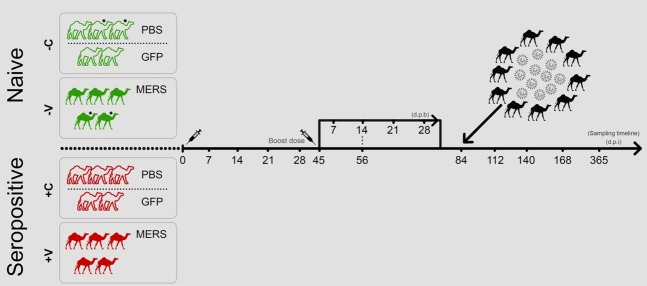
Figure 1
Figure 1
Evaluation of ChAdOx1 MERS vaccine in dromedary camels. Schematic diagram representing the study of immunogenicity and efficacy of ChAdOx1 MERS vaccine candidate in dromedary camels. +: Seropositive; −: seronegative; C: control group; V: vaccinated group. d.p.i.: days post immunisation. d.p.b.: days post boost. ● and ♦ indicate camels that were boosted with PBS or the vaccine, respectively, at 45 d.p.i.
Figure 2
Figure 2
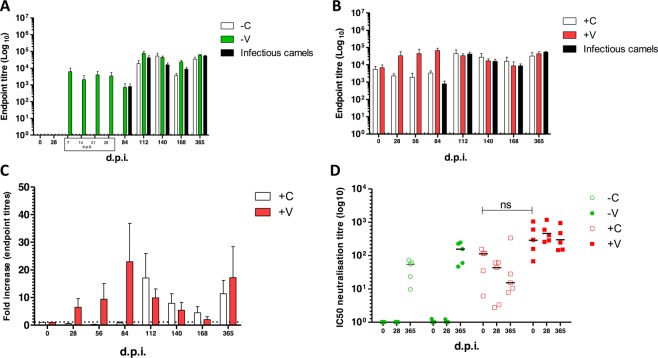
Antibody responses in dromedaries vaccinated with ChAdOx1 MERS. (A) Seronegative calves were either immunised with control injections (PBS or ChAdOx1 eGFP) in group −C (open bars), or with ChAdOx1 MERS in group −V (green bars). Two calves in group −V were boosted with a second dose of ChAdOx1 MERS at 45 d.p.i. Data in green bars prior to 84 d.p.i. are from the two boosted calves only; and data after 84 d.p.i. (after infection challenge) are from all five calves. (B) Seropositive camels were either immunised with control injections (PBS or ChAdOx1 eGFP) in group +C (open bars) or with ChAdOx1 MERS in group +V (red bars). Serum samples from different days (d.p.i. and d.p.b.) were evaluated for anti-S1 Ab endpoint titres. Infectious camels used as a natural challenge model (from 84 d.p.i.) were also evaluated (black bars) in (A,B). (C) The fold increase in Ab titres of groups +C and +V. (D) Analysis of nAbs in samples collected from 0, 28 and 365 d.p.i. (in A,B) using MERSpp NA. ns: No significant difference in antibody titres at day 0 in +C versus +V camels, by Kruskal-Wallis test with Dunn’s Multiple comparison test. +: Seropositive; −: seronegative; C: control group; V: vaccinated group. d.p.i.: days post immunisation. d.p.b.: days post boost.
Figure 3
Figure 3
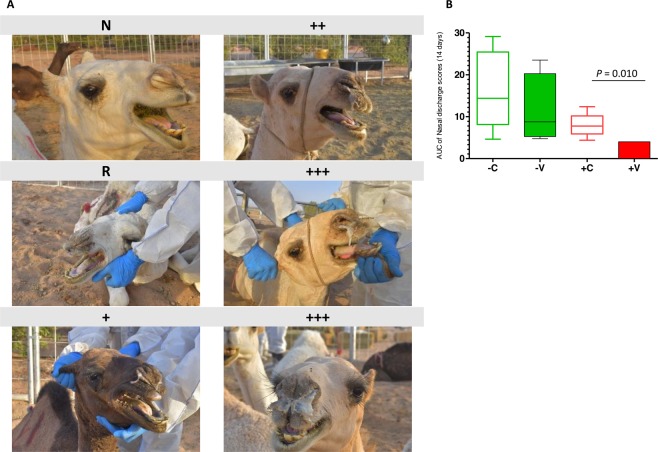
Severity and abundance of nasal discharge post natural infection challenge. The twenty camels in all groups (−C, −V, +C, and +V) were challenged with ten naturally infectious camels; and nasal discharges were assessed for their abundance and severity for 14 d.p.c.; using arbitrary units of 0 (N: normal), 0.25 (R: recovered), 1 (+: mild), 2 (++: moderate), or 3 (+++: severe). (A) Representative photos taken from different camels in different days. (B) Areas under the curve (AUC) for the nasal discharge scores collected daily from 1 to 14 d.p.c. are plotted. The analysis of mixed model on AUC of nasal discharge scores and fixed factors (d.p.c., seropositivity, and vaccine) shows that the overall vaccine effect over time was significant, p = 0.0274.; also +V had statistically significantly lower scores as compared to +C, by Kruskal-Wallis test with Dunn’s Multiple comparison test. d.p.i.: days post immunisation. +: Seropositive; −: seronegative; (C) control group; V: vaccinated group.
Figure 4
Figure 4
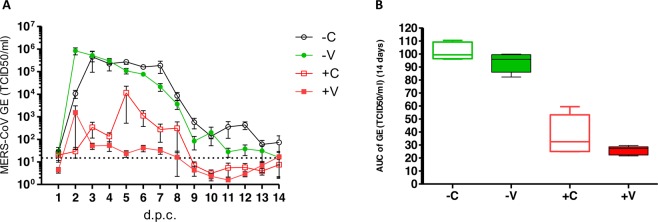
Efficacy of ChAdOx1 MERS in dromedaries based on GE TCID50/ml. Nasal swab samples from 1 to 14 days post challenge (d.p.c.) were assessed in absolute RT-qPCR quantification and the MERS-CoV viral genome equivalent (GE) to TCID50/ml is reported. (A) The mean titres of MERS-CoV GE (TCID50/ml) are reported from 1 to 14 days post challenge (d.p.c.) with SEM error bars for each group. (B) Areas under the curve (AUC) for the mean MERS-CoV GE (TCID50/ml) titres measured from 1 to 14 d.p.c. are plotted for each group. +: Seropositive; −: seronegative; (C) control group; V: vaccinated group. The analysis of mixed model on the log-transformed MERS-CoV GE (TCID50/ml) titres and fixed factors (d.p.c., seropositivity, and vaccine) shows that the vaccine was significant with p = 0.0059.
Figure 5
Figure 5
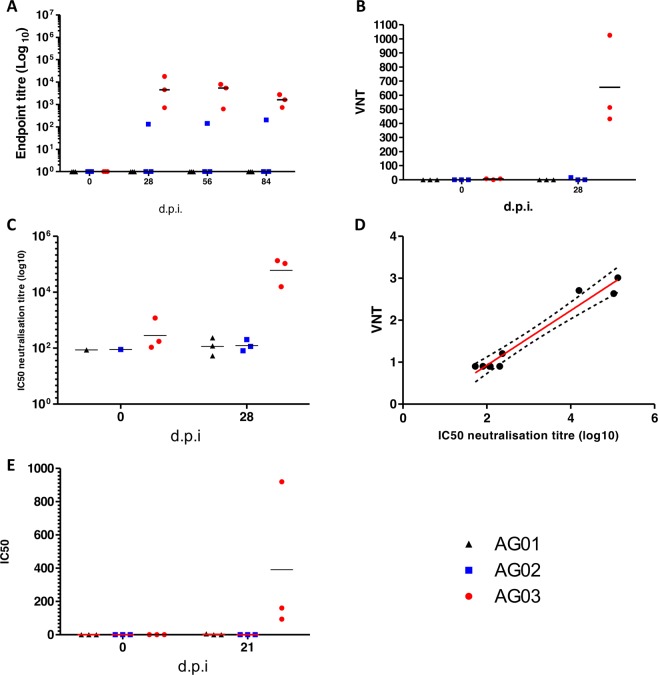
Antibody immune responses to ChAdOx1 MERS in dromedary calves at different ages. Seronegative dromedary calves, below 1 year old, were immunised with PBS (n = 2) or ChAdOx1-eGFP (n = 1) in group AG01 (black triangles) or with ChAdOx1 MERS in group AG02 (n = 3; blue squares). Older calves, 1–2 years old, were immunised with ChAdOx1 MERS in group AG03 (n = 3; red circles). (A) Anti-spike Ab titres were assessed in ELISA; and nAb titres were determined in MERS-CoV neutralisation assay (B) and in MERS pseudotyped virus neutralisation assay (MERSpp NA) (C). (D) Linear regression between the values of MERS-CoV neutralisation assay and MERSpp NA showed a significant relationship with R2 = 0.96, p < 0.0001. (A) Nasal mucosal nAbs were determined by MERSpp NA in samples from 0 and 21 d.p.c.

References

    1. WHO. MERS-CoV. (2019).
    1. Korea Centers for Disease, C. & Prevention. Middle East Respiratory Syndrome Coronavirus Outbreak in the Republic of Korea, 2015. Osong Public Heal. Res Perspect6, 269–278 (2015). - PMC - PubMed
    1. Lorch, J. M. et al. Experimental infection of bats with Geomyces destructans causes white-nose syndrome. Nature, 10.1038/nature10590 (2011). - PubMed
    1. Conzade, R. et al. Reported Direct and Indirect Contact with Dromedary Camels among Laboratory-Confirmed MERS-CoV Cases. Viruses10 (2018). - PMC - PubMed
    1. Kasem, S. et al. Cross-sectional study of MERS-CoV-specific RNA and antibodies in animals that have had contact with MERS patients in Saudi Arabia. J. Infect. Public Health11, 331–338. - PMC - PubMed

Publication types

MeSH terms

Substances