Antihypertensive medications and risk for incident dementia and Alzheimer's disease: a meta-analysis of individual participant data from prospective cohort studies
- PMID: 31706889
- PMCID: PMC7391421
- DOI: 10.1016/S1474-4422(19)30393-X
Antihypertensive medications and risk for incident dementia and Alzheimer's disease: a meta-analysis of individual participant data from prospective cohort studies
Abstract
Background: Dementia is a major health concern for which prevention and treatment strategies remain elusive. Lowering high blood pressure with specific antihypertensive medications (AHMs) could reduce the burden of disease. We investigated whether specific AHM classes reduced the risk for dementia.
Methods: We did a meta-analysis of individual participant data from eligible observational studies published between Jan 1, 1980, and Jan 1, 2019. Cohorts were eligible for inclusion if they prospectively recruited community-dwelling adults; included more than 2000 participants; collected data for dementia events over at least 5 years; had measured blood pressure and verified use of AHMs; included in-person exams, supplemented with additional data, to capture dementia events; and had followed up cases for mortality. We assessed the association of incident dementia and clinical Alzheimer's disease with use of five AHM classes, within strata of baseline high (systolic blood pressure [SBP] ≥140 mm Hg or diastolic blood pressure [DBP] ≥90 mm Hg) and normal (SBP <140 mm Hg and DBP <90 mm Hg) blood pressure. We used a propensity score to control for confounding factors related to the probability of receiving AHM. Study-specific effect estimates were pooled using random-effects meta-analyses.
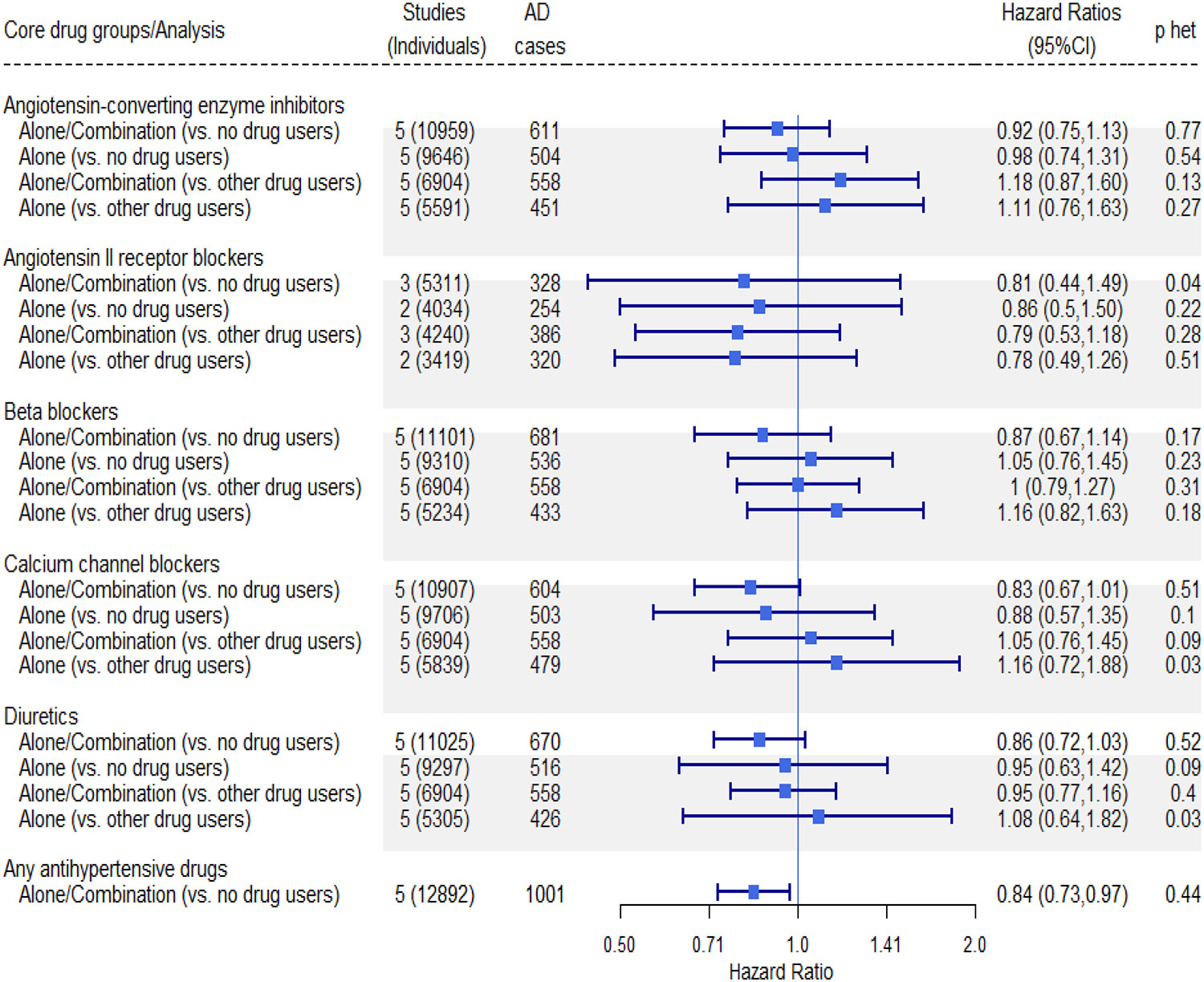
Results: Six prospective community-based studies (n=31 090 well phenotyped dementia-free adults older than 55 years) with median follow-ups across cohorts of 7-22 years were eligible for analysis. There were 3728 incident cases of dementia and 1741 incident Alzheimer's disease diagnoses. In the high blood pressure stratum (n=15 537), those using any AHM had a reduced risk for developing dementia (hazard ratio [HR] 0·88, 95% CI 0·79-0·98; p=0·019) and Alzheimer's disease (HR 0·84, 0·73-0·97; p=0·021) compared with those not using AHM. We did not find any significant differences between one drug class versus all others on risk of dementia. In the normal blood pressure stratum (n=15 553), there was no association between AHM use and incident dementia or Alzheimer's disease.
Interpretation: Over a long period of observation, no evidence was found that a specific AHM drug class was more effective than others in lowering risk of dementia. Among people with hypertensive levels of blood pressure, use of any AHM with efficacy to lower blood pressure might reduce the risk for dementia. These findings suggest future clinical guidelines for hypertension management should also consider the beneficial effect of AHM on the risk for dementia.
Funding: The Alzheimer's Drug Discovery Foundation and the National Institute on Aging Intramural Research Program.
Copyright © 2020 Elsevier Ltd. All rights reserved.
Conflict of interest statement
Conflict of interest
Authors have no conflicts to disclose.
Figures



Comment in
-
Advancing dementia prevention through effective blood pressure control.Lancet Neurol. 2020 Jan;19(1):25-27. doi: 10.1016/S1474-4422(19)30407-7. Epub 2019 Nov 6. Lancet Neurol. 2020. PMID: 31706888 No abstract available.
References
-
- Hernandorena I, Duron E, Vidal JS, Hanon O. Treatment options and considerations for hypertensive patients to prevent dementia. Expert Opin Pharmacother 2017; 18(10): 989–1000. - PubMed
Publication types
MeSH terms
Substances
Grants and funding
- HHSN268201100012C/HL/NHLBI NIH HHS/United States
- HHSN268201100009I/HL/NHLBI NIH HHS/United States
- R01 HL059367/HL/NHLBI NIH HHS/United States
- HHSN268201100007C/HL/NHLBI NIH HHS/United States
- U01 AG046871/AG/NIA NIH HHS/United States
- HHSN268201100006C/HL/NHLBI NIH HHS/United States
- N01 HC025195/HL/NHLBI NIH HHS/United States
- HHSN268201500001I/HL/NHLBI NIH HHS/United States
- HHSN268201100007I/HL/NHLBI NIH HHS/United States
- R01 HL087641/HL/NHLBI NIH HHS/United States
- U01 AG049505/AG/NIA NIH HHS/United States
- U01 HL096812/HL/NHLBI NIH HHS/United States
- R01 NS017950/NS/NINDS NIH HHS/United States
- N01 AG012100/AG/NIA NIH HHS/United States
- R01 AG054076/AG/NIA NIH HHS/United States
- RF1 AG059421/AG/NIA NIH HHS/United States
- HHSN268201100010C/HL/NHLBI NIH HHS/United States
- UL1 RR025005/RR/NCRR NIH HHS/United States
- HHSN268201100008C/HL/NHLBI NIH HHS/United States
- HHSN268201500001C/HL/NHLBI NIH HHS/United States
- HHSN268201100005G/HL/NHLBI NIH HHS/United States
- HHSN268201100008I/HL/NHLBI NIH HHS/United States
- ZIA AG007480/ImNIH/Intramural NIH HHS/United States
- R03 AG046614/AG/NIA NIH HHS/United States
- HHSN268201100011I/HL/NHLBI NIH HHS/United States
- HHSN268201100011C/HL/NHLBI NIH HHS/United States
- R01 HL086694/HL/NHLBI NIH HHS/United States
- U01 HG004402/HG/NHGRI NIH HHS/United States
- R01 AG049607/AG/NIA NIH HHS/United States
- U01 AG058589/AG/NIA NIH HHS/United States
- HHSN268201100005I/HL/NHLBI NIH HHS/United States
- P30 AG066546/AG/NIA NIH HHS/United States
- U01 AG052409/AG/NIA NIH HHS/United States
- HHSN268201100009C/HL/NHLBI NIH HHS/United States
- R01 HL070825/HL/NHLBI NIH HHS/United States
- HHSN268201100005C/HL/NHLBI NIH HHS/United States
- UH2 NS100605/NS/NINDS NIH HHS/United States
LinkOut - more resources
Full Text Sources
Medical