


Predicting Benefit From Evolocumab Therapy in Patients With Atherosclerotic Disease Using a Genetic Risk Score: Results From the FOURIER Trial
- PMID: 31707849
- PMCID: PMC8058781
- DOI: 10.1161/CIRCULATIONAHA.119.043805
Predicting Benefit From Evolocumab Therapy in Patients With Atherosclerotic Disease Using a Genetic Risk Score: Results From the FOURIER Trial
Erratum in
-
Correction to: Predicting Benefit From Evolocumab Therapy in Patients With Atherosclerotic Disease: Using a Genetic Risk Score.Circulation. 2024 Jun 11;149(24):e1414. doi: 10.1161/CIR.0000000000001262. Epub 2024 Jun 10. Circulation. 2024. PMID: 38857334 No abstract available.
Abstract
Background: The ability of a genetic risk score to predict risk in established cardiovascular disease and identify individuals who derive greater benefit from PCSK9 (proprotein convertase subtilisin/kexin type 9) inhibition has not been established.
Methods: We studied 14 298 patients with atherosclerotic cardiovascular disease from the FOURIER trial (Further Cardiovascular Outcomes Researh With PCSK9 Inhibition in Subjects With Elevated Risk). A 27-single-nucleotide polymorphism genetic risk score defined low (quintile 1), intermediate (quintiles 2-4), and high (quintile 5) genetic risk. Patients were also categorized by major atherosclerotic risk factors including diabetes mellitus, hypertension, low-density lipoprotein cholesterol ≥100 mg/dl, and smoking; multiple (≥2) risk factors was considered high clinical risk. Outcomes consisted of major coronary events (coronary heart death, myocardial infarction, or coronary revascularization) and major vascular events (major coronary events and ischemic stroke). Median follow-up was 2.3 years.
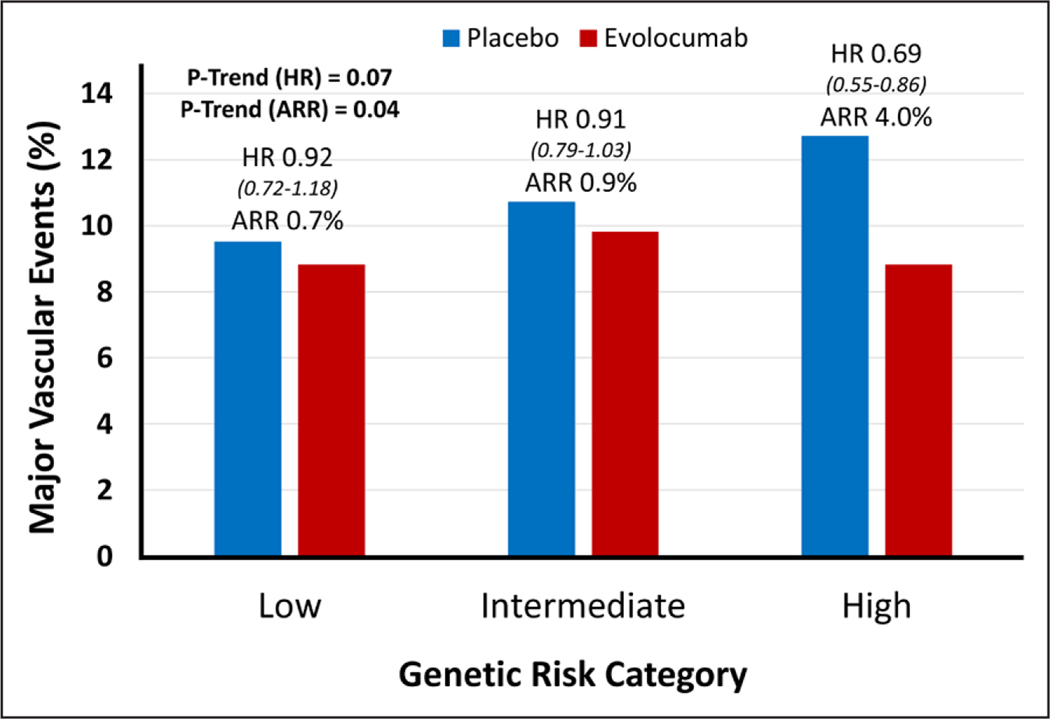
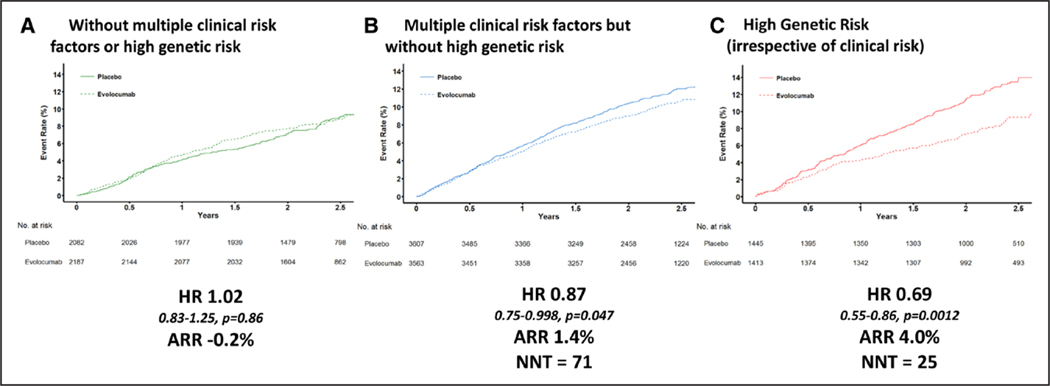
Results: After we adjusted for clinical factors, the genetic risk score was associated with risk for both major vascular events (Ptrend=0.005) and major coronary events (Ptrend<0.0001). Individuals with intermediate and high genetic risk scores had 1.23- and 1.65-fold increased hazard for major coronary events, respectively. Elevated genetic risk was additive to major atherosclerotic risk factors and identified patients more likely to benefit from evolocumab. There was no benefit for major vascular events in patients without multiple clinical risk factors or high genetic risk (hazard ratio [HR], 1.02; absolute risk reduction [ARR], -0.2%, P=0.86). In contrast, there was a 13% relative risk reduction (HR, 0.87 [0.75-0.998], P=0.047) and a 1.4% ARR in patients with multiple clinical risk factors but without high genetic risk and a 31% relative risk reduction (HR, 0.69 [0.55-0.86], P=0.0012), and 4.0% ARR in patients with high genetic risk, irrespective of clinical risk (Ptrend for HR=0.017, ARR Ptrend=0.004). Patients with high genetic risk who received evolocumab had event rates similar to patients with a low burden of both genetic and clinical risk.
Conclusion: Patients without multiple clinical risk factors or high genetic risk had a low event rate and did not appear to derive benefit from evolocumab over 2.3 years. Conversely, patients with multiple clinical risk factors but without high genetic risk had intermediate risk and intermediate risk reduction. Patients with high genetic risk, regardless of clinical risk, had a high event rate and derived the greatest relative and absolute benefit from evolocumab, which mitigated this risk.
Keywords: PCSK9 protein, human; cardiovascular disease; evolocumab; genetics; risk factors.
Figures

Comment in
-
Polygenic Risk Scores and Coronary Artery Disease: Ready for Prime Time?Circulation. 2020 Feb 25;141(8):637-640. doi: 10.1161/CIRCULATIONAHA.119.044770. Epub 2020 Feb 24. Circulation. 2020. PMID: 32091922 No abstract available.
References
-
- Mozaffarian D, Benjamin EJ, Go AS, Arnett DK, Blaha MJ, Cushman M, de Ferranti S, Després JP, Fullerton HJ, Howard VJ, et al. ; American Heart Association Statistics Committee and Stroke Statistics Subcommittee. Heart disease and stroke statistics–2015 update: a report from the American Heart Association. Circulation. 2015;131:e29–322. doi: 10.1161/CIR.0000000000000152 - DOI - PubMed
-
- Lloyd-Jones DM, Nam BH, D’Agostino RB Sr, Levy D, Murabito JM, Wang TJ, Wilson PW, O’Donnell CJ. Parental cardiovascular disease as a risk factor for cardiovascular disease in middle-aged adults: a prospective study of parents and offspring. JAMA. 2004;291:2204–2211. doi: 10.1001/jama.291.18.2204 - DOI - PubMed
-
- Mega JL, Stitziel NO, Smith JG, Chasman DI, Caulfield M, Devlin JJ, Nordio F, Hyde C, Cannon CP, Sacks F, et al. Genetic risk, coronary heart disease events, and the clinical benefit of statin therapy: an analysis of primary and secondary prevention trials. The Lancet. 2015;385:2264–2271. doi: 10.1016/S0140-6736(14)61730-X - DOI - PMC - PubMed
Publication types
MeSH terms
Substances
Grants and funding
LinkOut - more resources
Full Text Sources
Medical
Miscellaneous
