


A Model for Improving Health Care Quality for Transgender and Gender Nonconforming Patients
- PMID: 31708472
- PMCID: PMC7276233
- DOI: 10.1016/j.jcjq.2019.09.005
A Model for Improving Health Care Quality for Transgender and Gender Nonconforming Patients
Abstract
Problem definition: Transgender and gender nonconforming (TGNC) populations are disproportionately affected by limited health care access and poor health outcomes and commonly report discrimination and mistreatment in health care settings. Despite these disparities, comprehensive approaches to improve the quality of health care of TGNC patient populations are currently lacking.
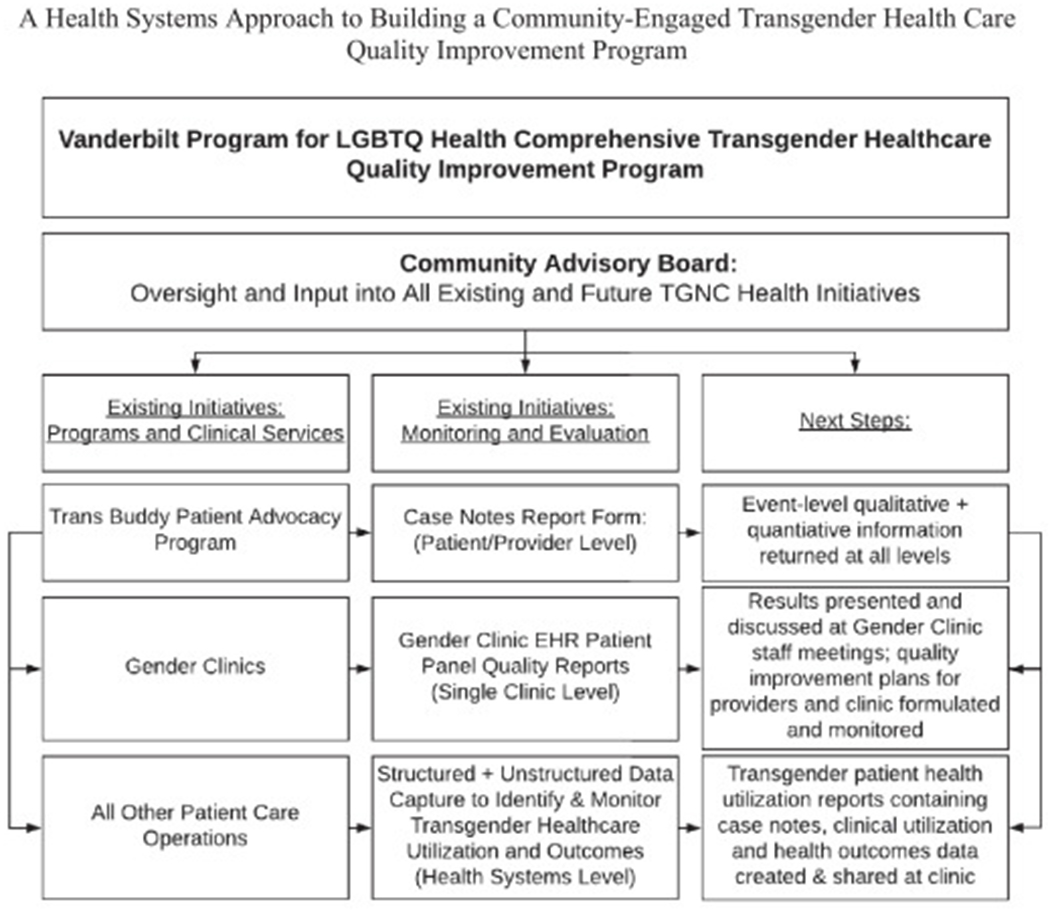
Initial approach: The Vanderbilt Program for LGBTQ Health has developed a multifaceted, community-engaged approach to improve the quality of health care of TGNC patients, which includes the creation of a transgender patient advocacy program, a community advisory board, and a transgender health clinic. To support the continuous quality improvement of transgender health care, the program is currently piloting a novel multilevel monitoring and evaluation (M&E) system to collect information at the individual patient visit and health systems levels.
Next steps: The next steps for Vanderbilt's community-engaged M&E system are to identify the clinics and health services most used by TGNC patients and assess the level of patient satisfaction in each area. This process will support the identification of high- and low-performing clinics and health services and allow for targeted delivery of trainings to improve the quality of culturally competent health care TGNC patients receive systemwide.
Conclusion: In collaboration with TGNC patient populations and community stakeholders, Vanderbilt has created a model to improve the quality of both transition- and non-transition-related health care at the systems level that can be adopted by other health care systems nationally.
Copyright © 2019 The Joint Commission. Published by Elsevier Inc. All rights reserved.
Conflict of interest statement
Figures
References
-
- Flores AR, et al. UCLA School of Law, Williams Institute, How Many Adults Identify as Transgender in the United States, June 2016. Accessed Oct 15, 2019 https://williamsinstitute.law.ucla.edu/research/how-many-adults-identify....
-
- National Center for Transgender Equality. The Report of the 2015 U.S. Transgender Survey: Executive Summary. James SE, et al. December 2016. (Updated: Dec 2017) Accessed Oct 15, 2019 https://transequality.org/sites/default/files/docs/usts/USTS-Executive-S....
-
- National Center for Transgender Equality. Injustice at Every Turn: A Report of the National Transgender Discrimination Survey. Grant JM, et al. 2011. Accessed Oct 15, 2019 https://www.transequality.org/sites/default/files/docs/resources/NTDS_Re....
-
- Jaffee KD, Shires DA , Stroumsa D. Discrimination and delayed health care among transgender women and men: implications for improving medical education and health care delivery. Med Care. 2016;54:1010–1016. - PubMed
MeSH terms
Grants and funding
LinkOut - more resources
Full Text Sources
