


Vitamin D Binding Protein and the Biological Activity of Vitamin D
- PMID: 31708871
- PMCID: PMC6821678
- DOI: 10.3389/fendo.2019.00718
Vitamin D Binding Protein and the Biological Activity of Vitamin D
Abstract
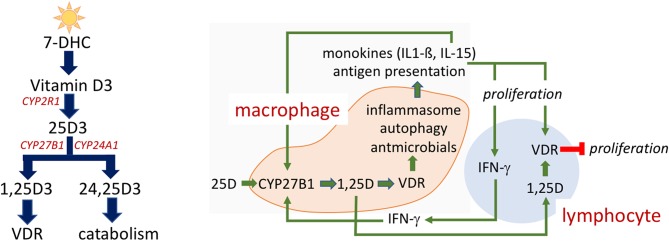
Vitamin D has a long-established role in bone health. In the last two decades, there has been a dramatic resurgence in research interest in vitamin D due to studies that have shown its possible benefits for non-skeletal health. Underpinning the renewed interest in vitamin D was the identification of the vital role of intracrine or localized, tissue-specific, conversion of inactive pro-hormone 25-hydroxyvitamin D [25(OH)D] to active 1,25-dihydroxyvitamin D [1,25(OH)2D]. This intracrine mechanism is the likely driving force behind vitamin D action resulting in positive effects on human health. To fully capture the effect of this localized, tissue-specific conversion to 1,25(OH)2D, adequate 25(OH)D would be required. As such, low serum concentrations of 25(OH)D would compromise intracrine generation of 1,25(OH)2D within target tissues. Consistent with this is the observation that all adverse human health consequences of vitamin D deficiency are associated with a low serum 25(OH)D level and not with low 1,25(OH)2D concentrations. Thus, clinical investigators have sought to define what concentration of serum 25(OH)D constitutes adequate vitamin D status. However, since 25(OH)D is transported in serum bound primarily to vitamin D binding protein (DBP) and secondarily to albumin, is the total 25(OH)D (bound plus free) or the unbound free 25(OH)D the crucial determinant of the non-classical actions of vitamin D? While DBP-bound-25(OH)D is important for renal handling of 25(OH)D and endocrine synthesis of 1,25(OH)2D, how does DBP impact extra-renal synthesis of 1,25(OH)2D and subsequent 1,25(OH)2D actions? Are their pathophysiological contexts where total 25(OH)D and free 25(OH)D would diverge in value as a marker of vitamin D status? This review aims to introduce and discuss the concept of free 25(OH)D, the molecular biology and biochemistry of vitamin D and DBP that provides the context for free 25(OH)D, and surveys in vitro, animal, and human studies taking free 25(OH)D into consideration.
Keywords: CYP27B1; DBP; VDR; bone; free vitamin D; immunology; vitamin D.
Copyright © 2019 Chun, Shieh, Gottlieb, Yacoubian, Wang, Hewison and Adams.
Figures
References
Publication types
Grants and funding
LinkOut - more resources
Full Text Sources
Other Literature Sources
