


Seed Coat Pattern QTL and Development in Cowpea (Vigna unguiculata [L.] Walp.)
- PMID: 31708953
- PMCID: PMC6824211
- DOI: 10.3389/fpls.2019.01346
Seed Coat Pattern QTL and Development in Cowpea (Vigna unguiculata [L.] Walp.)
Erratum in
-
Corrigendum: Seed coat pattern QTL and development in cowpea (Vigna unguiculata [L.] Walp.).Front Plant Sci. 2023 Nov 1;14:1299051. doi: 10.3389/fpls.2023.1299051. eCollection 2023. Front Plant Sci. 2023. PMID: 38023847 Free PMC article.
Abstract
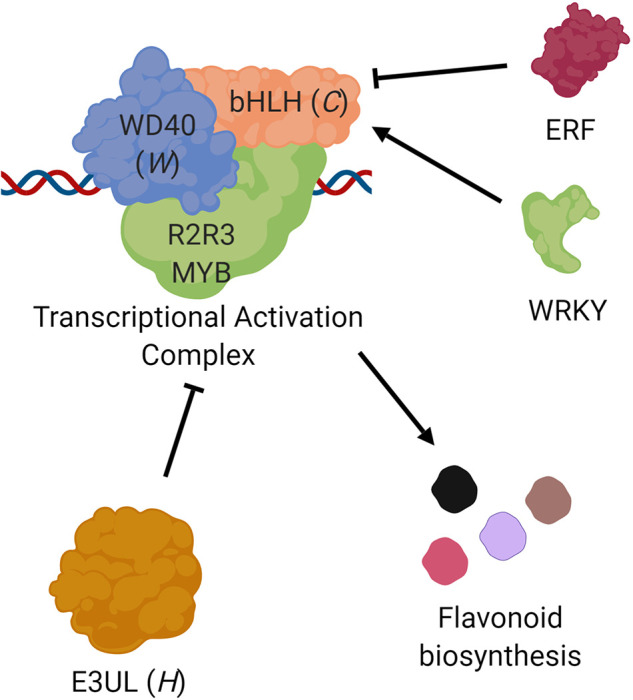
The appearance of the seed is an important aspect of consumer preference for cowpea (Vigna unguiculata [L.] Walp.). Seed coat pattern in cowpea has been a subject of study for over a century. This study makes use of newly available resources, including mapping populations, a reference genome and additional genome assemblies, and a high-density single nucleotide polymorphism genotyping platform, to map various seed coat pattern traits to three loci, concurrent with the Color Factor (C), Watson (W), and Holstein (H) factors identified previously. Several gene models encoding proteins involved in regulating the later stages of the flavonoid biosynthesis pathway have been identified as candidate genes, including a basic helix-loop-helix gene (Vigun07g110700) for the C locus, a WD-repeat gene (Vigun09g139900) for the W locus and an E3 ubiquitin ligase gene (Vigun10g163900) for the H locus. A model of seed coat development, consisting of six distinct stages, is described to explain some of the observed pattern phenotypes.
Keywords: Vigna unguiculata; cowpea; pattern; pigment; quantitative trait loci; seed coat.
Copyright © 2019 Herniter, Lo, Muñoz-Amatriaín, Lo, Guo, Huynh, Lucas, Jia, Roberts, Lonardi and Close.
Conflict of interest statement
The authors declare that the research was conducted in the absence of any commercial or financial relationships that could be construed as a potential conflict of interest.
Figures


References
-
- Boukar O., Belko N., Chamarthi S., Togola A., Batieno J., Owusu E., et al. . (2018). Cowpea (Vigna unguiculata): genetics, genomics and breeding. P. Breed. 138, 415–424. doi: 10.1111/pbr.12589 - DOI
-
- Drabo I., Ladieinde T. A. O., Smithson J. B., Redden R. (1988). Inheritance of eye pattern and seed coat colour in cowpea (Vigna unguiculata [L.] Walp.). Plant Breed. 100 (2), 119–123. doi: 10.1111/j.1439-0523.1988.tb00226.x - DOI
-
- Ehlers J. D., Hall A. E. (1997). Cowpea (Vigna unguiculata L. Walp.). Field Crops Res. 53 (1–3), 187–204. doi: 10.1016/S0378-4290(97)00031-2 - DOI
-
- FAOSTAT. (2019). “Crops.” http://www.fao.org/faostat/en/#data/QC.
