


Detailed phenotyping of posterior vs. anterior circulation ischemic stroke: a multi-center MRI study
- PMID: 31709475
- PMCID: PMC7035231
- DOI: 10.1007/s00415-019-09613-5
Detailed phenotyping of posterior vs. anterior circulation ischemic stroke: a multi-center MRI study
Abstract
Objective: Posterior circulation ischemic stroke (PCiS) constitutes 20-30% of ischemic stroke cases. Detailed information about differences between PCiS and anterior circulation ischemic stroke (ACiS) remains scarce. Such information might guide clinical decision making and prevention strategies. We studied risk factors and ischemic stroke subtypes in PCiS vs. ACiS and lesion location on magnetic resonance imaging (MRI) in PCiS.
Methods: Out of 3,301 MRIs from 12 sites in the National Institute of Neurological Disorders and Stroke (NINDS) Stroke Genetics Network (SiGN), we included 2,381 cases with acute DWI lesions. The definition of ACiS or PCiS was based on lesion location. We compared the groups using Chi-squared and logistic regression.
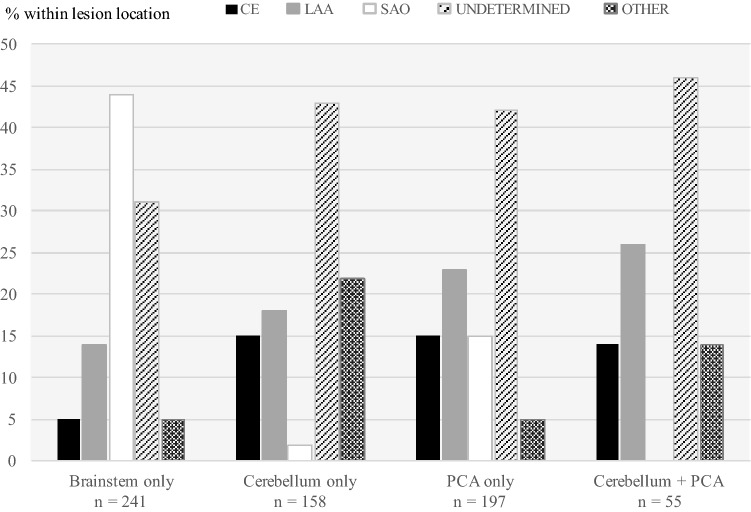
Results: PCiS occurred in 718 (30%) patients and ACiS in 1663 (70%). Diabetes and male sex were more common in PCiS vs. ACiS (diabetes 27% vs. 23%, p < 0.05; male sex 68% vs. 58%, p < 0.001). Both were independently associated with PCiS (diabetes, OR = 1.29; 95% CI 1.04-1.61; male sex, OR = 1.46; 95% CI 1.21-1.78). ACiS more commonly had large artery atherosclerosis (25% vs. 20%, p < 0.01) and cardioembolic mechanisms (17% vs. 11%, p < 0.001) compared to PCiS. Small artery occlusion was more common in PCiS vs. ACiS (20% vs. 14%, p < 0.001). Small artery occlusion accounted for 47% of solitary brainstem infarctions.
Conclusion: Ischemic stroke subtypes differ between the two phenotypes. Diabetes and male sex have a stronger association with PCiS than ACiS. Definitive MRI-based PCiS diagnosis aids etiological investigation and contributes additional insights into specific risk factors and mechanisms of injury in PCiS.
Keywords: Magnetic resonance imaging; Phenotyping; Posterior circulation brain infarction; Risk factors; Stroke.
Conflict of interest statement
PF, MD, AKG, JW, MDS, KLD, LC, RI, MJRJB, ECM, AVD, RS, HX, EGS, LH, KJ, J Roquer, JWC, PFMA, JPB, JJC, CJ, BMK, DOK, RL, JFM, TR, RLS, RS, PS, AS, DW, BBW, SJK, BDM, PG, and JP: None. SJTM reports personal fees from Alphabet, Inc., outside the submitted work; VT reports grants from NINDS funding, during the conduct of the study; personal fees and non-financial support from Boehringer Ingelheim, personal fees from Pfizer, personal fees from Medtronic, personal fees from Amgen, personal fees from Bayer, outside the submitted work; J Rosand reports personal fees from Boehringer Ingelheim, Pfizer, and New Beta Innovations, outside the submitted work; OW reports grants from NIH-NINDS, during the conduct of the study; personal fees from Penumbra, Inc and Genentech, outside the submitted work; NSR reports grants from National Institutes of Health, during the conduct of the study; AL reports personal fees from Bayer, BMS/Pfizer, Astra Zeneca, and Boehringer Ingelheim, outside the submitted work.
Figures

References
-
- Subramanian G, Silva J, Silver FL, Fang J, Kapral MK, Oczkowski W, Gould L, O’Donnell MJ, Investigators of the Registry of the Canadian Stroke N Risk factors for posterior compared to anterior ischemic stroke: an observational study of the Registry of the Canadian Stroke Network. Neuroepidemiology. 2009;33(1):12–16. doi: 10.1159/000209282. - DOI - PubMed
-
- De Marchis GM, Kohler A, Renz N, Arnold M, Mono ML, Jung S, Fischer U, Karameshev AI, Brekenfeld C, Gralla J, Schroth G, Mattle HP, Nedeltchev K. Posterior versus anterior circulation strokes: comparison of clinical, radiological and outcome characteristics. J Neurol Neurosurg Psychiatry. 2011;82(1):33–37. doi: 10.1136/jnnp.2010.211151. - DOI - PubMed
-
- Caplan LR, Wityk RJ, Glass TA, Tapia J, Pazdera L, Chang HM, Teal P, Dashe JF, Chaves CJ, Breen JC, Vemmos K, Amarenco P, Tettenborn B, Leary M, Estol C, Dewitt LD, Pessin MS. New England Medical Center Posterior Circulation Registry. Ann Neurol. 2004;56(3):389–398. doi: 10.1002/ana.20204. - DOI - PubMed
-
- von Sarnowski B, Schminke U, Grittner U, Tanislav C, Bottcher T, Hennerici MG, Tatlisumak T, Putaala J, Kaps M, Fazekas F, Enzinger C, Rolfs A, Kessler C, Sifap I. Posterior versus anterior circulation stroke in young adults: a comparative study of stroke aetiologies and risk factors in stroke among young fabry patients (sifap1) Cerebrovasc Dis. 2017;43(3–4):152–160. doi: 10.1159/000454840. - DOI - PubMed
Publication types
MeSH terms
Grants and funding
- U01 NS080168/NS/NINDS NIH HHS/United States
- P41EB015902/EB/NIBIB NIH HHS/United States
- NINDS U01 NS080168/NS/NINDS NIH HHS/United States
- R01NS100178/NS/NINDS NIH HHS/United States
- R01 NS105150/NS/NINDS NIH HHS/United States
- R01NS086905/NS/NINDS NIH HHS/United States
- R01 NS100178/NS/NINDS NIH HHS/United States
- R01 NS086905/NS/NINDS NIH HHS/United States
- P30 DK072488/DK/NIDDK NIH HHS/United States
- U01 NS069208/NS/NINDS NIH HHS/United States
- P41 EB015902/EB/NIBIB NIH HHS/United States
- R01NS105150/NS/NINDS NIH HHS/United States
LinkOut - more resources
Full Text Sources
Medical
