


Medical and Surgical Treatment of Reproductive Outcomes in Polycystic Ovary Syndrome: An Overview of Systematic Reviews
- PMID: 31710185
- PMCID: PMC6875858
- DOI: 10.22074/ijfs.2020.5608
Medical and Surgical Treatment of Reproductive Outcomes in Polycystic Ovary Syndrome: An Overview of Systematic Reviews
Abstract
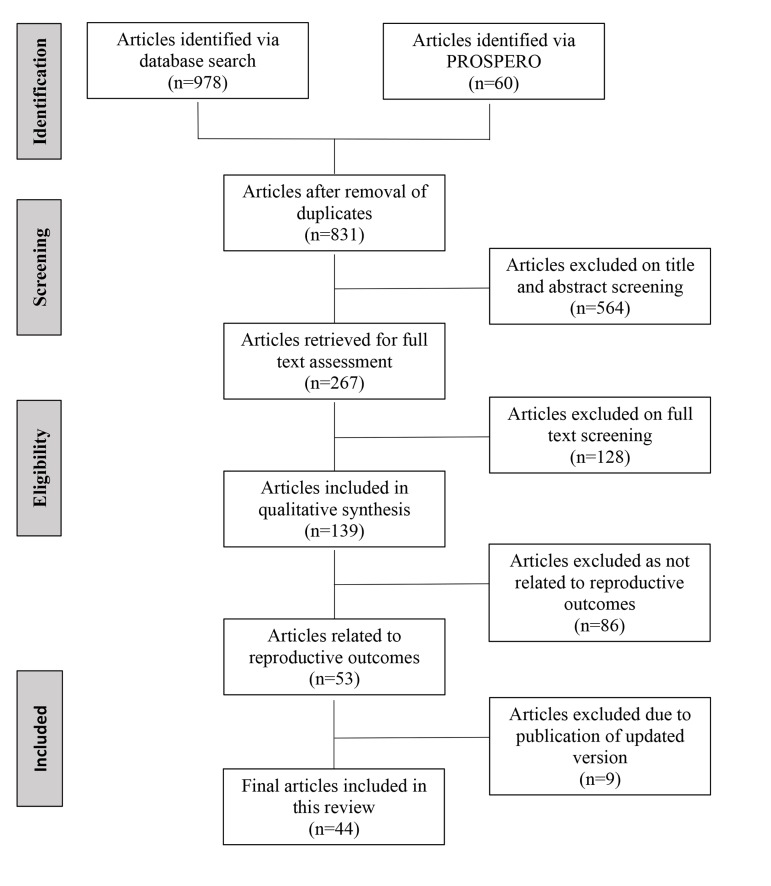
Polycystic ovary syndrome (PCOS) is a common, complex condition that affects up to 18% of reproductiveaged women, causing reproductive, metabolic and psychological dysfunctions. We performed an overview and appraisal of methodological quality of systematic reviews that assessed medical and surgical treatments for reproductive outcomes in women with PCOS. Databases (MEDLINE, EMBASE, CINAHL PLUS and PROSPERO) were searched on the 15th of September 2017. We included any systematic review that assessed the effect of medical or surgical management of PCOS on reproductive, pregnancy and neonatal outcomes. Eligibility assessment, data extraction and quality assessment by the Assessing the Methodological Quality of Systematic Reviews (AMSTAR) tool were performed in duplicate. We identified 53 reviews comprising 44 reviews included in this overview; the majority were moderate to high quality. In unselected women with PCOS, letrozole was associated with a higher live birth rate than clomiphene citrate (CC), while CC was better than metformin or placebo. In women with CC-resistant PCOS, gonadotrophins were associated with a higher live birth rate than CC plus metformin, which was better than laparoscopic ovarian drilling (LOD). LOD was associated with lower multiple pregnancy rates than other medical treatments. In women with PCOS undergoing in vitro fertilization/intracytoplasmic sperm injection (IVF/ICSI), the addition of metformin to gonadotrophins resulted in less ovarian hyperstimulation syndrome (OHSS), and higher pregnancy and live birth rates than gonadotrophins alone. Gonadotrophin releasing hormone (GnRH) antagonist was associated with less OHSS, gonadotrophin units and shorter stimulation length than GnRH agonist. Letrozole appears to be a good first line treatment and gonadotrophins, as a second line treatment, for anovulatory women with PCOS. LOD results in lower multiple pregnancy rates. However, due to the heterogeneous nature of the included populations of women with PCOS, further larger scale trials are needed with more precise assessment of treatments according to heterogeneous variants of PCOS.
Keywords: Infertility; Polycystic Ovary Syndrome; Review; Therapeutics; Treatment Outcome.
Copyright© by Royan Institute. All rights reserved.
Conflict of interest statement
The authors declare no conflicts of interest.
References
-
- Balen AH, Morley LC, Misso M, Franks S, Legro RS, Wijeyaratne CN, et al. The management of anovulatory infertility in women with polycystic ovary syndrome: an analysis of the evidence to support the development of global WHO guidance. Hum Reprod Update. 2016;22(6):687–708. - PubMed
-
- Thessaloniki ESHRE/ASRM-Sponsored PCOS Consensus Workshop Group. Consensus on infertility treatment related to polycystic ovary syndrome. Hum Reprod. 2008;23(3):462–477. - PubMed
-
- Conway G, Dewailly D, Diamanti-Kandarakis E, Escobar-Morreale HF, Franks S, Gambineri A, et al. The polycystic ovary syndrome: a position statement from the European Society of Endocrinology. Eur J Endocrinol. 2014;171(4):P1–P29. - PubMed
-
- Stein IF, Leventhal ML. Amenorrhea associated with bilateral polycystic ovaries. Am J Obstet Gynecol. 1935;29(2):181–191.
-
- Azziz R, Carmina E, Dewailly D, Diamanti-Kandarakis E, Escobar- Morreale HF, Futterweit W, et al. The androgen excess and PCOS society criteria for the polycystic ovary syndrome: the complete task force report. Fertil Steril. 2009;91(2):456–488. - PubMed
Publication types
LinkOut - more resources
Full Text Sources