Review
. 2019 Dec;17(6):538-547.
doi: 10.1007/s11914-019-00545-7.

Monocyte Chemoattractant Protein-1 (MCP-1/CCL2) Drives Activation of Bone Remodelling and Skeletal Metastasis

Affiliations
Review

Monocyte Chemoattractant Protein-1 (MCP-1/CCL2) Drives Activation of Bone Remodelling and Skeletal Metastasis

Bridie S Mulholland et al. Curr Osteoporos Rep. 2019 Dec.

Abstract

Purpose of review: The purpose of this review is to explore the role of monocyte chemoattractant protein-1 (MCP-1 or CCL2) in the processes that underpin bone remodelling, particularly the action of osteoblasts and osteoclasts, and its role in the development and metastasis of cancers that target the bone.

Recent findings: MCP-1 is a key mediator of osteoclastogenesis, being the highest induced gene during intermittent treatment with parathyroid hormone (iPTH), but also regulates catabolic effects of continuous PTH on bone including monocyte and macrophage recruitment, osteoclast formation and bone resorption. In concert with PTH-related protein (PTHrP), MCP-1 mediates the interaction between tumour-derived factors and host-derived chemokines to promote skeletal metastasis. In breast and prostate cancers, an osteolytic cascade is driven by tumour cell-derived PTHrP that upregulates MCP-1 in osteoblastic cells. This relationship between PTHrP and osteoblastic expression of MCP-1 may drive the colonisation of disseminated breast cancer cells in the bone. There is mounting evidence to suggest a pivotal role of MCP-1 in many diseases and an important role in the establishment of comorbidities. Coupled with its role in bone remodelling and the regulation of bone turnover, there is the potential for pathological relationships between bone disorders and bone-related cancers driven by MCP-1. MCP-1's role in bone remodelling and bone-related cancers highlights its potential as a novel anti-resorptive and anti-metastatic target.

Keywords: Bone remodelling; Breast cancer; MCP-1 or CCL-2; Metastasis; Osteoclast.


Conflict of interest statement

Bridie Mulholland, Mark Forwood and Nigel Morrison declare that they have no conflict of interest.

Figures
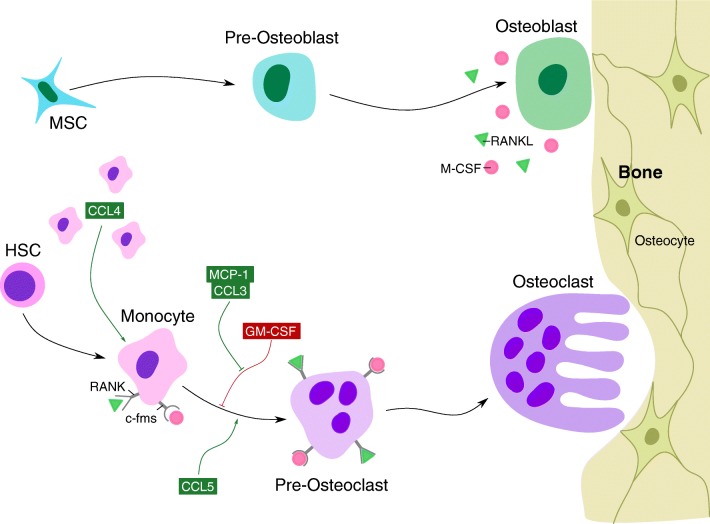
Fig. 1
Fig. 1
Role of notable chemokines in osteoclastogenesis. Osteoclast differentiation is primarily controlled by M-CSF and RANKL expression—M-CSF and RANKL expressed by osteoblasts bind their respective receptors c-fms and RANK on osteoclast precursors, driving monocyte differentiation into osteoclasts. A number of chemokines play an integral role in ensuring the success of osteoclastogenesis, notably CCL4, MCP-1, CCL3 and CCL5. CCL4 is responsible for the recruitment of osteoclast precursors; CCL3 and MCP-1 both reverse and rescue osteoclast differentiation from GM-CSF repression; and CCL5 strongly promotes osteoclast formation
Fig. 2
Fig. 2
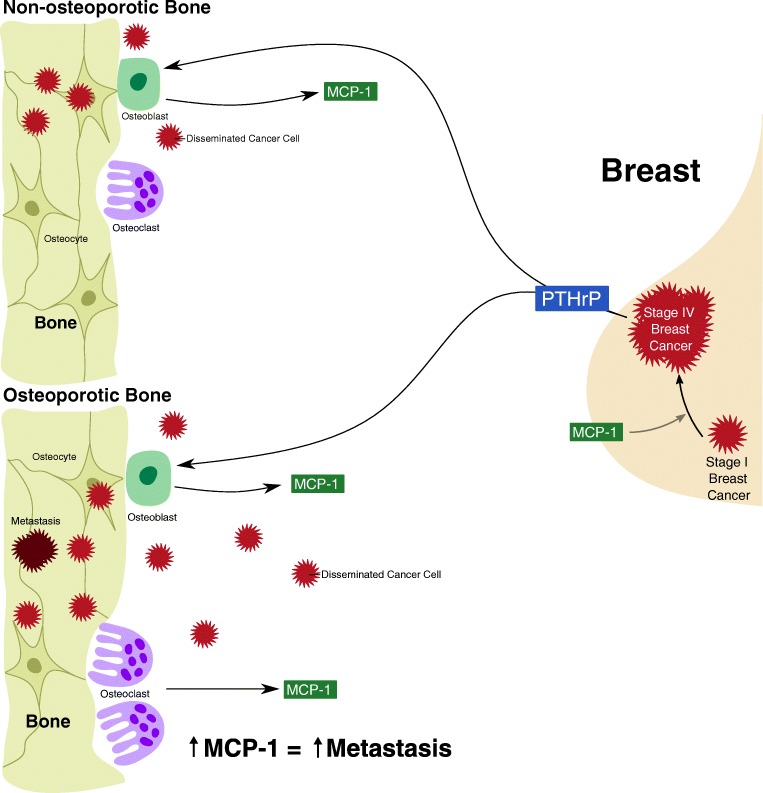
Potential role of osteoporosis and MCP-1 in breast cancer bone metastasis. PTHrP plays a pivotal role in breast cancer progression and osteoblastic expression of MCP-1. This relationship between PTHrP and osteoblastic expression of MCP-1 related to cancer progression may drive the colonisation of disseminated breast cancer cells in the bone. The increased osteoclast activity associated with osteoporosis results in an increase in MCP-1 expression. This further increase in MCP-1 expression in osteoporotic bone may increase the rate and likelihood of bone metastasis following breast cancer. MCP-1 is also involved in breast cancer progression, and so forms a vicious cycle of MCP-1 and PTHrP expression in progressing breast cancer, and MCP-1 expression in bone that encourages bone metastasis

References

    1. Deshmane SL, Kremlev S, Amini S, Sawaya BE. Monocyte chemoattractant protein-1 (MCP-1): an overview. J Interferon Cytokine Res. 2009;29(6):313–326. doi: 10.1089/jir.2008.0027. - DOI - PMC - PubMed
    1. Rollins BJ. Monocyte chemoattractant protein 1: a potential regulator of monocyte recruitment in inflammatory disease. Mol Med Today. 1996;2(5):198–204. doi: 10.1016/1357-4310(96)88772-7. - DOI - PubMed
    1. Qian BZ, Li J, Zhang H, Kitamura T, Zhang J, Campion LR, Kaiser EA, Snyder LA, Pollard JW. CCL2 recruits inflammatory monocytes to facilitate breast-tumour metastasis. Nature. 2011;475(7355):222–225. doi: 10.1038/nature10138. - DOI - PMC - PubMed
    1. Hughes Catherine E., Nibbs Robert J. B. A guide to chemokines and their receptors. The FEBS Journal. 2018;285(16):2944–2971. doi: 10.1111/febs.14466. - DOI - PMC - PubMed
    1. Morrison NA, Day CJ, Nicholson GC. Dominant negative MCP-1 blocks human osteoclast differentiation. J Cell Biochem. 2014;115(2):303–312. doi: 10.1002/jcb.24663. - DOI - PubMed

MeSH terms