. 2020 Jan 8;48(D1):D269-D276.
doi: 10.1093/nar/gkz975.

DisProt: intrinsic protein disorder annotation in 2020

András Hatos  1 Borbála Hajdu-Soltész  2 Alexander M Monzon  1 Nicolas Palopoli  3 Lucía Álvarez  4 Burcu Aykac-Fas  5 Claudio Bassot  6 Guillermo I Benítez  3 Martina Bevilacqua  1 Anastasia Chasapi  7 Lucia Chemes  4   8 Norman E Davey  9 Radoslav Davidović  10 A Keith Dunker  11 Arne Elofsson  6 Julien Gobeill  12 Nicolás S González Foutel  4 Govindarajan Sudha  6 Mainak Guharoy  13   14 Tamas Horvath  15 Valentin Iglesias  16 Andrey V Kajava  17   18 Orsolya P Kovacs  15 John Lamb  6 Matteo Lambrughi  5 Tamas Lazar  13   14 Jeremy Y Leclercq  17 Emanuela Leonardi  19   20 Sandra Macedo-Ribeiro  21 Mauricio Macossay-Castillo  13   14 Emiliano Maiani  5 José A Manso  21 Cristina Marino-Buslje  22 Elizabeth Martínez-Pérez  22 Bálint Mészáros  2 Ivan Mičetić  1 Giovanni Minervini  1 Nikoletta Murvai  15 Marco Necci  1 Christos A Ouzounis  7 Mátyás Pajkos  2 Lisanna Paladin  1 Rita Pancsa  15 Elena Papaleo  5   23 Gustavo Parisi  3 Emilie Pasche  12 Pedro J Barbosa Pereira  21 Vasilis J Promponas  24 Jordi Pujols  16 Federica Quaglia  1 Patrick Ruch  12 Marco Salvatore  6 Eva Schad  15 Beata Szabo  15 Tamás Szaniszló  2 Stella Tamana  24 Agnes Tantos  15 Nevena Veljkovic  10 Salvador Ventura  16 Wim Vranken  13   14   25 Zsuzsanna Dosztányi  2 Peter Tompa  13   14   15 Silvio C E Tosatto  1   26 Damiano Piovesan  1
Affiliations

DisProt: intrinsic protein disorder annotation in 2020

András Hatos et al. Nucleic Acids Res. .

Abstract

The Database of Protein Disorder (DisProt, URL: https://disprot.org) provides manually curated annotations of intrinsically disordered proteins from the literature. Here we report recent developments with DisProt (version 8), including the doubling of protein entries, a new disorder ontology, improvements of the annotation format and a completely new website. The website includes a redesigned graphical interface, a better search engine, a clearer API for programmatic access and a new annotation interface that integrates text mining technologies. The new entry format provides a greater flexibility, simplifies maintenance and allows the capture of more information from the literature. The new disorder ontology has been formalized and made interoperable by adopting the OWL format, as well as its structure and term definitions have been improved. The new annotation interface has made the curation process faster and more effective. We recently showed that new DisProt annotations can be effectively used to train and validate disorder predictors. We believe the growth of DisProt will accelerate, contributing to the improvement of function and disorder predictors and therefore to illuminate the 'dark' proteome.


Figures

Figure 1.
Figure 1.
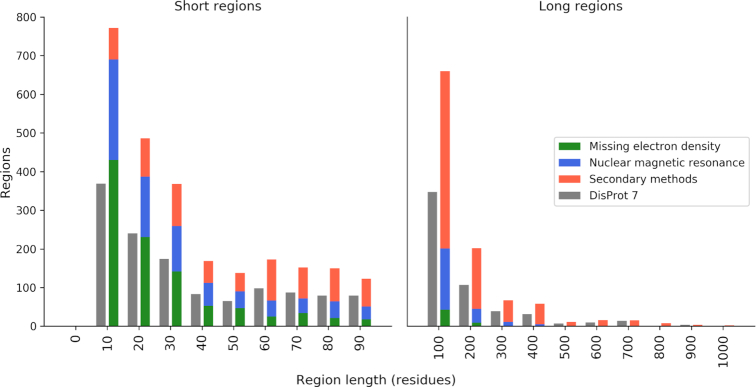
Distribution of region length. Regions shorter than 100 residues (left) are binned in groups of 10 residues. Regions longer than 100 (right) are binned in 100 residues. The tick labels indicate the lower bound which is included. Gray bars refer to the previous release (DisProt 7).
Figure 2.
Figure 2.
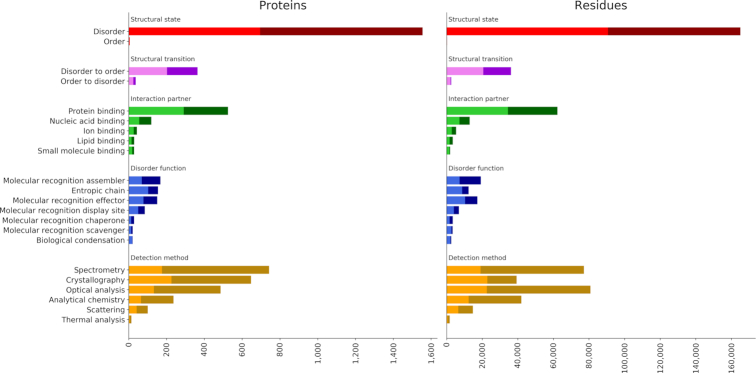
Distribution of disorder annotation terms. Terms belong to the Disorder Ontology and only those one node away from the ontology root are shown. Annotation counts for child terms are propagated to parents up to the root. The dark segments correspond to proteins (left) or residues (right) for which more than one piece of evidence is available. Different ontology aspects (namespaces) are grouped and have different colors.

References

    1. Romero P., Obradovic Z., Kissinger C.R., Villafranca J.E., Garner E., Guilliot S., Dunker A.K.. Thousands of proteins likely to have long disordered regions. Pac. Symp. Biocomput. 1998; 1998:437–448. - PubMed
    1. Wright P.E., Dyson H.J.. Intrinsically unstructured proteins: re-assessing the protein structure-function paradigm. J. Mol. Biol. 1999; 293:321–331. - PubMed
    1. van der Lee R., Buljan M., Lang B., Weatheritt R.J., Daughdrill G.W., Dunker A.K., Fuxreiter M., Gough J., Gsponer J., Jones D.T. et al. .. Classification of intrinsically disordered regions and proteins. Chem. Rev. 2014; 114:6589–6631. - PMC - PubMed
    1. Davey N.E. The functional importance of structure in unstructured protein regions. Curr. Opin. Struct. Biol. 2019; 56:155–163. - PubMed
    1. Perdigão N., Heinrich J., Stolte C., Sabir K.S., Buckley M.J., Tabor B., Signal B., Gloss B.S., Hammang C.J., Rost B. et al. .. Unexpected features of the dark proteome. Proc. Natl. Acad. Sci. U.S.A. 2015; 112:15898–15903. - PMC - PubMed

Publication types

MeSH terms

Substances