Review
. 2019 Nov;54 Suppl 3(Suppl 3):S13-S17.
doi: 10.1002/ppul.24547.

Cystic fibrosis precision therapeutics: Emerging considerations

Affiliations
Review

Cystic fibrosis precision therapeutics: Emerging considerations

Disha Joshi et al. Pediatr Pulmonol. 2019 Nov.

Abstract

Small molecules that address fundamental defects underlying cystic fibrosis (CF), including modulators such as the approved drugs ivacaftor, lumacaftor, tezacaftor, and elexacaftor, have advanced dramatically over the past few years and are transforming care and prognosis among individuals with this disease. The new treatment strategies are predicated on established scientific insight concerning pathogenesis, and applying "personalized" or "precision" interventions for specific abnormalities of the cystic fibrosis transmembrane conductance regulator (CFTR). Even with the advent of highly effective triple drug combinations-which hold great promise for the majority of patients with CF worldwide-barriers to precision therapy remain. These include refractory CFTR variants (premature truncation codons, splice defects, large indels, severe missense mutations, and others) not addressed by available modulators, and access to leading-edge therapeutic compounds for patients with ultrarare forms of CF. In addition to describing the remarkable progress that has occurred regarding CF precision medicine, this review outlines some of the remaining challenges. The CF experience is emblematic of many conditions for which personalized interventions are actively being sought.

Keywords: combination drug therapy; investigational drugs; personalized medicine.


Figures

Figure 1
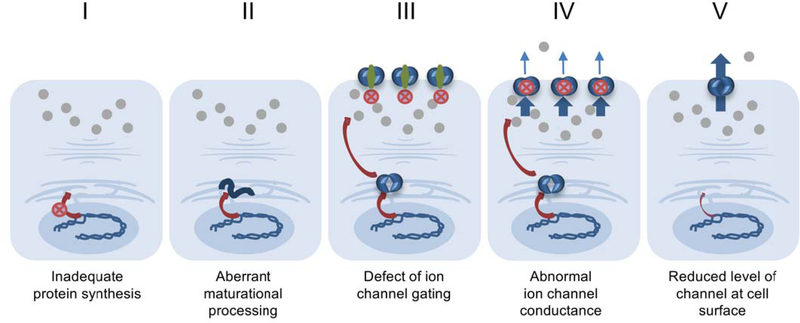
Figure 1. Traditional classification of CFTR mutations.
Note that a sixth group (plasma membrane instability) is sometimes included as a separate category. Alternative evaluation of CFTR variants based on modulator response offers an additional means of binning CFTR molecular defects, with designations that constitute greater than six categories,. Modulator treatments have been shown to confer beneficial effects across many CFTR mutational subgroups, based on increased expression of well-folded CFTR (mediated by correctors) and enhanced residual ion channel activity (potentiators) in a manner that is sometimes less dependent on underlying molecular abnormality or mutation subclass.
Figure 2
Figure 2
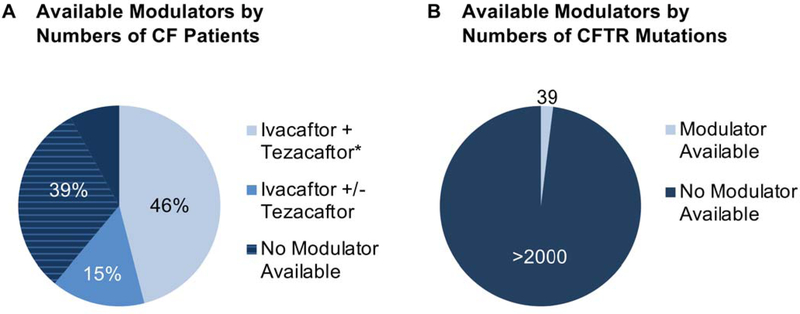
(A) Subset of individuals with an approved modulator from among ~30,000 patients in the U.S. Approximately 15% of individuals with CF are approved for treatment using ivacaftor alone, with a subset of these (below) also approved for ivacaftor/tezacaftor. The (*) describes F508del/F508del genotype, and denotes approval for ivacaftor together with either lumacaftor or tezacaftor (46% of patients with CF). For another ~ 39% of patients, no modulator drugs are yet available. The majority of these individuals carry a copy of F508del and are anticipated to benefit from triple combination therapy (TCTs, hatched detail of diagram, see text). (B) Subset of CF variants with an approved modulator. Among > 2000 disease-associated mutations, thirty-nine currently are “on label.” Ivacaftor as a single agent is available for the following mutations (~ 15% of patients): E56K, P67L, R74W, D110E, D110H, R117C, E193K, L206W, R347H, R352Q, A455E, D579G, E831X, S945L, S977F, F1052V, K1060T, A1067T, R1070W, F1074L, D1152H, D1270N, 711+3A->G, 2789+5G->A, 3272–26A->G, 3849+10kb C->T, G551D, R117H, G178R, S549N, S549R, G551S, G1069R, R1070Q, G1244E, S1251N, S1255P, and G1349D. Combination treatment with ivacaftor and tezacaftor is also approved when any of the first 26 ivacaftor-responsive variants from the list above is present at either CFTR locus, or for individuals homozygous with F508del. Additional studies will be required to estimate numbers of patients with CF who encode variants not formally approved for modulator treatment, but likely to show clinical benefit following drug administration.

References

    1. Sorscher EJ. Cystic Fibrosis In: Jameson JL, Fauci AS, Kasper DL, Hauser SL, Longo DL, Loscalzo J, editors. Harrison’s principles of internal medicine. 20th edition New York: McGraw-Hill Education; 2018. Chapter 285,2 volumes (xli, 3528, I-214 pages).
    1. Accurso FJ, Rowe SM, Clancy JP, Boyle MP, Dunitz JM, Durie PR, Sagel SD, Hornick DB, Konstan MW, Donaldson SH, et al. Effect of VX-770 in persons with cystic fibrosis and the G551D-CFTR mutation. N Engl J Med 2010; 363:1991–2003. - PMC - PubMed
    1. Van Goor F, Hadida S, Grootenhuis PD, Burton B, Stack JH, Straley KS, Decker CJ, Miller M, McCartney J, Olson ER, et al. Correction of the F508del-CFTR protein processing defect in vitro by the investigational drug VX-809. Proc Natl Acad Sci U S A, 2011; 108:18843–18848. - PMC - PubMed
    1. Wainwright CE, Elborn JS, Ramsey BW. Lumacaftor-ivacaftor in patients with cystic fibrosis homozygous for Phe508del CFTR. N Engl J Med 2015; 373:1783–1784. - PubMed
    1. Davies JC, Moskowitz SM, Brown C, Horsley A, Mall MA, McKone EF, Plant BJ, Prais D, Ramsey BW, et al. VX-659-Tezacaftor-ivacaftor in patients with cystic fibrosis and one or two Phe508del alleles. N Engl J Med 2018; 379:1599–1611. - PMC - PubMed

Publication types

MeSH terms