


The association of nativity/length of residence and cardiovascular disease risk factors in the United States
- PMID: 31715217
- PMCID: PMC7340142
- DOI: 10.1016/j.ypmed.2019.105893
The association of nativity/length of residence and cardiovascular disease risk factors in the United States
Abstract
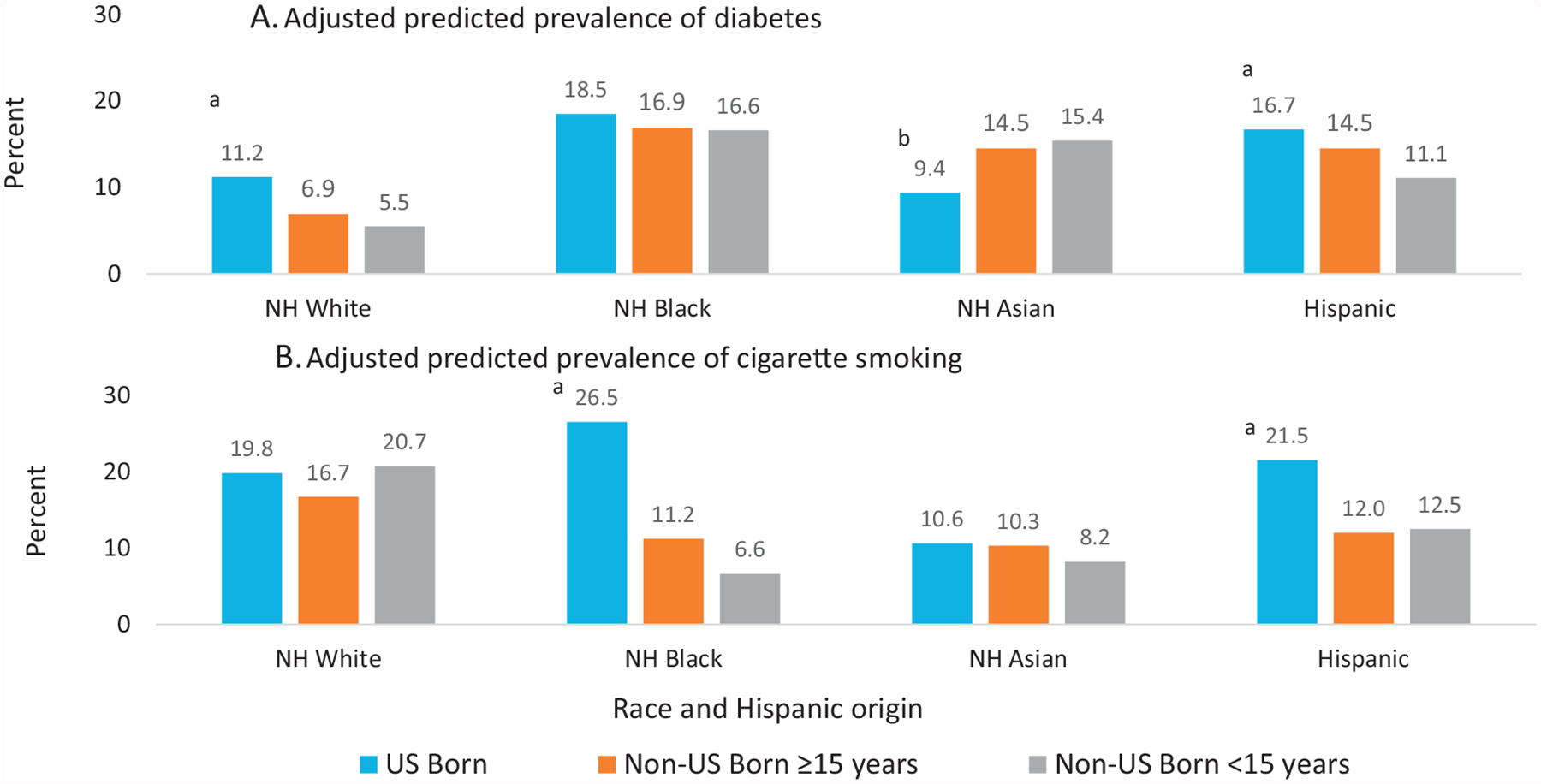
Differences by nativity status for cardiovascular disease (CVD) risk factors have been previously reported. Recent research has focused on understanding how other acculturation factors, such as length of residence, affect health behaviors and outcomes. This study examines the association between CVD risk factors and nativity/length of US residence. Using cross-sectional data from 15,965 adults in the 2011-2016 National Health and Nutrition Examination Surveys (analyzed in 2018), prevalence ratios and predicted marginals from logistic regression models are used to estimate associations of CVD risk factors (i.e., hypertension, hypercholesterolemia, diabetes, overweight/obesity and smoking) with nativity/length of residence (<15 years, ≥15 years) in the US. In sex-, age-, education- and race and Hispanic origin- adjusted analyses, a higher percentage of US (50 states and District of Columbia) born adults (86.4%) had ≥1 CVD risk factor compared to non-US born residents in the US <15 years (80.1%) but not ≥15 years (85.1%). Compared to US born counterparts, regardless of length of residence, hypertension overall and smoking among non-Hispanic white and Hispanic adults were lower among non-US born residents. Overweight/obesity overall and diabetes among Hispanic adults were lower among non-US born residents in the US <15 years. In contrast, non-US born non-Hispanic Asian residents in the US <15 years had higher prevalence of diabetes. Non-US born adults were less likely to have most CVD risk factors compared to US born adults regardless of length of residence, although, for smoking and diabetes this pattern differed by race and Hispanic origin.
Keywords: Cardiovascular disease risk factors; Cigarette smoking; Diabetes; High cholesterol; Hypertension; NHANES; Nativity/length of residence; Overweight/obesity.
Published by Elsevier Inc.
Conflict of interest statement
Declaration of competing interest
None of the authors of this paper has any conflicts of interest.
Figures
References
-
- Akbulut-Yuksel M, Kugler AD, 2016. Intergenerational persistence of health: do immigrants get healthier as they remain in the U.S. for more generations? Economics & Human Biology 23, 136–148. - PubMed
-
- Bharmal N, Kaplan RM, Shapiro MF, et al. , 2015. The association of duration of residence in the United States with cardiovascular disease risk factors among South Asian immigrants. J. Immigr. Minor. Health 17 (3), 781–790. - PubMed
-
- Bieler GS, Brown GG, Williams RL, Brogan DJ, 2010. Estimating model-adjusted risks, risk differences, and risk ratios from complex survey data. Am. J. Epidemiol 171 (5), 618–623. - PubMed
MeSH terms
Grants and funding
LinkOut - more resources
Full Text Sources
Medical
