Review
. 2019 Nov 9;7(11):544.
doi: 10.3390/microorganisms7110544.

Bifidobacterium bifidum: A Key Member of the Early Human Gut Microbiota

Affiliations
Review

Bifidobacterium bifidum: A Key Member of the Early Human Gut Microbiota

Francesca Turroni et al. Microorganisms. .

Abstract

Bifidobacteria typically represent the most abundant bacteria of the human gut microbiota in healthy breast-fed infants. Members of the Bifidobacterium bifidum species constitute one of the dominant taxa amongst these bifidobacterial communities and have been shown to display notable physiological and genetic features encompassing adhesion to epithelia as well as metabolism of host-derived glycans. In the current review, we discuss current knowledge concerning particular biological characteristics of the B. bifidum species that support its specific adaptation to the human gut and their implications in terms of supporting host health.

Keywords: Bifidobacterium bifidum; bifidobacteria; genomics; microbiota; probiotics.


Conflict of interest statement

The authors declare no conflict of interest.

Figures
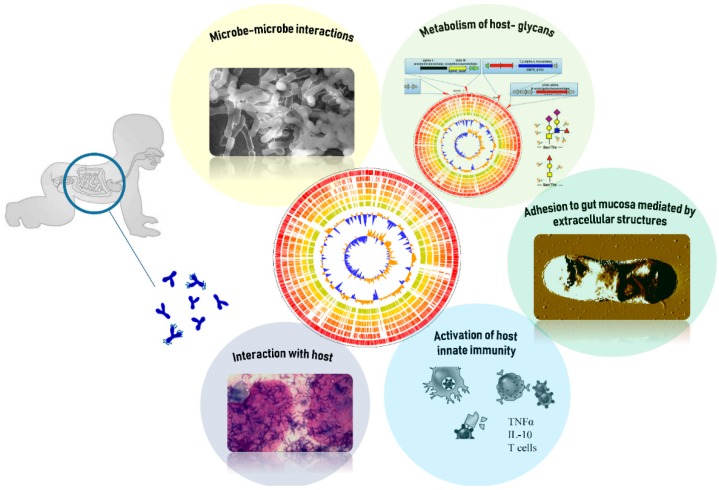
Figure 1
Figure 1
Schematic representation of the main properties exerted by B. bifidum in the human gut. Specifically, there is much evidence in the literature that shows that B. bifidum is able to interact with the host and with other members of gut microbiota by different mechanisms, activate the host immunity, adhere to gut mucosa with its extracellular structures, and metabolize host glycans, such as mucin. See the main text for further explanation.

References

    1. Goodfellow M., Kampfer P., Busse H., Trujillo M.E., Suzuki K., Ludwig W., Whitman W.B. Bergey’s Manual of Systematic Bacteriology. 2nd ed. Springer; New York, NY, USA: 2012.
    1. Ventura M., Canchaya C., Tauch A., Chandra G., Fitzgerald G.F., Chater K.F., van Sinderen D. Genomics of Actinobacteria: Tracing the evolutionary history of an ancient phylum. Microbiol. Mol. Biol. Rev. MMBR. 2007;71:495–548. doi: 10.1128/MMBR.00005-07. - DOI - PMC - PubMed
    1. Turroni F., van Sinderen D., Ventura M. Genomics and ecological overview of the genus Bifidobacterium. Int. J. Food Microbiol. 2011;149:37–44. doi: 10.1016/j.ijfoodmicro.2010.12.010. - DOI - PubMed
    1. Avershina E., Lundgard K., Sekelja M., Dotterud C., Storro O., Oien T., Johnsen R., Rudi K. Transition from infant- to adult-like gut microbiota. Environ. Microbiol. 2016;18:2226–2236. doi: 10.1111/1462-2920.13248. - DOI - PubMed
    1. Milani C., Mancabelli L., Lugli G.A., Duranti S., Turroni F., Ferrario C., Mangifesta M., Viappiani A., Ferretti P., Gorfer V., et al. Exploring vertical transmission of bifidobacteria from mother to child. Appl. Environ. Microbiol. 2015;81:7078–7087. doi: 10.1128/AEM.02037-15. - DOI - PMC - PubMed

LinkOut - more resources
