


Impact on Physical Fitness of the Chinese CHAMPS: A Clustered Randomized Controlled Trial
- PMID: 31718019
- PMCID: PMC6888011
- DOI: 10.3390/ijerph16224412
Impact on Physical Fitness of the Chinese CHAMPS: A Clustered Randomized Controlled Trial
Abstract
Background: School physical activity (PA) policy, physical education curriculum, teacher training, knowledge of physical fitness, and parental support are among the key issues underlying the declining trend of physical fitness in children and adolescents. The Chinese CHAMPS was a multi-faceted intervention program to maximize the opportunities for moderate and vigorous physical activity (MVPA), and increase physical fitness in middle school students. The purpose of the study was to test whether the levels of modification in school physical education policy and curriculum incrementally influenced the changes in cardiorespiratory fitness and other physical fitness outcomes.
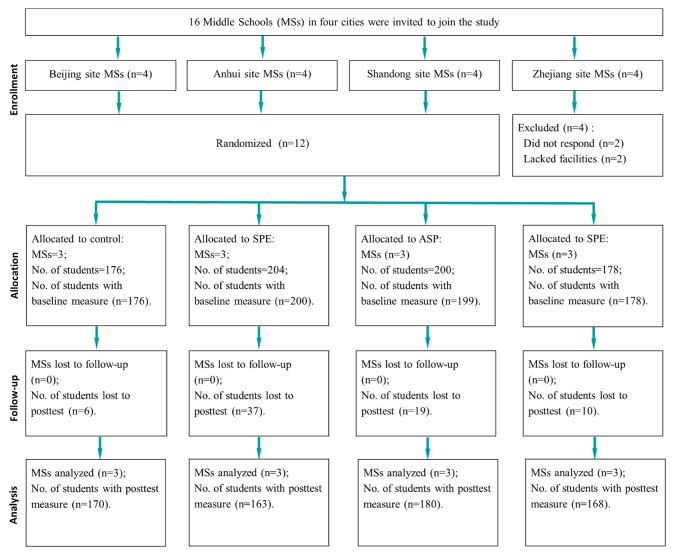
Methods: This 8-month study was a clustered randomized controlled trial using a 2 × 2 factorial design. The participants were 680 7th grade students (mean age = 12.66 years) enrolled in 12 middle schools that were randomly assigned to one of four treatment conditions: school physical education intervention (SPE), afterschool program intervention (ASP), SPE+ASP, and control. Targeted behaviors of the Chinese CHAMPS were the student's sedentary behavior and MVPA. The study outcomes were assessed by a test battery of physical fitness at the baseline and posttest. Sedentary behavior and MVPA were measured in randomly selected students using observations and accelerometry.
Results: The terms contrasting the pooled effect of SPE, ASP, and SPE+ASP vs. Control, the pooled effect of SPE and SPE+ASP vs. ASP only, and the effect of SPE+ASP vs. ASP on CRF and other physical fitness outcomes were all significant after adjusting for covariates, supporting the study hypothesis. Process evaluation demonstrated high fidelity of the intervention in the targeted students' behaviors.
Conclusions: Chinese CHAMPS demonstrated the impact of varying the amount of MVPA and vigorous physical activity (VPA) on the physical fitness in middle school students in support of the need to increase the opportunity for PA in schools and to introduce high-intensity exercises in school-based PA programs. Modification of school policy, quality of physical education curriculum, and teacher training were important moderators of the improvement in physical fitness. (Trial registration: ChiCTR-IOR-14005388, the Childhood Health; Activity and Motor Performance Study.).
Keywords: cardiorespiratory fitness; high-intensity physical activity; physical functional training; socioecological model.
Conflict of interest statement
The authors declare that they have no competing interests.
References
Publication types
MeSH terms
LinkOut - more resources
Full Text Sources
Medical
