


Comment
doi: 10.1073/pnas.1914509116.
Epub 2019 Nov 12.
Reply to Mislavsky et al.: Sometimes people really are averse to experiments
Affiliations
- PMID: 31719207
- PMCID: PMC6883814
- DOI: 10.1073/pnas.1914509116
Item in Clipboard
Comment
Reply to Mislavsky et al.: Sometimes people really are averse to experiments
Proc Natl Acad Sci U S A.
.
No abstract available
Conflict of interest statement
The authors declare no competing interest.
Figures
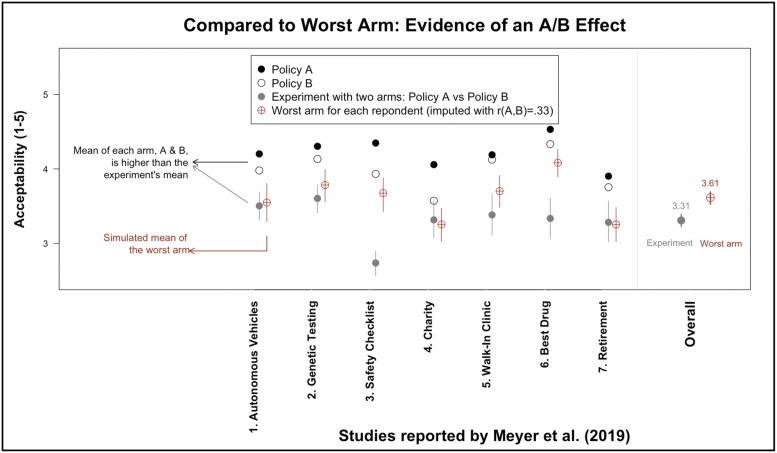
Simulation run using Mislavsky et al.’s R code. We modified their simulation—which they used to claim that there was no evidence for experiment aversion—by replacing the 3 weakest studies (“Basic Income,” “Health Worker Recruitment,” and “Teacher Well-being”) with 3 studies that found a large A/B effect (“Safety Checklist,” “Walk-In Clinic,” and “Best Drug”). We used the same input correlation (r = 0.33) that Mislavsky et al. obtained from 99 Amazon Mechanical Turk participants. The overall comparison (Far Right) now produces evidence of an A/B effect, where the mean of the worst arm (M = 3.61) is greater than (and outside the 95% CI limits of) the mean of the experiment (M = 3.31).
Comment on
-
Objecting to experiments that compare two unobjectionable policies or treatments.Proc Natl Acad Sci U S A. 2019 May 28;116(22):10723-10728. doi: 10.1073/pnas.1820701116. Epub 2019 May 9. Proc Natl Acad Sci U S A. 2019. PMID: 31072934 Free PMC article.
-
The minimum mean paradox: A mechanical explanation for apparent experiment aversion.Proc Natl Acad Sci U S A. 2019 Nov 26;116(48):23883-23884. doi: 10.1073/pnas.1912413116. Epub 2019 Nov 6. Proc Natl Acad Sci U S A. 2019. PMID: 31694881 Free PMC article. No abstract available.
References
-
- Mislavsky R., Dietvorst B., Simonsohn U., Critical condition: People don’t dislike a corporate experiment more than they dislike its worst condition. Mark. Sci., 10.1287/mksc.2019.1166. - DOI
Publication types
MeSH terms
LinkOut - more resources
Full Text Sources
