


Automated Detection of Pain from Facial Expressions: A Rule-Based Approach Using AAM
- PMID: 31719714
- PMCID: PMC6850895
- DOI: 10.1117/12.912537
Automated Detection of Pain from Facial Expressions: A Rule-Based Approach Using AAM
Abstract
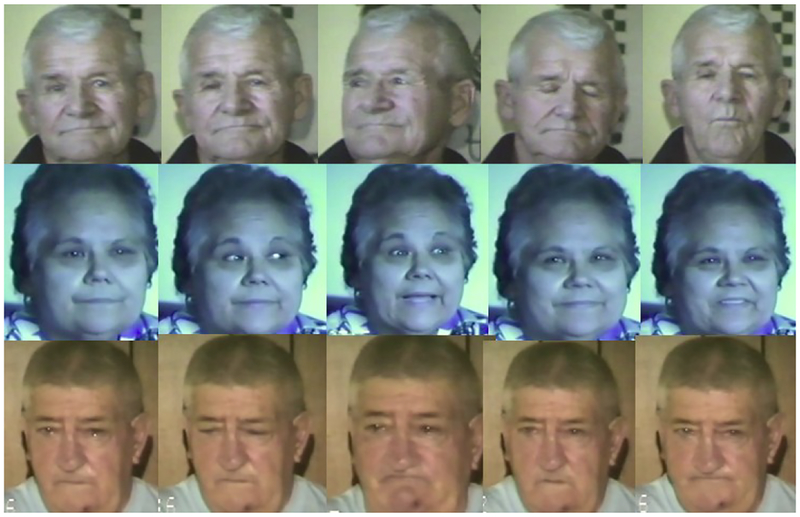
In this paper, we examine the problem of using video analysis to assess pain, an important problem especially for critically ill, non-communicative patients, and people with dementia. We propose and evaluate an automated method to detect the presence of pain manifested in patient videos using a unique and large collection of cancer patient videos captured in patient homes. The method is based on detecting pain-related facial action units defined in the Facial Action Coding System (FACS) that is widely used for objective assessment in pain analysis. In our research, a person-specific Active Appearance Model (AAM) based on Project-Out Inverse Compositional Method is trained for each patient individually for the modeling purpose. A flexible representation of the shape model is used in a rule-based method that is better suited than the more commonly used classifier-based methods for application to the cancer patient videos in which pain-related facial actions occur infrequently and more subtly. The rule-based method relies on the feature points that provide facial action cues and is extracted from the shape vertices of AAM, which have a natural correspondence to face muscular movement. In this paper, we investigate the detection of a commonly used set of pain-related action units in both the upper and lower face. Our detection results show good agreement with the results obtained by three trained FACS coders who independently reviewed and scored the action units in the cancer patient videos.
Keywords: Automated Pain Detection; Coefficient Partitioning AAM; FACS; Rule-Based Recognition.
Figures




References
-
- Craig K, Prkachin K, Grunau R, [The facial expression of pain. Handbook of pain assessment], New York: Guilford; (2001).
-
- Ekman P, Friesen W, and Hager J, [Facial Action Coding System: The Manual], Research Nexus division of Network Research Information. Salt Lake City, UT, USA: (2002).
-
- Wilkie DJ, “Facial Expressions of Pain in Lung Cancer,” Analgesia 1:2, 91–99 (1995).
-
- Lucey P, et al., “Automatically Detecting Action Units from Faces of Pain: Comparing Shape and Appearance Features”, CVPR Workshops (2009).
-
- Matthews I, and Baker S, “Active appearance models revisited,” International Journal of Computer Vision, 60(2), 135–164 (2004).
Grants and funding
LinkOut - more resources
Full Text Sources