Pattern of Presentation of Patients With Breast Cancer in Iraq in 2018: A Cross-Sectional Study
- PMID: 31721627
- PMCID: PMC6882514
- DOI: 10.1200/JGO.19.00041
Pattern of Presentation of Patients With Breast Cancer in Iraq in 2018: A Cross-Sectional Study
Abstract
Purpose: This study aims to describe the pattern of presentation of Iraqi female patients with breast cancer by assessing the grades and stages of their cancers at the time of presentation, to identify patients' main complaints, and to discover whether there is any difference in presentation between patients in Iraq and those in other countries.
Patients and methods: This is a retrospective cross-sectional study that was performed in the National Center of Cancer in 2018. The target population was female patients with breast cancer who came to the Center for treatment and follow-up. A sample of 171 patients was drawn from this population. Self-evaluation forms were used in interviews with the patients to collect personal and sociodemographic data; clinical and histologic characteristics of the patients' tumors were obtained from their medical records. Ethical approval was obtained.
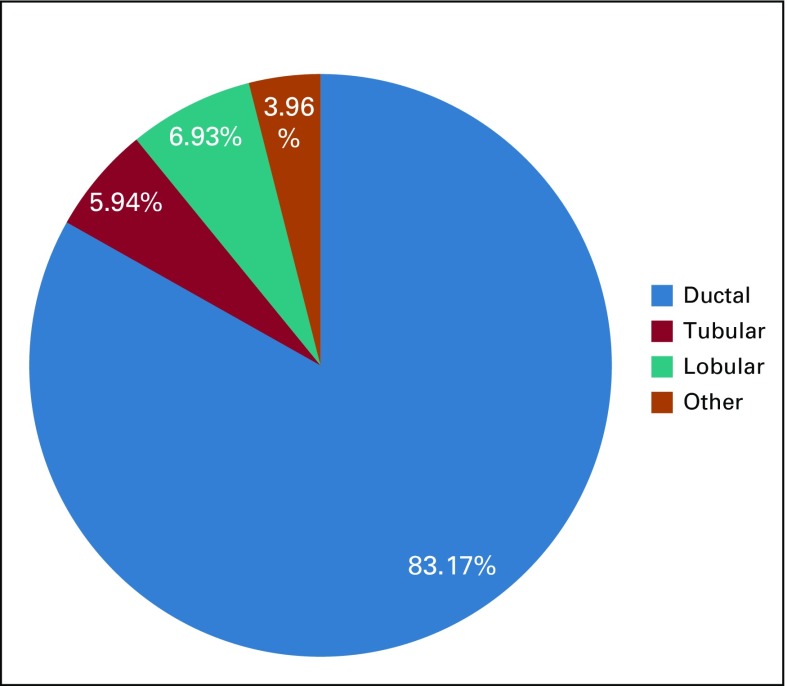
Results: Forty-five percent of the patients were younger than age 50 years, and 25% were younger than age 45 years. In all, 42.9% of the patients were diagnosed with stage III and 25% with stage IV cancer, and metastasis was diagnosed in 24.1%. In our study population, 53.4% of the tumors were found in the right breast, and 3.9% of patients had bilateral breast tumors. The most common histopathologic type was invasive ductal carcinoma (81.4%) followed by invasive lobular carcinoma (6.9%) and tubular carcinoma (5.9%). The patients' most common complaints were breast lump (71.3%) and pain (18.9%). No correlation was found between tumor stage and breast self-examination, family history, education, occupation, histopathology, or grade.
Conclusion: Most of the patients are diagnosed at a late stage when treatment is less effective.
Conflict of interest statement
The following represents disclosure information provided by authors of this manuscript. All relationships are considered compensated unless otherwise noted. Relationships are self-held unless noted. I = Immediate Family Member, Inst = My Institution. Relationships may not relate to the subject matter of this manuscript. For more information about ASCO's conflict of interest policy, please refer to
Open Payments is a public database containing information reported by companies about payments made to US-licensed physicians (
No potential conflicts of interest were reported.
Figures
References
-
- World Health Organization Cancer. 2018 https://www.who.int/en/news-room/fact-sheets/detail/cancer/ September 12,
-
- World Health Organization, Regional Office for the Eastern Mediterranean Towards a strategy for cancer control in the Eastern Mediterranean Region. http://applications.emro.who.int/dsaf/dsa1002.pdf
-
- Ferly J, Shin HR, Bray F, et al. Estimates of worldwide burden of cancer in 2008: GLOBOCAN 2008. Int J Cancer. 2010;127:2893–2917. - PubMed
-
- Iraqi Cancer Board . Results of the Iraqi Cancer Registry 2009. Baghdad, Iraq: Iraqi Cancer Registry Center, Ministry of Health; 2015. https://moh.gov.iq/upload/upfile/ar/833.pdf
-
- Ferlay J, Shin HR, Bray F, et al. Estimates of worldwide burden of cancer in 2008: GLOBOCAN 2008. Int J Cancer. 2010 https://onlinelibrary.wiley.com/doi/full/10.1002/ijc.25516 - DOI - PubMed
MeSH terms
LinkOut - more resources
Full Text Sources
Medical