. 2019 Nov 14;18(1):162.
doi: 10.1186/s12943-019-1081-4.

circLMTK2 acts as a sponge of miR-150-5p and promotes proliferation and metastasis in gastric cancer

Affiliations

circLMTK2 acts as a sponge of miR-150-5p and promotes proliferation and metastasis in gastric cancer

Sen Wang et al. Mol Cancer. .

Abstract

Background: As a novel class of non-coding RNAs, circular RNAs (circRNAs) are key regulators of the development and progression of different cancers. However, little is known about the function and biological mechanism of circLMTK2, also named hsa_circ_0001725, in gastric cancer (GC) tumourigenesis.

Methods: circLMTK2 was identified in ten paired cancer specimens and adjacent normal tissues by RNA sequencing and genome-wide bioinformatic analysis and verified by quantitative real-time PCR (qRT-PCR). Knockdown or exogenous expression of circLMTK2 combined with in vitro and in vivo assays were performed to prove the functional significance of circLMTK2. The molecular mechanism of circLMTK2 was demonstrated by searching the CircNet database and confirmed by RNA in vivo precipitation assays, western blotting, luciferase assays and rescue experiments.

Results: circLMTK2 was frequently upregulated in GC tissues, and high circLMTK2 expression was associated with poor prognosis, lymph node metastasis and poor TNM stage in GC patients. Functionally, circLMTK2 overexpression promoted GC cell proliferation and tumourigenicity in vitro and in vivo. Furthermore, ectopic circLMTK2 expression enhanced GC cell migration and invasion in vitro and tumour metastasis in vivo. In addition, we demonstrated that circLMTK2 could sponge miR-150-5p, thus indirectly regulating the c-Myc expression and contributing to GC tumourigenesis.

Conclusion: Our findings demonstrate that circLMTK2 functions as a tumour promoter in GC through the miR-150-5p/c-Myc axis and could thus be a prognostic predictor and therapeutic target for GC.

Keywords: C-Myc; Gastric cancer; circLMTK2; miR-150-5p.


Conflict of interest statement

The authors declare that they have no conflict of interest.

Figures

Fig. 1
Fig. 1
Identification of circular RNAs by RNA-seq analyses in GC. (a) RNA-seq analysis of circular RNAs in ten paired human GC tissues and matched normal tissues. (b) Total number of circRNAs and back-spliced reads that were identified in ten paired GC tissues and matched normal tissues. (c) Origin of circRNAs in the genome. (d) Clustered heatmap of the differentially expressed circRNAs in ten paired human GC tissues and matched normal tissues. Rows represent circRNAs, while columns represent tissues. The circRNAs were classified according to the Pearson correlation. (e) Circo plots showing differentially expressed circRNAs and their host genes in GC tissues. Outer: differentially expressed circRNAs; Inner: host genes. The values represent the log (fold change) of cancer vs. normal, red: upregulated, blue: downregulated
Fig. 2
Fig. 2
Characteristics of the circLMTK2 in GC cells. (a) The genomic loci of the LMTK2 gene and circLMTK2. The expression of circLMTK2 was detected by qRT-PCR and was validated by Sanger sequencing. The arrows represent divergent primers that bind to the genomic region of circLMTK2. (b) qRT-PCR analysis of circLMTK2 and LMTK2 mRNA after treatment with RNase R. (c) qRT-PCR analysis of circLMTK2 and LMTK2 mRNA after treatment with actinomycin D at the indicated time points. (d) qRT-PCR analysis of circLMTK2 and LMTK2 mRNA in either the cytoplasm or the nucleus. (e) RNA fluorescence in situ hybridization (FISH) for circLMTK2. The nuclei were stained with 4,6-diamidino-2-phenylindole (DAPI). Scale bar, 5 μm
Fig. 3
Fig. 3
circLMTK2 promotes GC cell proliferation and tumourigenicity in vitro and in vivo. (a and b) Assessment of the proliferation of AGS and MGC-803 cells transfected with control or circLMTK2 siRNAs by CCK-8 assay. (c) Stable circLMTK2 overexpression promoted BGC-823 cell proliferation. OD, optical density. (d and e) Assessment of DNA synthesis using an EdU assay in MGC-803 and AGS cells transfected with control or circLMTK2 siRNAs. (f) Stable circLMTK2 overexpression promoted DNA synthesis in BGC-823 cells. Micrographs represent at least three experiments. Scale bar = 200 μm. (g and h) Colony formation assay using AGS and MGC-803 cells transfected with control or circLMTK2 siRNAs. (i) Stable circLMTK2 overexpression promoted BGC-823 cell colony formation. (j) Xenograft assay with BGC-823 stable cell lines. (k) circLMTK2 over-expression increased the volume of the xenograft tumours. (l) circLMTK2 over-expression increased the weight of the xenograft tumours. (a-l) Results are shown as the mean ± standard error of the mean (SEM) of three experiments. *P < 0.05; **P < 0.01; ***P < 0.001 (Student’s t-test)
Fig. 4
Fig. 4
circLMTK2 enhances GC cell migration and invasion in vitro and tumour metastasis in vivo. (a and b) Silencing circLMTK2 inhibits the migration and invasion of AGS cells transfected with control or circLMTK2 siRNAs. (c and d) Silencing circLMTK2 inhibits the migration and invasion of MGC-803 cells transfected with control or circLMTK2 siRNAs. (e) Stable circLMTK2 overexpression promoted BGC-823 cell migration and invasion in vitro. Representative images are shown on the left. The values shown on the right represent the mean ± SEM. (f) BGC-823 cells stably transfected with circLMTK2 or empty vector control were injected into the tail vein of BALB/c nude mice (2 × 106 cells per mouse, n = 9 for each group). The nude mice treated with circLMTK2-transfected cells demonstrated significantly more lung metastatic colonies. The data are presented as the mean ± SEM. Scale bars, 100 and 400 μm. The paraffin sections were imaged with a Leica Microsystems Microscope (Leica biosystems, Wetzlar, Germany). (A-F) The data are the means ± SEM of three experiments. *P < 0.05; **P < 0.01; ***P < 0.001 (Student’s t-test)
Fig. 5
Fig. 5
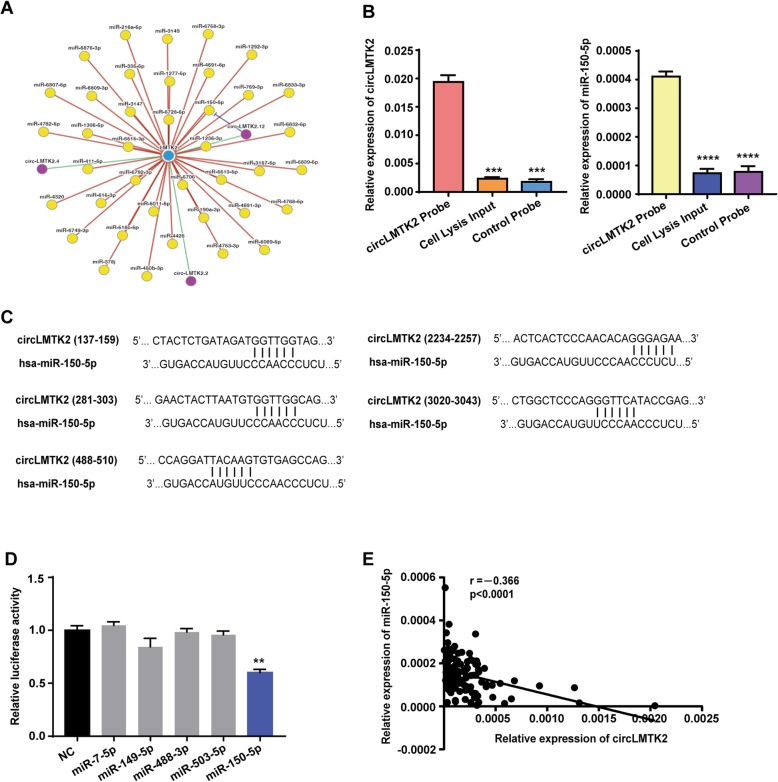
circLMTK2 serves as a miRNA sponge for the miR-150-5p. (a) circRNA-miRNA-gene regulatory network from the CircNet database. (b) Left: circLMTK2 in GC cell lysate was pulled down and enriched with a circLMTK2- specific probe and then detected by qRT-PCR. Right: miR-150-5p was pulled down and enriched with a circLMTK2-specific probe and then detected by qRT-PCR. (c) A schematic drawing shows the putative binding sites of miR-150-5p with respect to circLMTK2. (d) A luciferase reporter assay was used to detect the luciferase activity of LUC-circRNA in HEK 293 T cells cotransfected with miRNA mimics. The data are the means ± SEM of three experiments. (e) The correlation between circLMTK2 and miR-150-5p levels in 120 GC patients. Pearson’s correlation coefficient values (r) and P values are as indicated
Fig. 6
Fig. 6
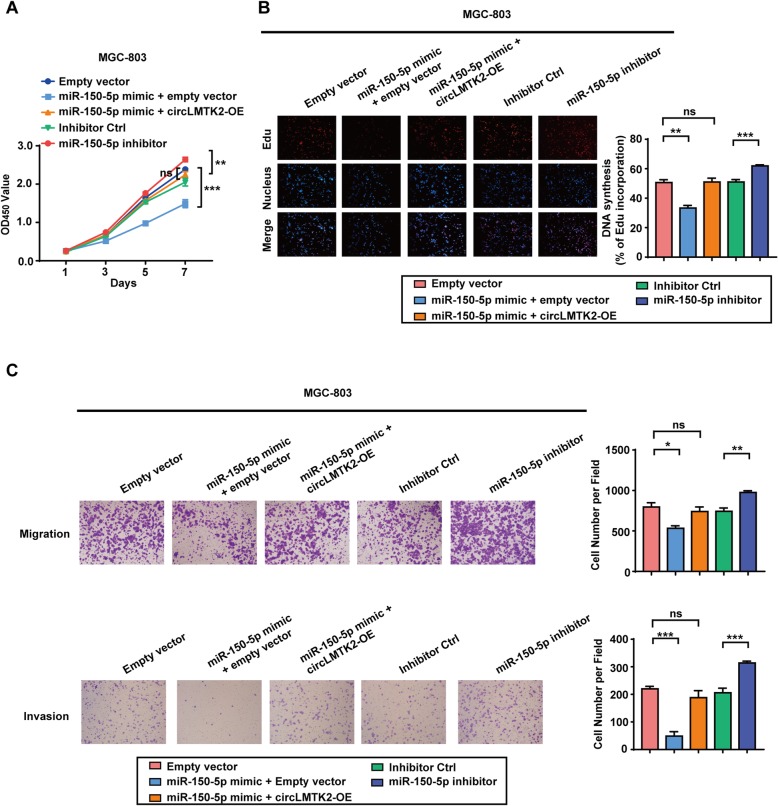
circLMTK2 promotes GC cell growth and metastasis by sponging miR-150-5p (a) The re-introduction of circLMTK2 reversed the inhibitory effect of miR-150-5p on MGC-803 cell proliferation. MiR-150-5p inhibitors promoted MGC-803 cell proliferation. (b) The re-introduction of circLMTK2 reversed the inhibitory effect of miR-150-5p on DNA synthesis. MiR-150-5p inhibitors promoted GC cell DNA synthesis. The micrographs represent at least three experiments. Scale bar = 200 μm. (c) The suppressed migration of MGC-803 cells induced by miR-150-5p was restored via circLMTK2 re-introduction. MiR-150-5p inhibitors promoted GC cell migration and invasion in vitro. (a-c) The data are the means ± SEM of three experiments. *P < 0.05; **P < 0.01; ***P < 0.001; ****P < 0.0001 (Student’s t-test)
Fig. 7
Fig. 7
circLMTK2 expression is upregulated in GC. (a) c-Myc mRNA levels were repressed by silencing circLMTK2 or miR-150-5p overexpression in GC cells. In contrast, c-Myc mRNA levels were enhanced by circLMTK2 overexpression in GC cells. The data are the means ± SEM of three experiments. *P < 0.05; **P < 0.01 (Student’s t-test) (b) c-Myc protein levels were repressed by silencing circLMTK2 or miR-150-5p overexpression in GC cells. In contrast, c-Myc protein levels were enhanced by circLMTK2 overexpression in GC cells. (c) Left: Diagram of putative miR-150-5p binding sites in the 3′-UTR of c-Myc. The mutant sequences c-Myc 3′-UTR sequences used in the luciferase reporter constructs are indicated in red. Right: Relative activities of luciferase reporters containing c-Myc 3′-UTR variants cotransfected with miR-150-5p or negative control mimics in HEK 293 T cells. ****P < 0.0001 (Student’s t-test). (d) Correlation between circLMTK2 and c-Myc levels in GC tissues. Pearson’s correlation coefficient values (r) and P values are as indicated. (e) Relative circLMTK2 mRNA levels in 120 matched human GC/normal tissues. The values are expressed as medians with interquartile ranges. (f) Kaplan-Meier analysis of the correlation between circLMTK2 expression and overall survival (OS) in 120 patients with GC. Log-rank tests were used to determine statistical significance. The patients were divided into two groups according to the median value of circLMTK2 expression

Similar articles

Cited by

References

    1. Siegel RL, Miller KD, Jemal A. Cancer statistics, 2019. CA Cancer J Clin. 2019;69(1):7–34. doi: 10.3322/caac.21551. - DOI - PubMed
    1. Siegel R, Ma J, Zou Z, Jemal A. Cancer statistics, 2014. CA Cancer J Clin. 2014;64(1):9–29. doi: 10.3322/caac.21208. - DOI - PubMed
    1. Chen D, Wang H, Chen J, Li Z, Li S, Hu Z, Huang S, Zhao Y, He X. MicroRNA-129-5p regulates glycolysis and cell proliferation by targeting the glucose transporter SLC2A3 in gastric Cancer cells. Front Pharmacol. 2018;9:502. doi: 10.3389/fphar.2018.00502. - DOI - PMC - PubMed
    1. Guarnerio J, Bezzi M, Jeong JC, Paffenholz SV, Berry K, Naldini MM, Lo-Coco F, Tay Y, Beck AH, Pandolfi PP. Oncogenic role of fusion-circRNAs derived from Cancer-associated chromosomal translocations. Cell. 2016;165(2):289–302. doi: 10.1016/j.cell.2016.03.020. - DOI - PubMed
    1. Memczak S, Jens M, Elefsinioti A, Torti F, Krueger J, Rybak A, Maier L, Mackowiak SD, Gregersen LH, Munschauer M, et al. Circular RNAs are a large class of animal RNAs with regulatory potency. Nature. 2013;495(7441):333–338. doi: 10.1038/nature11928. - DOI - PubMed

Publication types

MeSH terms