Nutrient regulation of mTORC1 at a glance
- PMID: 31722960
- PMCID: PMC6857595
- DOI: 10.1242/jcs.222570
Nutrient regulation of mTORC1 at a glance
Abstract
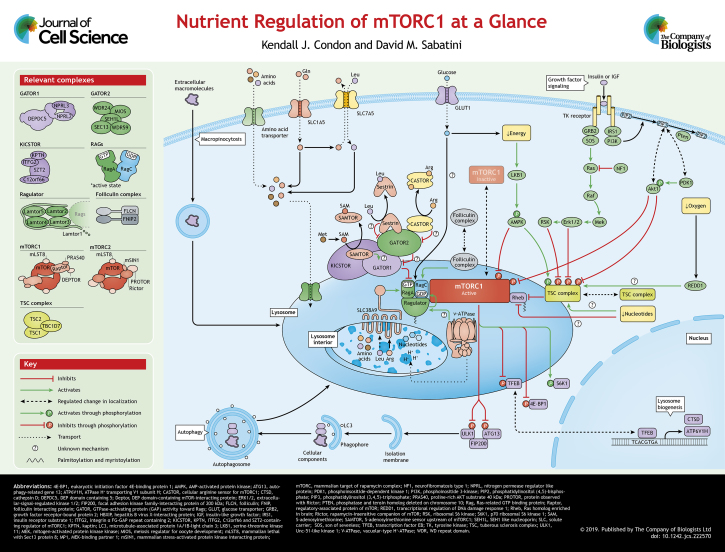
The mechanistic target of rapamycin (mTOR) signaling pathway coordinates environmental and intracellular cues to control eukaryotic cell growth. As a pivot point between anabolic and catabolic processes, mTOR complex 1 (mTORC1) signaling has established roles in regulating metabolism, translation and autophagy. Hyperactivity of the mTOR pathway is associated with numerous human diseases, including diabetes, cancer and epilepsy. Pharmacological inhibition of the mTOR pathway can extend lifespan in a variety of model organisms. Given its broad control of essential cellular processes and clear relevance to human health, there is extensive interest in elucidating how upstream inputs regulate mTORC1 activation. In this Cell Science at a Glance article and accompanying poster, we summarize our understanding of how extracellular and intracellular signals feed into the mTOR pathway, how the lysosome acts as an mTOR signaling hub, and how downstream signaling controls autophagy and lysosome biogenesis.
Keywords: Amino acids; Autophagy; Cell growth; Glucose; Lysosome; Nutrients; Signaling; mTORC1.
© 2019. Published by The Company of Biologists Ltd.
Conflict of interest statement
Competing interestsThe authors declare no competing or financial interests.
References
-
- Baba M., Hong S. B., Sharma N., Warren M. B., Nickerson M. L., Iwamatsu A., Esposito D., Gillette W. K., Hopkins R. F. III, Hartley J. L. et al. (2006). Folliculin encoded by the BHD gene interacts with a binding protein, FNIP1, and AMPK, and is involved in AMPK and mTOR signaling. Proc. Natl. Acad. Sci. USA 103, 15552-15557. 10.1073/pnas.0603781103 - DOI - PMC - PubMed
-
- Bar-Peled L., Chantranupong L., Cherniack A. D., Chen W. W., Ottina K. A., Grabiner B. C., Spear E. D., Carter S. L., Meyerson M. and Sabatini D. M. (2013). A Tumor suppressor complex with GAP activity for the Rag GTPases that signal amino acid sufficiency to mTORC1. Science 340, 1100-1106. 10.1126/science.1232044 - DOI - PMC - PubMed
Publication types
MeSH terms
Substances
Grants and funding
LinkOut - more resources
Full Text Sources
Research Materials
Miscellaneous