. 2019 Aug 2;75(31):4059-4070.
doi: 10.1016/j.tet.2019.05.055. Epub 2019 May 27.

Iridium-Catalyzed Silylation of Unactivated C-H Bonds

Affiliations

Iridium-Catalyzed Silylation of Unactivated C-H Bonds

John F Hartwig et al. Tetrahedron. .

Abstract

The functionalization of primary C-H bonds has been a longstanding challenge in catalysis. Our group has developed a series of silylations of primary C-H bonds that occur with site selectivity and diastereoselectivity resulting from an approach to run the reactions as intramolecular processes. These reactions have become practical by using an alcohol or amine as a docking site for a hydrosilyl group, thereby leading to intramolecular silylations of C-H bonds at positions dictated by the presence common functional groups in the reactants. Oxidation of the C-Si bond leads to the introduction of alcohol functionality at the position of the primary C-H bond of the reactant. The development, scope, and applications of these functionalization reactions is described in this minireview.


Figures

Fig. 1
Fig. 1
Proposed mechanism for hydrosilyl-directed borylations of aromatic C-H bonds.
Fig. 2
Fig. 2
Relative computed transition-state energies for the C-H bond-cleavage and C-Si bond-forming elementary reaction steps of rhodium-catalyzed silylation of primary and secondary C-H bonds.
Scheme 1
Scheme 1
Platinum catalyzed intramolecular silylation of a methyl C-H bond.
Scheme 2
Scheme 2
Iridium-catalyzed borylation of ortho C-H bonds of phenols directed by a hydrosilyl ether.
Scheme 3
Scheme 3
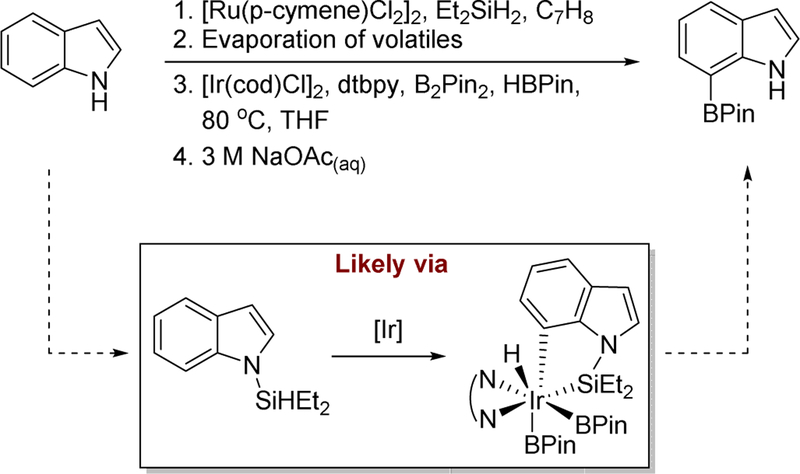
Borylation of indoles at the 7-position of the heterocycle likely proceeds through a pathway directed by the hydrosilyl group.
Scheme 4
Scheme 4
Silylation of methyl C-H bonds of hydrosilyl ethers affords 1,3-diols after Tamao-Fleming oxidation of the intermediate 5-membered oxasilolanes (top). Scope of the reaction (bottom).
Scheme 5
Scheme 5
Regioselective one-pot hydroxylation of a methyl C-H bond of methyl oleanate to afford methyl hederagenate in high yield.
Scheme 6
Scheme 6
Hydrosilyl ether-directed γ-C-H bond silylation efficiently yields 1,3-diols after oxidation.
Scheme 7
Scheme 7
Competition experiments prove the preferential activation of methyl C-H bonds over methylene C-H bonds.
Scheme 8
Scheme 8
δ-C-H bond silylation of hydrosilyl ethers catalyzed by the combination of rhodium and xantphos generates 1,4-diols after oxidation and can be applied to the hydroxylation of complex architectures.
Scheme 9
Scheme 9
The strategy to access β-C-H bond silylation comprises the installation of a hydrosilyl acetal directing group and C-H bond silylation. The resulting dioxasilinanes have been oxidized to the corresponding 1,2-diols
Scheme 10
Scheme 10
Hydrosilylation of alkenes affords precursors for Ir-catalyzed δ-C-H bond silylation to yield acetyl-protected 1,4-diols after oxidation.
Scheme 11
Scheme 11
Hydrosilyl-directed silylation of β-C-H bonds of tertiary amines followed by oxidation and protection of the resulting silapyrrolidines affords N-boc-1,2-amino alcohols.
Scheme 12
Scheme 12
Ir-catalyzed hydrosilyl-directed silylation of enantiotopic methyl C-H bonds yields enantiopure products and can be applied to complex molecule scaffolds.
Scheme 13
Scheme 13
Use of a chiral ancillary ligand enables the enantioselective β-C-H bond silylation reaction to occur in high yields and moderate enantioselectivities.
Scheme 14
Scheme 14
4-step, 1-pot reaction sequence affording fully protected sugars in good yields.
Scheme 15
Scheme 15
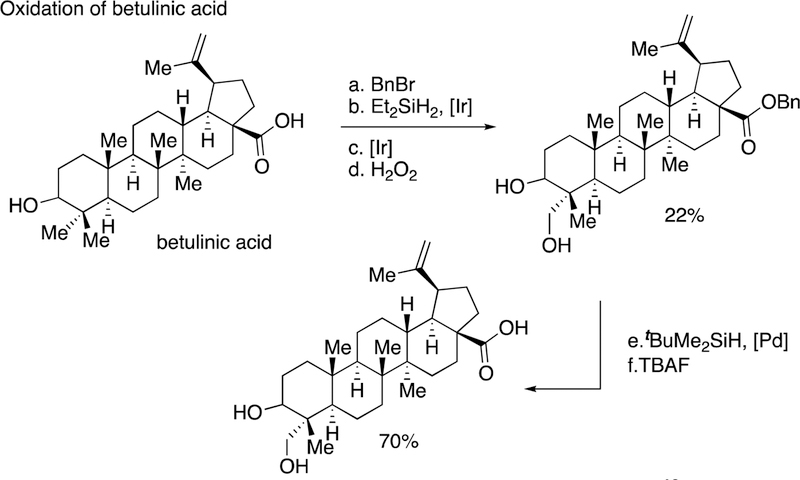
C-H bond silylation of betulinic acid occurs in modest yield.
Scheme 16
Scheme 16
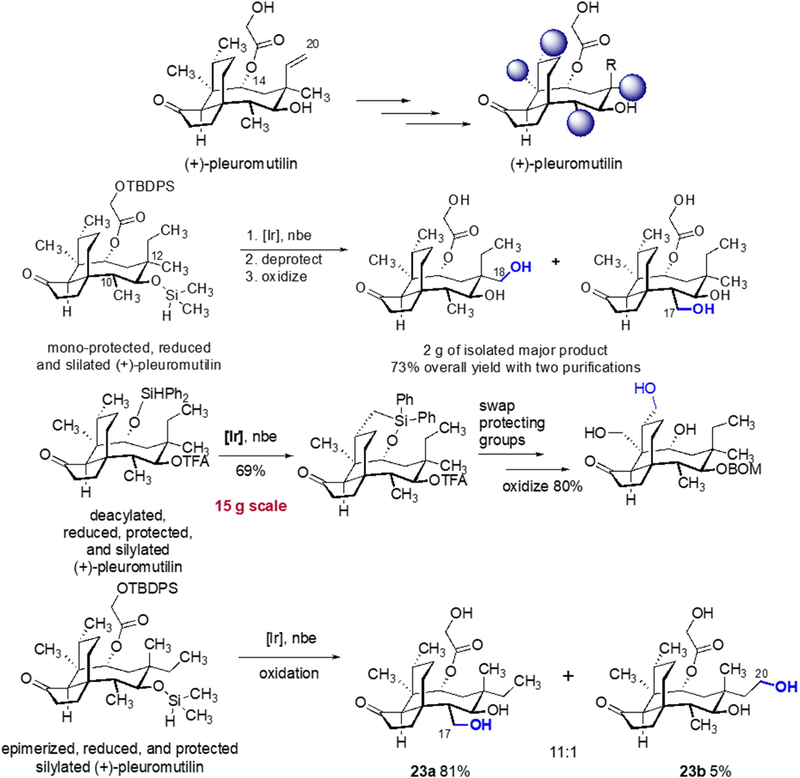
Summary of the strategic C-H bond silylations of (+)-pleuromutilin.
Scheme 17
Scheme 17
Pd-catalyzed directed-silylation of primary C-H bonds located beta or gamma to the directing group.–,
Scheme 18
Scheme 18
Application of Pd-catalyzed C-H bond silylation to polypeptide substrates in modest to good yields.
Scheme 19
Scheme 19
Ru-catalyzed silylation of the primary alkyl C(sp3)-H bond of pyridines.

References

    1. Newton CG, Wang S-G, Oliveira CC, Cramer N, Chem. Rev 2017; 117:8908. - PubMed
    1. He J, Wasa M, Chan KSL, Shao Q, Yu J-Q, Chem. Rev 2017; 117:8754. - PMC - PubMed
    1. Park Y, Kim Y, Chang S, Chem. Rev 2017; 117:9247. - PubMed
    1. Hartwig JF, Larsen MA, ACS Cent. Sci 2016; 2:281. - PMC - PubMed
    1. Kumar A, Bhatti TM, Goldman AS, Chem. Rev 2017; 117:12357. - PubMed