Review
. 2019 Nov 5:12:1756284819884196.
doi: 10.1177/1756284819884196. eCollection 2019.

Immune checkpoint inhibitor-associated gastrointestinal and hepatic adverse events and their management

Affiliations
Review

Immune checkpoint inhibitor-associated gastrointestinal and hepatic adverse events and their management

Uday N Shivaji et al. Therap Adv Gastroenterol. .

Abstract

Background: Drug-induced colitis is a known complication of therapies that alter the immune balance, damage the intestinal barrier or disturb intestinal microbiota. Immune checkpoint inhibitors (ICI) directed against cancer cells may result in activated T lymphocyte-induced immune-related adverse events (AEs), including immune-related colitis and hepatitis. The aim of this review article is to summarize the incidence of gastrointestinal (GI) and hepatic AEs related to ICI therapy. We have also looked at the pathogenesis of immune-mediated AEs and propose management strategies based on current available evidence.

Methods: A literature search using PubMed and Medline databases was undertaken using relevant search terms pertaining to names of individual drugs, mechanism of action, related AEs and their management.

Results: ICI-related GI AEs are common, and colitis appears to be the most common side effect, with some studies reporting incidence as high as 30%. The incidence of both all-grade colitis and hepatitis were highest with combination therapy with anti-CTLA-4/PD-1; severity of colitis was dose-dependent (anti-CTLA-4). Early intervention is associated with better outcomes.

Conclusion: ICI-related GI and hepatic AEs are common and clinicians need to be aware. Patients with GI AEs benefit from early diagnosis using endoscopy and computed tomography. Early intervention with oral steroids is effective in the majority of patients, and in steroid-refractory colitis infliximab and vedolizumab have been reported to be useful; mycophenolate has been used for steroid-refractory hepatitis.

Keywords: anti-CTLA-4; anti-PD1; anti-PDL1; immune checkpoint inhibitors; immune-related colitis; immune-related hepatitis; management.


Conflict of interest statement

Conflict of interest statement: The authors declare that there is no conflict of interest.

Figures
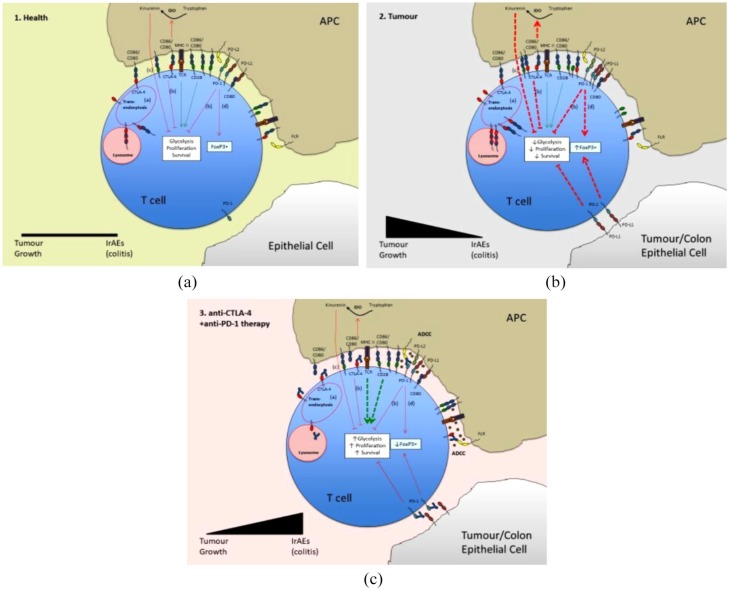
Figure 1.
Figure 1.
Pathology of checkpoint-inhibitor-induced gastrointestinal toxicities. In healthy tissues (A) low levels of self- or non-self-antigen-TCR and CD28 co-stimulation signals that lead to increased glycolysis, T cell proliferation and survival are balanced by inhibitory signals through co-inhibitory receptors CTLA-4 and PD-1 that are constitutively expressed on patrolling Treg and induced on stimulated effector T cells. The inhibitory pathways that extend from these receptors include (a) competitive binding of CTLA-4 and CD28 for their shared ligands CD80 and CD86 – this is enhanced by CD86/80 transendocytosis in which CTLA-4 recruits its ligands into vesicles that deliver them to the lysosome for degradation; (b) dephosphorylation of activatory phosphate groups on signalling proteins assembled downstream of CD28 and antigen-TCR; (c) production of kinurenins that inhibit T cell proliferation from tryptophan by indoleamine dioxygenase (IDO), which is activated downstream of CD86/80 engagement of CTLA-4; and (d) induction of FoxP3 downstream of PD-1. In tumour (B), CTLA-4, PD-1 and their ligands are elevated. Inhibitory signals (a–d) are therefore increased relative to stimulatory signals through tumour neoantigen-TCR and CD28. This reduces the activation and expansion of effector T cells, enabling the tumour to grow. Anti-CTLA-4 and anti-PD-1/PD-L1 therapies (C) block inhibitory pathways (a–d) and Treg with constitutively high expression of CTLA-4 and PD-1 are destroyed by tissue macrophages through antibody dependent cellular cytotoxicity (ADCC) and antibody-mediated phagocytosis. Altogether this results in T cell activation, proliferation and survival and differentiation into inflammatory effector classes that mediate destruction of the tumour but promote IrAEs in peripheral tissues, especially the colon, where self-antigens or microbial antigens might overlap with tumour neoantigens. Key: Green lines represent co-stimulation pathways and red lines co-inhibitory pathways. Arrowheads indicate induction and wedges inhibition of the response. Line thickness indicates the strength of the pathway.
Figure 2.
Figure 2.
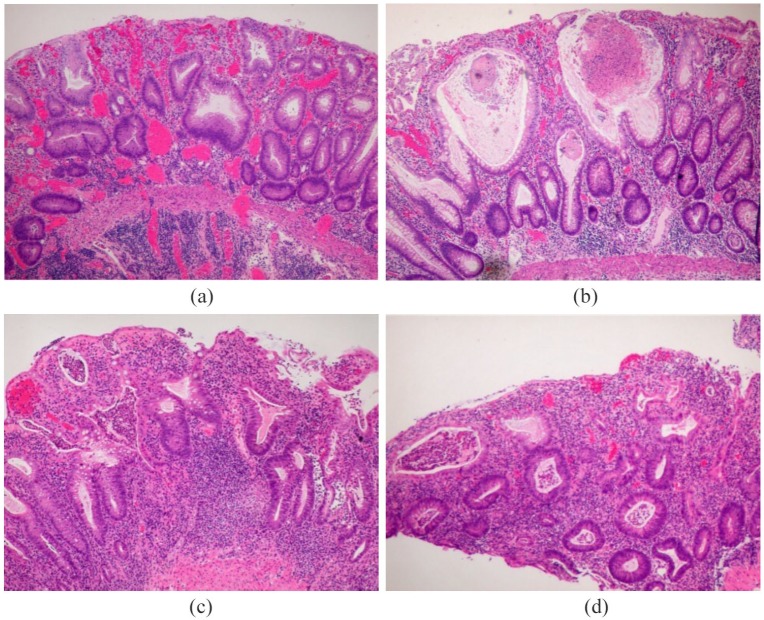
(a) A case of ipilimumab-related colitis. A patient with melanoma was treated with ipilimumab (anti- CTLA-4). Severe active colitis, with expansion of lamina propria lymphoplasma cells, cryptitis, crypt destruction/dropout and crypt architecture alteration. (b) Additionally, many crypts show significant distention (‘ballooning’) due to intraluminal inflammatory exudate accumulation. (c) A male patient was given ipilimumab, nivolumab and IL2 to treat metastatic prostatic carcinoma, then developed bloody diarrhoea. Severe active chronic colitis mimics ulcerative colitis. (d) Severe active colitis, with expansion of lamina propria lymphoplasma cells, cryptitis, crypt abscesses, crypt destruction/dropout, crypt architecture alteration and basal lymphoplasmacytosis.
Figure 3.
Figure 3.
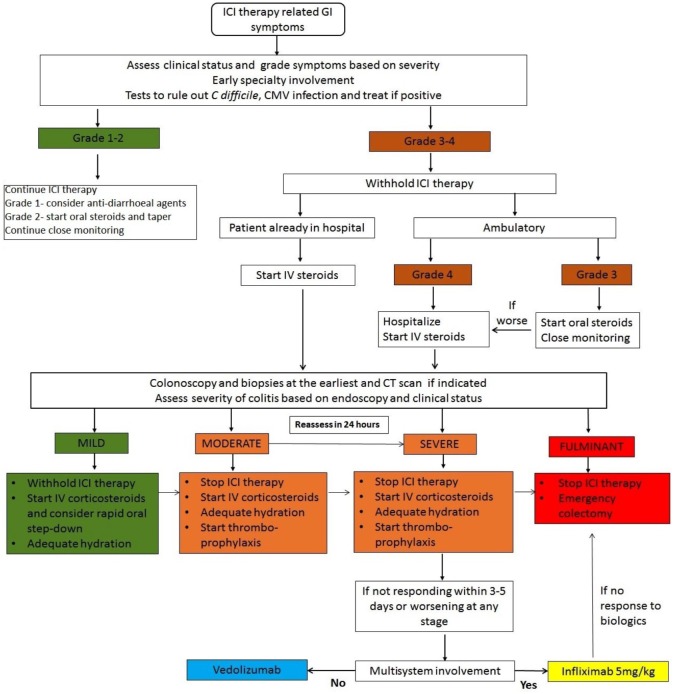
Proposed algorithm for management of checkpoint inhibitor-associated diarrhoea or colitis. CMV, cytomegalovirus; CT, computed tomography; ICI, immune checkpoint inhibitors; IV, intravenous.

References

    1. Michot JM, Bigenwald C, Champiat S, et al. Immune-related adverse events with immune checkpoint blockade: a comprehensive review. Eur J Cancer 2016; 54: 139–148. - PubMed
    1. Beck KE, Blansfield JA, Tran KQ, et al. Enterocolitis in patients with cancer after antibody blockade of cytotoxic T-lymphocyte-associated antigen 4. J Clin Oncol 2006; 24: 2283. - PMC - PubMed
    1. Wang DY, Ye F, Zhao S, et al. Incidence of immune checkpoint inhibitor-related colitis in solid tumor patients: a systematic review and meta-analysis. Oncoimmunology 2017; 10: e1344805. - PMC - PubMed
    1. National Institute of Health. Common Terminology Criteria for Adverse Events (CTCAE). NIH Publ. 2010;2009:0–71.
    1. Baxi S, Yang A, Gennarelli RL, et al. Immune-related adverse events for anti-PD-1 and anti-PD-L1 drugs: systematic review and meta-analysis. BMJ (Online) 2018;360:k793. - PMC - PubMed