. 2019 Oct 31;9(4):283-291.
doi: 10.5826/dpc.0904a07. eCollection 2019 Oct.

Dermoscopic-Histopathological Correlation of Eccrine Poroma: An Observational Study

Affiliations

Dermoscopic-Histopathological Correlation of Eccrine Poroma: An Observational Study

Marco A Chessa et al. Dermatol Pract Concept. .

Abstract

Background: Eccrine poroma (EP) is a benign adnexal neoplasm that can be pigmented in 17% of cases. Four histopathological variants of EP exist. Dermoscopically, EP can mimic many other skin neoplasms.

Objectives: To provide a dermoscopic-histopathological correlation of EP, classifying the clinical and dermoscopic features of EPs on the basis of their histopathological subtype, in an attempt to better characterize these entities.

Patients and methods: A single-center retrospective study was conducted. Clinical data were collected; patients were classified on the basis of the 4 histopathological variants of EPs. Dermoscopic images were reviewed. A dermoscopic-histopathological correlation was performed, and the results were compared with literature data.

Results: Twenty-six lesions were included, both pigmented and nonpigmented. Three of the 4 histopathological variants were identified. Different dermoscopic features were observed for each distinct histopathological subtype of EP. The lesions mimicked different types of other skin neoplasms, in particular: nonpigmented hidroacanthoma simplex resembled nonmelanoma skin cancer; pigmented hidroacanthoma simplex appeared like a seborrheic keratosis or a solar lentigo; EPs sensu stricto presented as pink nodules if nonpigmented and were similar to seborrheic keratosis if pigmented; dermal duct tumors appeared as pigmented nodular lesions.

Conclusions: Distinct dermoscopic features appeared to be recurrent in each histopathological variant. Dermoscopy can provide important clues for the diagnosis of EP; the final diagnosis is allowed by histopathology. To achieve a correct diagnosis of EP, because of its clinical and dermoscopic variability, surgical excision is recommended.

Keywords: dermoscopy; diagnosis; eccrine; histopathology; poroma.


Conflict of interest statement

Competing interests: The authors have no conflicts of interest to disclose.

Figures

Figure 1
Figure 1
Dermoscopic and histopathological findings of the 26 eccrine poromas included in the study. [Copyright: ©2019 Chessa et al.]
Figure 2
Figure 2
(A) Nonpigmented hidroacanthoma simplex (NPHS) appearing as a pink plaque of the hip. (B,C) On dermoscopy, glomerular (black arrow), linear irregular (green bolt), flower-like (green arrow), and corkscrew vessels (yellow star) and milia-like cysts (dark blue triangle) were observed (original magnifications ×20 and ×40, respectively). (D) Histopathological features of NPHS were detected, consisting of well-circumscribed poroid cells arranged in an ovoid aggregation confined within the epidermis (H&E staining, original magnification ×4). (E) At higher magnification, sharply delineated aggregations of poroid cells that spare the basal layer of the epidermis and dark-staining pyknotic nuclei can be seen better (H&E staining, original magnification ×40). [Copyright: ©2019 Chessa et al.]
Figure 3
Figure 3
(A) Pigmented hidroacanthoma simplex appearing as a dark brown plaque located on the forehead. (B,C) On dermoscopy, a brown pseudonetwork with fingerprint-like structures around follicles (light blue arrow), milia-like cysts (dark blue triangle), and comedo-like openings (black arrow) were seen, mimicking a seborrheic keratosis (original magnifications ×20 and ×40, respectively). (D) On histopathology, sharply delineated aggregation of poroid, cuticular cells and tubular structures, and an increase of melanin pigment among the epidermis, were observed (H&E staining, original magnification ×10). (E) At higher magnification, small, dark, monomorphous, neoplastic poroid cells constitute most of the sharply circumscribed aggregations within the epidermis; these findings are diagnostic of hidroacanthoma simplex (H&E staining, original magnification ×40). [Copyright: ©2019 Chessa et al.]
Figure 4
Figure 4
(A) Clinical presentation of a nonpigmented eccrine poroma sensu stricto as a pink nodule located on the foot. (B,C) Dermoscopy shows milky red areas (light blue arrow), milky red globules (dark blue triangle), and dotted vessels (black arrow) (original magnifications ×20 and ×40, respectively). (D,E) Histopathologically, the neoplasm consists of poroid and cuticular cells and tubular structures which are continuous with the epidermis (H&E staining, original magnifications ×10 and ×40, respectively). [Copyright: ©2019 Chessa et al.]
Figure 5
Figure 5
(A) A pigmented eccrine poroma (PEP) presenting as a well-defined, pigmented seborrheic keratosis-like lesion of the abdomen. (B,C) Dermoscopy shows a gray-to-brown background with a uniform distribution of the vascular structures, consisting mainly of hairpin vessels (yellow star) in the central part and linear irregular (yellow arrow) and serpentine vessels (black arrow) at the periphery of the PEP (original magnifications ×20 and ×40, respectively). (D) Histopathologically, an increase of melanin pigment is present among the PEP (H&E staining, original magnification ×10). (E) At higher magnification, the 2 cell types that constitute poromas are seen: cells with small dark-staining nuclei and scant cytoplasm are poroid cells, whereas cells with larger, paler nuclei and abundant cytoplasm are cuticular cells (H&E staining, original magnification ×20). [Copyright: ©2019 Chessa et al.]
Figure 6
Figure 6
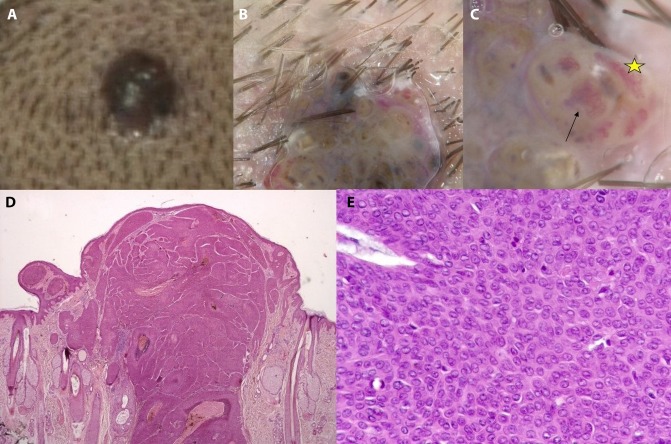
(A) A pigmented dermal duct tumor appearing as a pigmented nodule of the scalp. (B,C) Dermoscopy reveals light brown, pigmented lobules separated by grayish septa, with some leaf-like (yellow star) and flower-like vessels (black arrow) in some peripheral lobules (original magnifications ×20 and ×40, respectively). (D) Histopathological features consist of poroid cells and cuticular cells aggregated in small, discrete intradermal nodules (H&E staining, original magnification ×4). (E) At higher magnification, vacuoles are visible within cuticular cells and represent a stage en route to formation of ducts (H&E staining, original magnification ×40). [Copyright: ©2019 Chessa et al.]
Figure 7
Figure 7
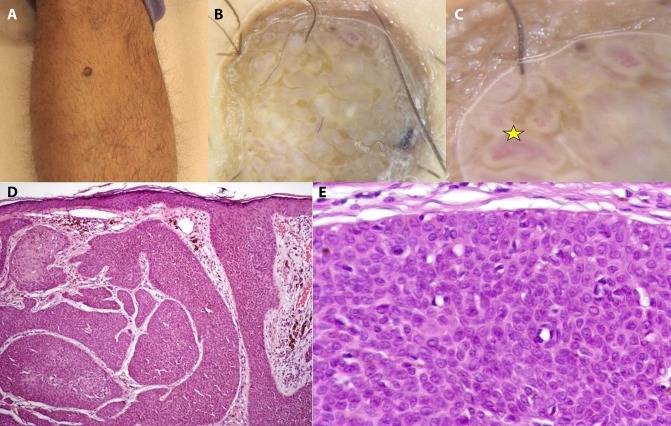
(A) A pigmented dermal duct tumor presenting as a pigmented nodule of the lower limb. (B,C) Dermoscopy shows yellow lobules separated by grayish septa, with flower-like vessels (yellow star) in some peripheral lobules (original magnifications ×20 and ×40, respectively). (D) Histopathology shows poroid and cuticular cells aggregated in intradermal nodules with an increase of melanin pigment (H&E staining, original magnification ×10). (E) At higher magnification, the sequence of changes that leads to formation of ductal structures is visible; the earliest changes consist of tiny vacuoles within the cytoplasm of cuticular cells (H&E staining, original magnification ×40). [Copyright: ©2019 Chessa et al.]

References

    1. Minagawa A, Koga H. Dermoscopy of pigmented poromas. Dermatology. 2010;221(1):78–83. - PubMed
    1. Lallas A, Chellini PR, Guimarães MG, et al. Eccrine poroma: the great dermoscopic imitator. J Eur Acad Dermatol Venereol. 2016;30(10):e61–e63. - PubMed
    1. Battistella M, Langbein L, Peltre B, Cribier B. From hidroacanthoma simplex to poroid hidradenoma: clinicopathologic and immunohistochemic study of poroid neoplasms and reappraisal of their histogenesis. Am J Dermatopathol. 2010;32(5):459–468. - PubMed
    1. Martín JM, Bella-Navarro R, Jordá E. Vascular patterns in dermoscopy. Actas Dermosifiliogr. 2012;103(5):357–375. - PubMed
    1. Ayhan E, Ucmak D, Akkurt Z. Vascular structures in dermoscopy. An Bras Dermatol. 2015;90(4):545–553. - PMC - PubMed

LinkOut - more resources