Review
. 2019 Dec;47(8):1004-1011.
doi: 10.1177/0192623319878398. Epub 2019 Nov 14.

Lupus, Silica, and Dietary Omega-3 Fatty Acid Interventions

Affiliations
Review

Lupus, Silica, and Dietary Omega-3 Fatty Acid Interventions

Kathryn A Wierenga et al. Toxicol Pathol. 2019 Dec.

Abstract

Two environmental factors, crystalline silica (cSiO2), a toxic airborne particle encountered occupationally, and docosahexaenoic acid (DHA), a dietary omega-3 highly unsaturated fatty acid (HUFA), have the potential to influence the development of systemic lupus erythematosus (lupus). Using the NZBWF1 mouse, which spontaneously develops lupus, we found that intranasal exposure to cSiO2 significantly decreases latency and promotes rapid progression of the disease. Specifically, cSiO2 induces the development of ectopic lymphoid structures (ELS) containing germinal centers in the lungs that yield vigorous and diverse autoantibody responses locally and systemically. Transcriptomic analysis revealed that cSiO2 promotes a robust type I interferon gene signature that likely precipitates ELS neogenesis. Intriguingly, dietary supplementation with human-relevant doses of DHA impedes cSiO2-induced gene expression, ELS neogenesis, autoantibody elevation, and glomerulonephritis in this lupus-prone mouse model. Together, our findings point to the feasibility of enhancing tissue omega-3 HUFAs as a personalized nutritional intervention to impede onset and progression of environment-triggered autoimmune disease.

Keywords: autoimmunity; ectopic lymphoid structure; lung; omega-3 fatty acid; silica; systemic lupus erythematosus; tertiary lymphoid organ.


Conflict of interest statement

Conflicting Interests Statement

The authors declare no real, perceived or potential conflicts of interest with respect to the research, authorship, and/or publication of this article.

Figures
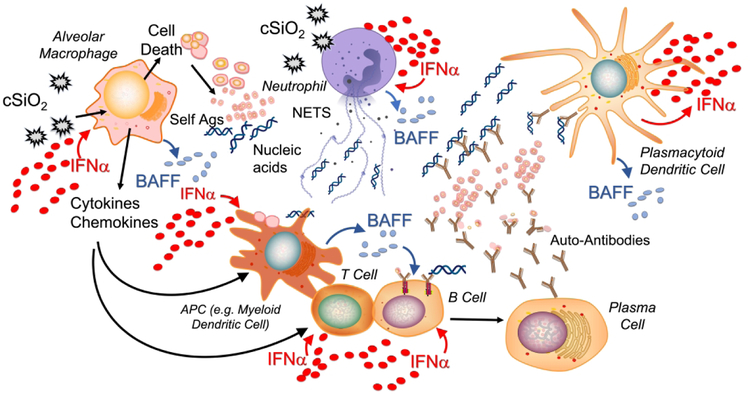
Figure 1:
Figure 1:. Putative role for type 1 IFN in cSiO2-induced lupus.
When inhaled, cSiO2 induces cell death in multiple cell types present in the lung (e.g. neutrophils and macrophages) leading to the extracellular release of host nucleic acids. cSiO2 also stimulates release of neutrophil extracellular traps (NETs) which contribute to the accumulation of extracellular DNA. Extracellular nucleic acids, either viral or innate, induce the release of type I IFN from many immune cell types. In lupus, plasmacytoid dendritic cells (pDCs) are recognized as a primary producer of IFNα, the major type I IFN. Extracellular DNA along with other uncleared cellular debris can be presented by antigen presenting cells, promoting the development of autoreactive B and T cells. This process is enhanced directly by IFNα and by other cytokines and chemokines, such as B-cell activating factor (BAFF), released from immune cells in response to IFNα. Autoreactive plasma cells will produce autoantibodies against host antigens, forming DNA-containing immune complexes that can be recognized by pDCs to further drive this cycle. Adapted from Chasset F & Arnaud L, 2018.
Figure 2:
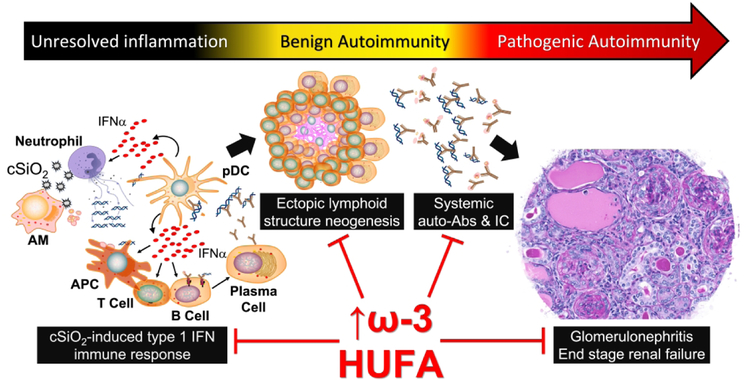
Figure 2:. cSiO2-induced autoimmune pathogenesis is correlated with the omega-3 HUFA score.
The cSiO2-induced type I IFN gene signature promotes ectopic lymphoid structure neogenesis in the lungs, and production of pathogenic autoantibodies which form immune complexes (IC) with host antigens. This culminates in systemic autoimmunity and glomerulonephritis. When mice are fed diets rich in DHA, autoimmune pathogenesis is suppressed. Improved disease status and decreased inflammatory endpoints are associated with an increase in omega-3 HUFAs in the cell phospholipid membrane. Biomarkers that evaluate membrane fatty acids, such as the HUFA score, are crucial to developing omega-3 supplementation strategies to prevent or ameliorate inflammatory and autoimmune disease.

References

    1. Dorner T, Furie R. Novel paradigms in systemic lupus erythematosus. Lancet 2019;393(10188):2344–2358. doi: 10.1016/S0140-6736(19)30546-X - DOI - PubMed
    1. Durcan L, O’Dwyer T, Petri M. Management strategies and future directions for systemic lupus erythematosus in adults. Lancet 2019;393(10188):2332–2343. doi: 10.1016/S0140-6736(19)30237-5 - DOI - PubMed
    1. Parks CG, Miller FW, Pollard KM, et al. Expert panel workshop consensus statement on the role of the environment in the development of autoimmune disease. Int J Mol Sci 2014;15(8):14269–14297. doi: 10.3390/ijms150814269 - DOI - PMC - PubMed
    1. Charoenwoodhipong P, Harlow SD, Marder W, et al. Dietary omega polyunsaturated fatty acid intake and patient-reported outcomes in systemic lupus erythematosus: The Michigan Lupus Epidemiology & Surveillance (MILES) Program. Arthritis Care & Research 0(ja). doi: 10.1002/acr.23925 - DOI - PMC - PubMed
    1. Parks CG, Cooper GS, Nylander-French LA, et al. Occupational exposure to crystalline silica and risk of systemic lupus erythematosus: a population-based, case-control study in the southeastern United States. Arthritis Rheum 2002;46(7):1840–1850. doi: 10.1002/art.10368 - DOI - PubMed

Publication types

MeSH terms