


Predictors of Loss to Follow-Up Among Pediatric and Adult Hematopoietic Cell Transplantation Survivors: A Report from the Center for International Blood and Marrow Transplant Research
- PMID: 31726205
- PMCID: PMC7367505
- DOI: 10.1016/j.bbmt.2019.11.003
Predictors of Loss to Follow-Up Among Pediatric and Adult Hematopoietic Cell Transplantation Survivors: A Report from the Center for International Blood and Marrow Transplant Research
Abstract
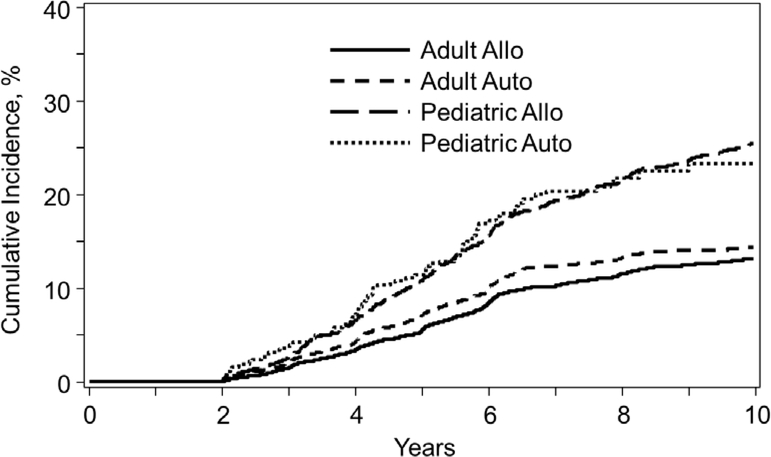
Follow-up is integral for hematopoietic cell transplantation (HCT) care to ensure surveillance and intervention for complications. We characterized the incidence of and predictors for being lost to follow-up. Two-year survivors of first allogeneic HCT (10,367 adults and 3865 children) or autologous HCT (7291 adults and 467 children) for malignant/nonmalignant disorders between 2002 and 2013 reported to the Center for International Blood and Marrow Transplant Research were selected. The cumulative incidence of being lost to follow-up (defined as having missed 2 consecutive follow-up reporting periods) was calculated. Marginal Cox models (adjusted for center effect) were fit to evaluate predictors. The 10-year cumulative incidence of being lost to follow-up was 13% (95% confidence interval [CI], 12% to 14%) in adult allogeneic HCT survivors, 15% (95% CI, 14% to 16%) in adult autologous HCT survivors, 25% (95% CI, 24% to 27%) in pediatric allogeneic HCT survivors, and 24% (95% CI, 20% to 29%) in pediatric autologous HCT survivors. Factors associated with being lost to follow-up include younger age, nonmalignant disease, public/no insurance (reference: private), residence farther from the tranplantation center, and being unmarried in adult allogeneic HCT survivors; older age and testicular/germ cell tumor (reference: non-Hodgkin lymphoma) in adult autologous HCT survivors; older age, public/no insurance (reference: private), and nonmalignant disease in pediatric allogeneic HCT survivors; and older age in pediatric autologous HCT survivors. Follow-up focusing on minimizing attrition in high-risk groups is needed to ensure surveillance for late effects.
Keywords: Bone marrow transplantation; Lost to follow-up; Stem cell transplantation; Survivor.
Copyright © 2019 American Society for Transplantation and Cellular Therapy. Published by Elsevier Inc. All rights reserved.
Conflict of interest statement
Conflict of Interest Disclosure
Dr. Ganguly receives support from Seattle Genetics, Kite Phrama, Janssen Pharmaceuticals, and Daiichi Sankyo.
Figures
References
-
- Pasquini MC. Impact of graft-versus-host disease on survival. Best Pract Res Clin Haematol. 2008;21(2):193–204. - PubMed
