


Comment
doi: 10.1038/s41422-019-0253-5.
BAX and BAK become killers without a BH3 trigger
Affiliations
- PMID: 31729467
- PMCID: PMC6951333
- DOI: 10.1038/s41422-019-0253-5
Item in Clipboard
Comment
BAX and BAK become killers without a BH3 trigger
Cell Res.
2019 Dec.
No abstract available
Conflict of interest statement
The author declares no competing interests.
Figures
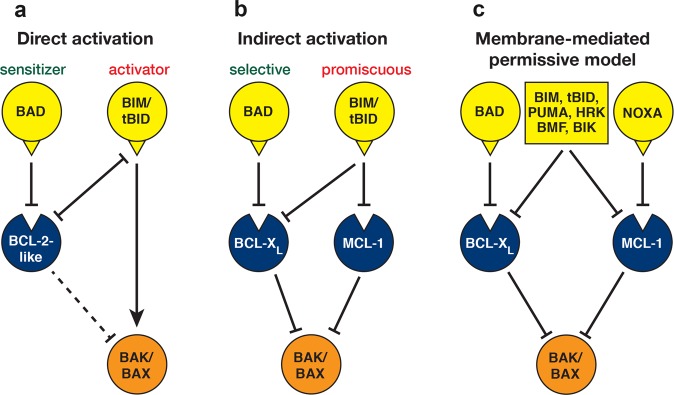
Models for the activation of BAK and BAX to drive apoptosis. a The direct activation model posits that BH3-only proteins are either sensitizers (e.g., BAD), which can only engage and neutralize pro-survival family members, or activators (e.g., BIM and activated BID (tBID)), which can also bind BAX and BAK and trigger their rearrangement into lethal oligomeric forms that damage the MOM and seal commitment to apoptosis. b The indirect activation model suggests that BH3-only proteins can only engage pro-survival family members, but certain ones are more potent because they can bind and neutralize all pro-survival members (are promiscuous), whereas others (like BAD and NOXA) are less potent because they are selective for a subset of pro-survival members. c The membrane-mediated permissive Model is an indirect activation model that emphasizes BCL-XL and MCL-1 as key targets for inactivation by BH3-only proteins to free BAX and BAK for death duty. In this model, once freed from pro-survival restraint, activation of BAX and BAK is autonomous, probably requiring only association with the MOM for BAX
Comment on
-
BH3-only proteins target BCL-xL/MCL-1, not BAX/BAK, to initiate apoptosis.Cell Res. 2019 Nov;29(11):942-952. doi: 10.1038/s41422-019-0231-y. Epub 2019 Sep 24. Cell Res. 2019. PMID: 31551537 Free PMC article.
References
Publication types
MeSH terms
Substances
LinkOut - more resources
Full Text Sources
Research Materials
