Review
. 2019 Oct 25;20(21):5321.
doi: 10.3390/ijms20215321.

Heat Shock Proteins: Dynamic Biomolecules to Counter Plant Biotic and Abiotic Stresses

Affiliations
Review

Heat Shock Proteins: Dynamic Biomolecules to Counter Plant Biotic and Abiotic Stresses

Saeed Ul Haq et al. Int J Mol Sci. .

Abstract

Due to the present scenario of climate change, plants have to evolve strategies to survive and perform under a plethora of biotic and abiotic stresses, which restrict plant productivity. Maintenance of plant protein functional conformation and preventing non-native proteins from aggregation, which leads to metabolic disruption, are of prime importance. Plant heat shock proteins (HSPs), as chaperones, play a pivotal role in conferring biotic and abiotic stress tolerance. Moreover, HSP also enhances membrane stability and detoxifies the reactive oxygen species (ROS) by positively regulating the antioxidant enzymes system. Additionally, it uses ROS as a signal to molecules to induce HSP production. HSP also enhances plant immunity by the accumulation and stability of pathogenesis-related (PR) proteins under various biotic stresses. Thus, to unravel the entire plant defense system, the role of HSPs are discussed with a special focus on plant response to biotic and abiotic stresses, which will be helpful in the development of stress tolerance in plant crops.

Keywords: abiotic stress; biotic stress; chaperone; co-chaperone; heat shock factor; protein folding; stress resistance.


Conflict of interest statement

The authors declare no conflict of interest.

Figures
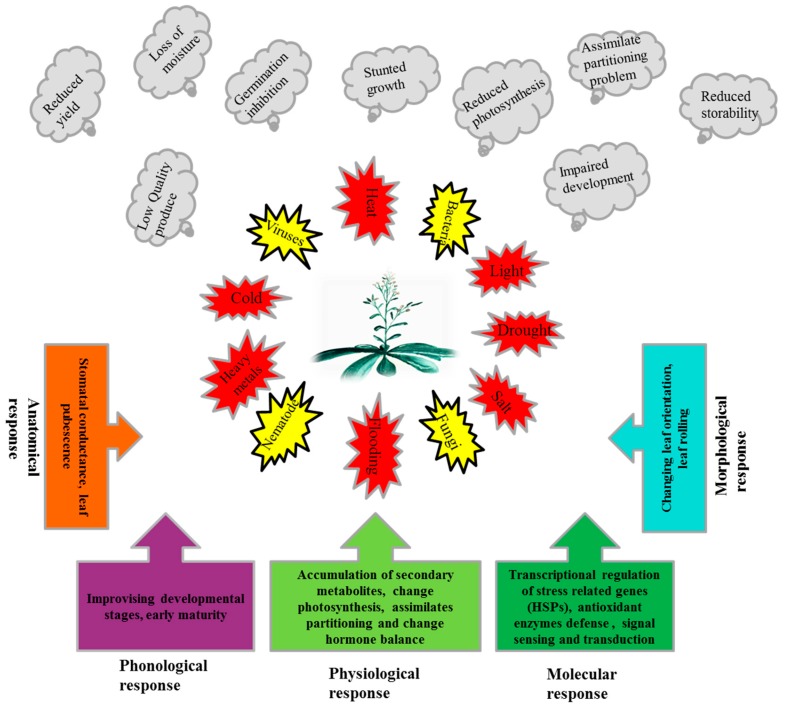
Figure 1
Figure 1
Exposures of plants to different biotic and abiotic stresses, adverse effects of these stresses on plants and response mechanisms of plants to these stresses.
Figure 2
Figure 2
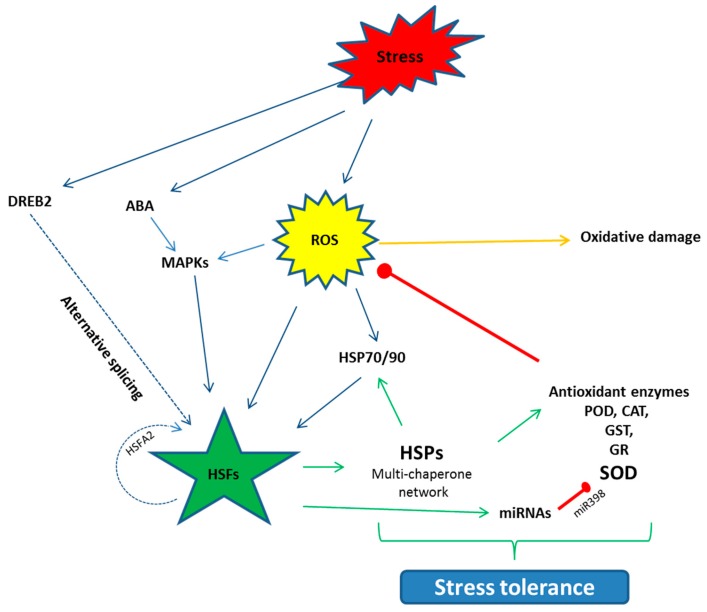
Schematic diagram of the activation of the HSFs and their interaction with the other pathways to counter stress situations. HSFs are activated directly or indirectly through the event of alternative splicing. HSFs further regulate the down-stream HSPs, antioxidant enzyme genes and miRNAs, which help the plants to develop stress tolerance. Arrows denote the positive while red bars stand for negative interaction. ROS (Reactive oxygen species), ABA (Abscisic acid), MAPK (Mitogen-activated Protein Kinase), DREB (Dehydration responsive element binding protein), POD (Peroxidase), CAT (Catalase), GST (Glutathione S transferase), GR (Glutathione reductase), SOD (Superoxide dismutase).
Figure 3
Figure 3
Schematic presentation of the HSP transcriptional regulation, transport and disposal, under biotic and abiotic stresses. The diagram integrates both positive (Arrows) and negative (Bars) regulatory mechanisms. Biotic and abiotic stresses provoke the HSFs through calcium accumulation, recognition of invading pathogen effector proteins, ROS or misfolding and aggregation of cell proteins, which results in activation of HSP and other stress responsive proteins. ROS (Reactive oxygen species), PLD (Phospholipase D), MAPK (Mitogen-activated protein kinase), CDPK (Calcium-dependent protein kinase), HSF (Heat shock factor), CBF (C-repeat binding factor), DREB (Dehydration response element binding protein), ABRE (Abscisic acid-responsive element), MYB (Myeloblastosis), HSP (Heat shock protein), RLKs (Receptor-like kinases), RLP (Receptor-like proteins), PAMP (Pathogenesis-associated molecular pattern), PTI (Pattern-triggered immunity), ETI (Effector-triggered immunity) NLR (Node-like receptor protein), GST (Glutathione-s-transferase), APX2(Ascorbate peroxidase 2).

References

    1. Mittler R. Abiotic Stress, the Field Environment and Stress Combination. Trends Plant Sci. 2006;11:15–19. doi: 10.1016/j.tplants.2005.11.002. - DOI - PubMed
    1. Swindell W.R., Huebner M., Weber A.P. Transcriptional Profiling of Arabidopsis Heat Shock Proteins and Transcription Factors Reveals Extensive Overlap Between Heat and Non-Heat Stress Response Pathways. BMC Genom. 2007;8:125. doi: 10.1186/1471-2164-8-125. - DOI - PMC - PubMed
    1. Al-Whaibi M.H. Plant Heat-Shock Proteins: A Mini Review. J. King Saud Univ. Sci. 2011;23:139–150. doi: 10.1016/j.jksus.2010.06.022. - DOI
    1. Guo M., Liu J., Ma X., Luo D., Gong Z., Lu M. The Plant Heat Stress Transcription Factors (HSFs): Structure, Regulation, and Function in Response to Abiotic Stresses. Front. Plant Sci. 2016;7:114. doi: 10.3389/fpls.2016.00114. - DOI - PMC - PubMed
    1. Xu Y., Zhan C., Huang B. Heat Shock Proteins in Association with Heat Tolerance in Grasses. Int. J. Proteom. 2011;2011:529648. doi: 10.1155/2011/529648. - DOI - PMC - PubMed