


Improvements in Glycemic, Micronutrient, and Mineral Indices in Arab Adults with Pre-Diabetes Post-Lifestyle Modification Program
- PMID: 31731609
- PMCID: PMC6893589
- DOI: 10.3390/nu11112775
Improvements in Glycemic, Micronutrient, and Mineral Indices in Arab Adults with Pre-Diabetes Post-Lifestyle Modification Program
Abstract
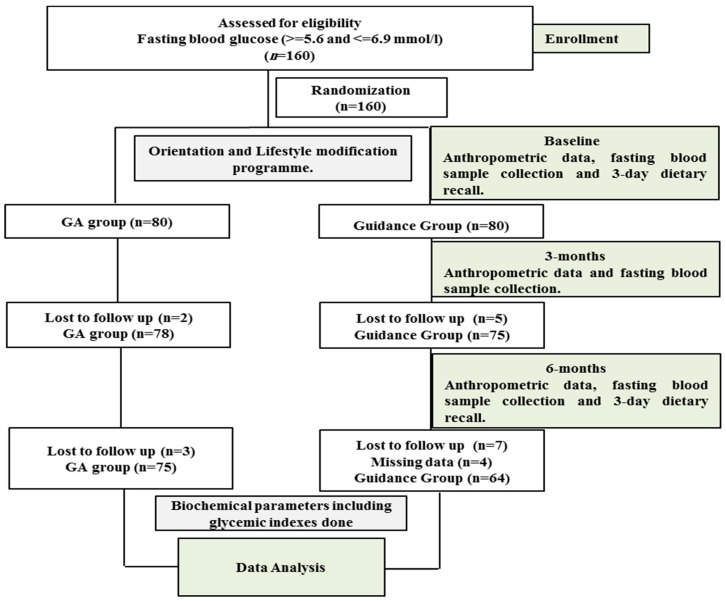
The present study aimed to investigate the changes in dietary patterns of adult Saudis with prediabetes who underwent a six-month lifestyle modification program. A total of 160 Saudis with prediabetes (baseline fasting glucose 5.6-6.9 mmol/L), aged 20-60 years, were enrolled in one of the two arms: A one-time general advice about lifestyle modification (GA group) at orientation or a well-structured and monitored nutrition and lifestyle counseling for six months (guidance group). Fasting blood samples and a dietary recall for daily intakes of macro/micronutrients using a validated computerized food database "ESHA-the Food Processor Nutrition Analysis program" were collected pre- and post-intervention. Compliance to reference daily intake (RDI) was also calculated at both time points. At baseline, overall, severe deficiencies in the majority of micronutrient intakes were observed. Post intervention, clinically significant improvements in the glycemic indices (fasting glucose and insulin resistance) were seen over time in the guidance group. Also, significant improvements in dietary habits and physical activity levels were more apparent in the guidance group than the GA group, particularly in the daily intakes of total carbohydrate (46.9% compliance post vs. 20.3% at baseline); dietary fiber (21.9% vs. 3.1%); and some micronutrients like vitamin B6 (21.3% vs. 6.7%), vitamin B12 (45.3% vs. 28%), vitamin C (21.9% vs. 7.8%), riboflavin (40% vs. 10.7%), niacin (41.3% vs. 14.7%), magnesium (18.8% vs. 4.7%), iron (54.7% vs. 34.4%), and copper (37.3% vs. 13.3%). The study highlights the effects of a six-month lifestyle modification program in improving dietary micronutrient intakes of Saudis with prediabetes. Since micronutrient intake was observed to be low, fortification of these micronutrients in the Saudi diet is recommended.
Keywords: lifestyle modification; micronutrients; minerals; nutrition guidance; pre-diabetes; recommended dietary intakes.
Conflict of interest statement
The authors declare no conflict of interest. The funders had no role in the design of the study; in the collection, analyses, or interpretation of data; in the writing of the manuscript, or in the decision to publish the results.
Figures
References
-
- Ogurtsova K., da Rocha Fernandes J.D., Huang Y., Linnenkamp U., Guariguata L., Cho N.H., Cavan D., Shaw J.E., Makaroff L.E. IDF Diabetes Atlas: Global estimates for the prevalence of diabetes for 2015 and 2040. Diabetes Res. Clin. Pract. 2017;128:40–50. doi: 10.1016/j.diabres.2017.03.024. - DOI - PubMed
-
- Kahn R. American Diabetes Association. Diagnosis and classification of diabetes mellitus. Diabetes Care. 2014;37:S81–S90. - PubMed
-
- The Lancet Prediabetes and the potential to prevent diabetes. [(accessed on 1 January 2019)];Lancet. 2012 379:2213. doi: 10.1016/S0140-6736(12)60960-X. Available online: http://www.thelancet.com/journals/lancet/article/PIIS0140-6736%2812%2960.... - DOI - PubMed
Publication types
MeSH terms
Substances
Grants and funding
LinkOut - more resources
Full Text Sources
Medical
