


Diagnosis of Feline Infectious Peritonitis: A Review of the Current Literature
- PMID: 31731711
- PMCID: PMC6893704
- DOI: 10.3390/v11111068
Diagnosis of Feline Infectious Peritonitis: A Review of the Current Literature
Abstract
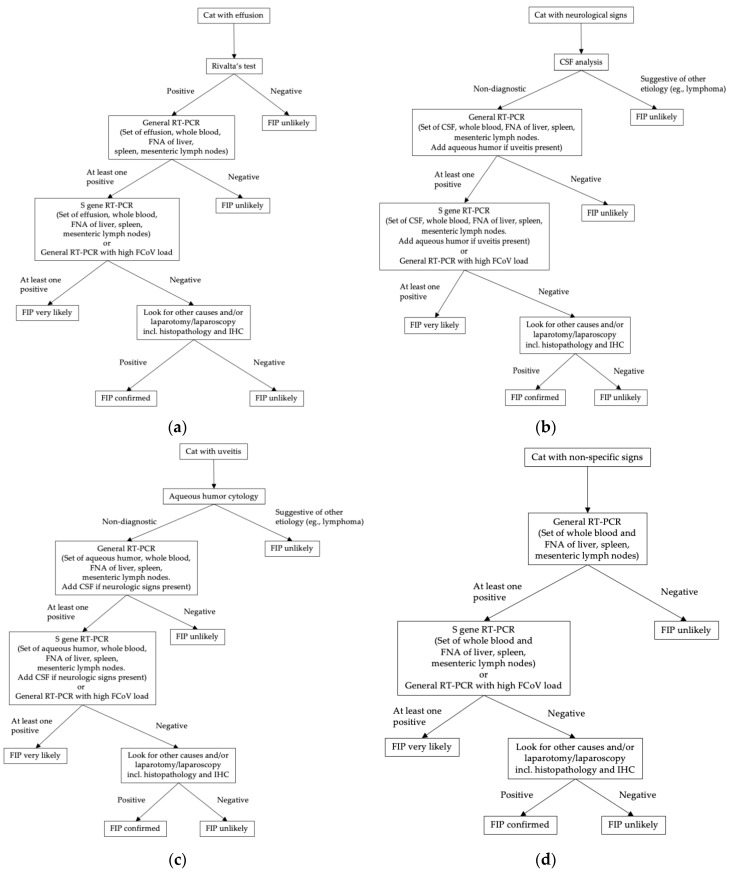
Feline infectious peritonitis (FIP) is a fatal disease that poses several challenges for veterinarians: clinical signs and laboratory changes are non-specific, and there are two pathotypes of the etiologic agent feline coronavirus (FCoV), sometimes referred to as feline enteric coronavirus (FECV) and feline infectious peritonitis virus (FIPV) that vary fundamentally in their virulence, but are indistinguishable by a number of diagnostic methods. This review focuses on all important steps every veterinary practitioner has to deal with and new diagnostic tests that can be considered when encountering a cat with suspected FIP with the aim to establish a definitive diagnosis. It gives an overview on all available direct and indirect diagnostic tests and their sensitivity and specificity reported in the literature in different sample material. By providing summarized data for sensitivity and specificity of each diagnostic test and each sample material, which can easily be accessed in tables, this review can help to facilitate the interpretation of different diagnostic tests and raise awareness of their advantages and limitations. Additionally, diagnostic trees depict recommended diagnostic steps that should be performed in cats suspected of having FIP based on their clinical signs or clinicopathologic abnormalities. These steps can easily be followed in clinical practice.
Keywords: FIP; ICC; IHC; RT-PCR; antibody; diagnosis; immunocytochemistry; immunohistochemistry.
Conflict of interest statement
Katrin Hartmann has given talks for MSD, Merial, Boehringer Ingelheim and Idexx. She participated in research funded by or using products from MSD, Merial, Boehringer, Zoetis, Megacor, Biogal and Scil. There is no commercial conflict of interest as the information generated here is solely for scientific dissemination. The authors declare that they have no competing interests.
Figures
Similar articles
-
Sensitivity and specificity of a real-time reverse transcriptase polymerase chain reaction detecting feline coronavirus mutations in effusion and serum/plasma of cats to diagnose feline infectious peritonitis.BMC Vet Res. 2017 Aug 2;13(1):228. doi: 10.1186/s12917-017-1147-8. BMC Vet Res. 2017. PMID: 28768514 Free PMC article.
-
Establishment of Full-Length cDNA Clones and an Efficient Oral Infection Model for Feline Coronavirus in Cats.J Virol. 2021 Oct 13;95(21):e0074521. doi: 10.1128/JVI.00745-21. Epub 2021 Aug 18. J Virol. 2021. PMID: 34406859 Free PMC article.
-
Detection of feline coronavirus RNA, spike gene mutations, and feline coronavirus antigen in macrophages in aqueous humor of cats in the diagnosis of feline infectious peritonitis.J Vet Diagn Invest. 2020 Jul;32(4):527-534. doi: 10.1177/1040638720927362. Epub 2020 Jun 9. J Vet Diagn Invest. 2020. PMID: 32517543 Free PMC article.
-
2022 AAFP/EveryCat Feline Infectious Peritonitis Diagnosis Guidelines.J Feline Med Surg. 2022 Sep;24(9):905-933. doi: 10.1177/1098612X221118761. J Feline Med Surg. 2022. PMID: 36002137 Free PMC article. Review.
-
Feline coronavirus in multicat environments.Vet Clin North Am Small Anim Pract. 2011 Nov;41(6):1133-69. doi: 10.1016/j.cvsm.2011.08.004. Vet Clin North Am Small Anim Pract. 2011. PMID: 22041208 Free PMC article. Review.
Cited by
-
An updated review of feline coronavirus: mind the two biotypes.Virus Res. 2023 Mar;326:199059. doi: 10.1016/j.virusres.2023.199059. Epub 2023 Feb 2. Virus Res. 2023. PMID: 36731629 Free PMC article. Review.
-
Use of selected samples to diagnose a tricky feline viral disease in a cat with uveitis and neurological signs.Braz J Vet Med. 2023 Jul 24;45:e001223. doi: 10.29374/2527-2179.bjvm001223. eCollection 2023. Braz J Vet Med. 2023. PMID: 37521360 Free PMC article.
-
Detection of Feline Coronavirus RNA in Cats with Feline Infectious Peritonitis and Their Housemates.Viruses. 2025 Jul 4;17(7):948. doi: 10.3390/v17070948. Viruses. 2025. PMID: 40733565 Free PMC article.
-
Feline infectious peritonitis virus-associated rhinitis in a cat.JFMS Open Rep. 2020 Jun 23;6(1):2055116920930582. doi: 10.1177/2055116920930582. eCollection 2020 Jan-Jun. JFMS Open Rep. 2020. PMID: 32637147 Free PMC article.
-
Development of a New Indirect ELISA Test for the Detection of Anti-Feline Coronavirus Antibodies in Cats.Vet Sci. 2025 Mar 4;12(3):245. doi: 10.3390/vetsci12030245. Vet Sci. 2025. PMID: 40266922 Free PMC article.
References
-
- Pedersen N.C., Boyle J.F., Floyd K. Infection studies in kittens, using feline infectious peritonitis virus propagated in cell culture. Am. J. Vet. Res. 1981;42:363–367. - PubMed
Publication types
MeSH terms
Substances
LinkOut - more resources
Full Text Sources
Miscellaneous
