


A Complex Dance: Measuring the Multidimensional Worlds of Influenza Virus Evolution and Anti-Influenza Immune Responses
- PMID: 31731815
- PMCID: PMC6963821
- DOI: 10.3390/pathogens8040238
A Complex Dance: Measuring the Multidimensional Worlds of Influenza Virus Evolution and Anti-Influenza Immune Responses
Abstract
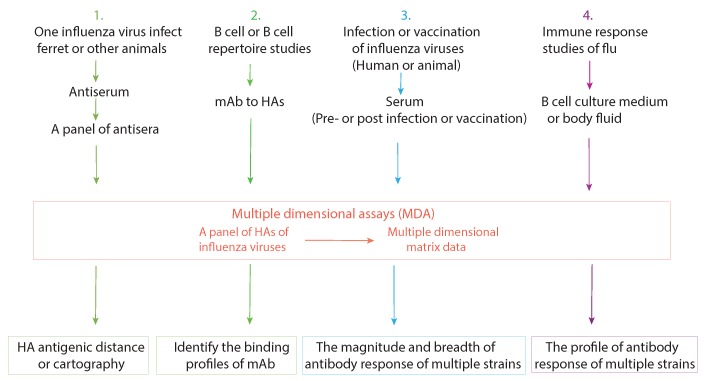
The human antibody response to influenza virus infection or vaccination is as complicated as it is essential for protection against flu. The constant antigenic changes of the virus to escape human herd immunity hinder the yearly selection of vaccine strains since it is hard to predict which virus strains will circulate for the coming flu season. A "universal" influenza vaccine that could induce broad cross-influenza subtype protection would help to address this issue. However, the human antibody response is intricate and often obscure, with factors such as antigenic seniority or original antigenic sin (OAS), and back-boosting ensuring that each person mounts a unique immune response to infection or vaccination with any new influenza virus strain. Notably, the effects of existing antibodies on cross-protective immunity after repeated vaccinations are unclear. More research is needed to characterize the mechanisms at play, but traditional assays such as hemagglutinin inhibition (HAI) and microneutralization (MN) are excessively limited in scope and too resource-intensive to effectively meet this challenge. In the past ten years, new multiple dimensional assays (MDAs) have been developed to help overcome these problems by simultaneously measuring antibodies against a large panel of influenza hemagglutinin (HA) proteins with a minimal amount of sample in a high throughput way. MDAs will likely be a powerful tool for accelerating the study of the humoral immune response to influenza vaccination and the development of a universal influenza vaccine.
Keywords: broad neutralizing antibody(bnAb); hemagglutinin (HA) of influenza virus; heterosubtypic immunity of influenza; humoral response; influenza virus; mPLEX-Flu assay; multiple dimensional assay (MDA); original antigenic sin “OAS”; protein microarray assay; “universal” influenza vaccine.
Conflict of interest statement
All authors declare no conflict of interest.
Figures

References
-
- Iuliano A.D., Roguski K.M., Chang H.H., Muscatello D.J., Palekar R., Tempia S., Cohen C., Gran J.M., Schanzer D., Cowling B.J., et al. Estimates of global seasonal influenza-associated respiratory mortality: A modelling study. Lancet. 2018;391:1285–1300. doi: 10.1016/S0140-6736(17)33293-2. - DOI - PMC - PubMed
-
- Koel B.F., Burke D.F., Bestebroer T.M., Van Der Vliet S., Zondag G.C.M., Vervaet G., Skepner E., Lewis N.S., Spronken M.I.J., Russell C.A., et al. Substitutions Near the Receptor Binding Site Determine Major Antigenic Change During Influenza Virus Evolution. Science. 2013;342:976–979. doi: 10.1126/science.1244730. - DOI - PubMed
Publication types
Grants and funding
LinkOut - more resources
Full Text Sources
Miscellaneous
