


The use of human papillomavirus DNA methylation in cervical intraepithelial neoplasia: A systematic review and meta-analysis
- PMID: 31732479
- PMCID: PMC6921230
- DOI: 10.1016/j.ebiom.2019.10.053
The use of human papillomavirus DNA methylation in cervical intraepithelial neoplasia: A systematic review and meta-analysis
Abstract
Background: Methylation of viral DNA has been proposed as a novel biomarker for triage of human papillomavirus (HPV) positive women at screening. This systematic review and meta-analysis aims to assess how methylation levels change with disease severity and to determine diagnostic test accuracy (DTA) in detecting high-grade cervical intra-epithelial neoplasia (CIN).
Methods: We performed searches in MEDLINE, EMBASE and CENTRAL from inception to October 2019. Studies were eligible if they explored HPV methylation levels in HPV positive women. Data were extracted in duplicate and requested from authors where necessary. Random-effects models and a bivariate mixed-effects binary regression model were applied to determine pooled effect estimates.
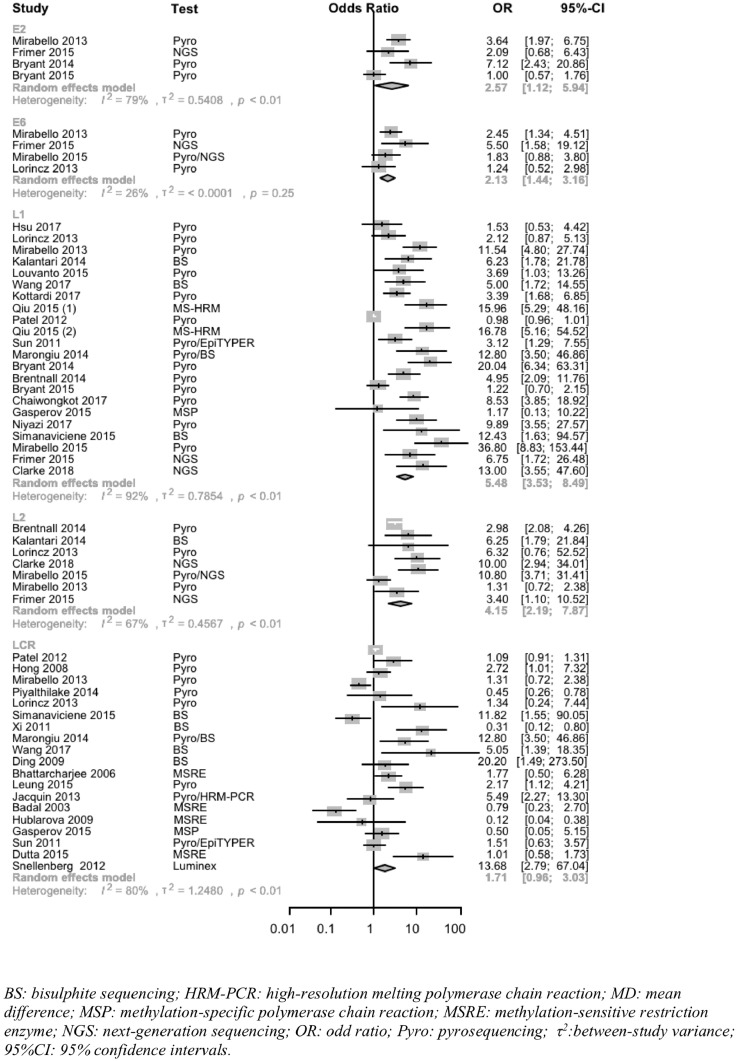
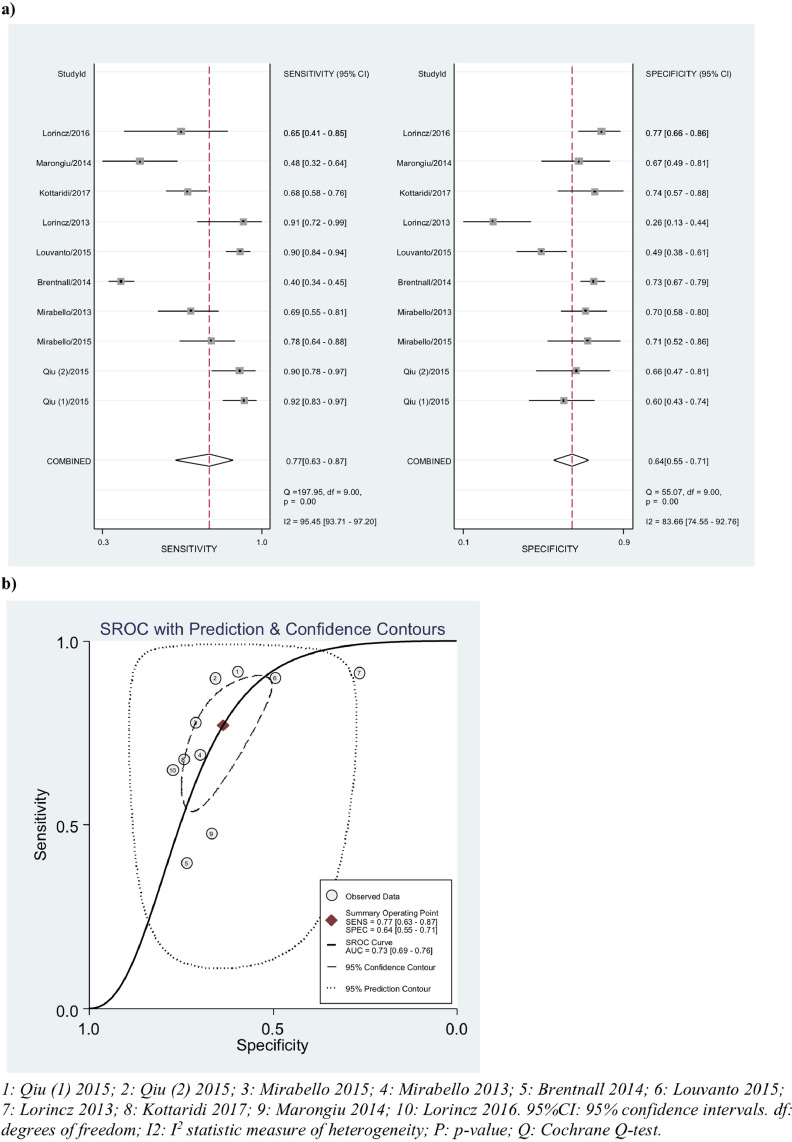
Findings: 44 studies with 8819 high-risk HPV positive women were eligible. The pooled estimates for positive methylation rate in HPV16 L1 gene were higher for high-grade CIN (≥CIN2/high-grade squamous intra-epithelial lesion (HSIL) (95% confidence interval (95%CI:72·7% (47·8-92·2))) vs. low-grade CIN (≤CIN1/low-grade squamous intra-epithelial lesion (LSIL) (44·4% (95%CI:16·0-74·1))). Pooled difference in mean methylation level was significantly higher in ≥CIN2/HSIL vs. ≤CIN1/LSIL for HPV16 L1 (11·3% (95%CI:6·5-16·1)). Pooled odds ratio of HPV16 L1 methylation was 5·5 (95%CI:3·5-8·5) for ≥CIN2/HSIL vs. ≤CIN1/LSIL (p < 0·0001). HPV16 L1/L2 genes performed best in predicting CIN2 or worse (pooled sensitivity 77% (95%CI:63-87), specificity 64% (95%CI:55-71), area under the curve (0·73 (95%CI:0·69-0·77)).
Interpretation: Higher HPV methylation is associated with increased disease severity, whilst HPV16 L1/L2 genes demonstrated high diagnostic accuracy to detect high-grade CIN in HPV16 positive women. Direct clinical use is limited by the need for a multi-genotype and standardised assays. Next-generation multiplex HPV sequencing assays are under development and allow potential for rapid, automated and low-cost methylation testing.
Funding: NIHR, Genesis Research Trust, Imperial Healthcare Charity, Wellcome Trust NIHR Imperial BRC, European Union's Horizon 2020.
Keywords: Cervical intraepithelial neoplasia; Cervical screening; DNA methylation; Human papillomavirus; Meta-analysis.
Copyright © 2019. Published by Elsevier B.V.
Conflict of interest statement
No conflicts to declare.
Figures
References
-
- Bosch F.X., de Sanjose S. Chapter 1: Human papillomavirus and cervical cancer-burden and assessment of causality. J Natl Cancer Inst Monogr. 2003;(31):3–13. - PubMed
-
- Ho G.Y., Bierman R., Beardsley L., Chang C.J., Burk R.D. Natural history of cervicovaginal papillomavirus infection in young women. N Engl J Med. 1998;338(7):423–428. - PubMed
-
- Ronco G., Dillner J., Elfstrom K.M. Efficacy of HPV-based screening for prevention of invasive cervical cancer: follow-up of four European randomised controlled trials. Lancet. 2014;383(9916):524–532. - PubMed
-
- Arbyn M., Ronco G., Anttila A. Evidence regarding human papillomavirus testing in secondary prevention of cervical cancer. Vaccine. 2012;30(Suppl 5):F88–F99. - PubMed
-
- Cuzick J., Clavel C., Petry K.U. Overview of the European and North American studies on HPV testing in primary cervical cancer screening. Int J Cancer. 2006;119(5):1095–1101. - PubMed
Publication types
MeSH terms
Substances
Grants and funding
LinkOut - more resources
Full Text Sources
