. 2019 Dec;14(12):3303-3332.
doi: 10.1038/s41596-019-0220-0. Epub 2019 Nov 15.

Derivation of self-renewing lung alveolar epithelial type II cells from human pluripotent stem cells

Affiliations

Derivation of self-renewing lung alveolar epithelial type II cells from human pluripotent stem cells

Anjali Jacob et al. Nat Protoc. 2019 Dec.

Abstract

Alveolar epithelial type II cells (AEC2s) are the facultative progenitors of lung alveoli and serve as the surfactant-producing cells of air-breathing organisms. Although primary human AEC2s are difficult to maintain stably in cell cultures, recent advances have facilitated the derivation of AEC2-like cells from human pluripotent stem cells (hPSCs) in vitro. Here, we provide a detailed protocol for the directed differentiation of hPSCs into self-renewing AEC2-like cells that can be maintained for up to 1 year in culture as epithelial-only spheres without the need for supporting mesenchymal feeder cells. The month-long protocol requires recapitulation of the sequence of milestones associated with in vivo development of the distal lung, beginning with differentiation of cells into anterior foregut endoderm, which is followed by their lineage specification into NKX2-1+ lung progenitors and then distal/alveolar differentiation to produce progeny that express transcripts and possess functional properties associated with AEC2s.


Conflict of interest statement

Competing interests

The authors declare no competing interests.

Figures
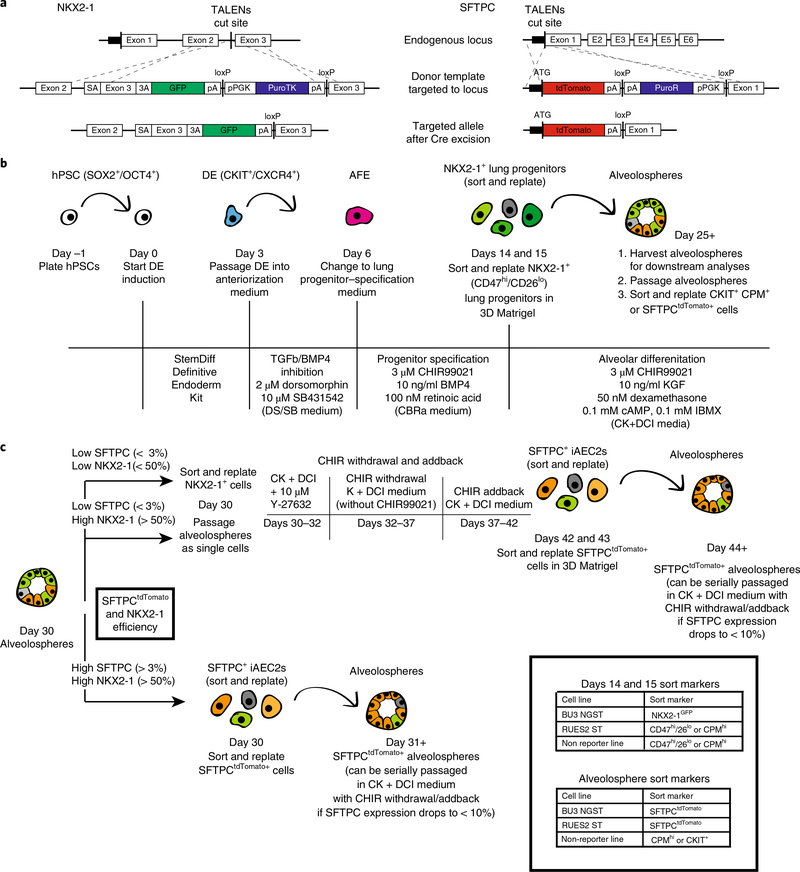
Fig. 1 |
Fig. 1 |. Overview of PSC-derived alveolosphere differentiation protocol.
a, TALENs targeting strategy and edited NKX2–1GFP and SFTPCtdTomato loci after Cre-mediated antibiotic cassette excision. a adapted with permission from ref. , Elsevier. b, Schematic of differentiation protocol with arrows representing steps involving passaging or sorting. Markers for intermediate cell types are noted where relevant. Media components and concentrations are listed for each respective part of the protocol. c, Schematic of options for post day 30 culture of alveolospheres with recommended sort markers for days 14, 15 and 30+ cells. 3A, 3′ acceptor site; AFE, anterior foregut endoderm; ATG, ATG translation start site; DE, definitive endoderm; E, exon; hPSC, human pluripotent stem cell; pA, poly A; pPGK, phosphoglycerate kinase I promoter; puroTK, puromycin and thymidine kinase cassette; PuroR, puromycin resistance gene; SA, splice acceptor; TALEN, transcription activator-like effector nuclease.
Fig. 2 |
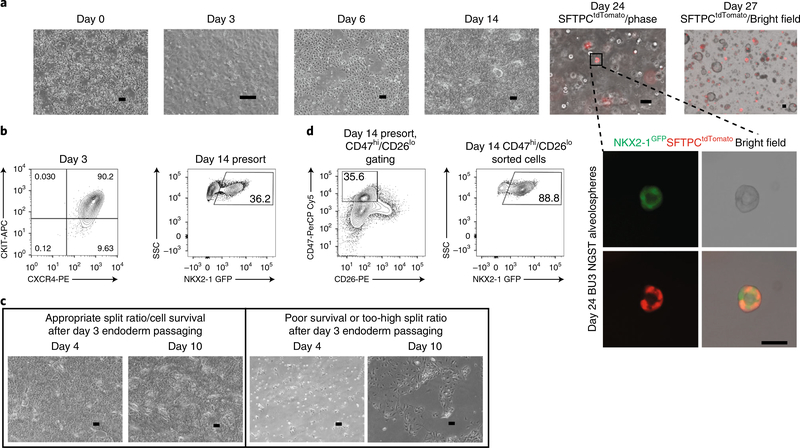
Fig. 2 |. Representative images and flow cytometric profiles throughout PSC-derived alveolosphere differentiation protocol.
a, Representative phase-contrast (phase) images of cells at various days of differentiation, including day 0 (24 h after plating PSCs), day 3 (definitive endoderm), day 6 (anterior foregut endoderm), day 14 (NKX2–1+ lung progenitors), and days 24 and 27 (alveolospheres). Scale bars, 200 μm. Inset, higher-magnification image of alveolosphere from day 24 shows expression of NKX2–1GFP (green) and SFTPCtdTomato (red). Scale bar, 50 μm. b, Representative day 3 endoderm and day 14 presort flow cytometry. c, Left panels show morphology of cells from days 4 to 10 with good cell survival and appropriate passaging density on day 3 of differentiation, whereas right panels show morphology from days 4 to 10 with either poor cell survival or a too-sparse plating density on day 3. Scale bars, 200 μm. d, Representative flow cytometry gates for either CD47hi/CD26lo (RUES2 ST) or NKX2–1GFP + (BU3 NGST) gating strategies on day 14. APC, allophycocyanin; PE, phycoerythrin.
Fig. 3 |
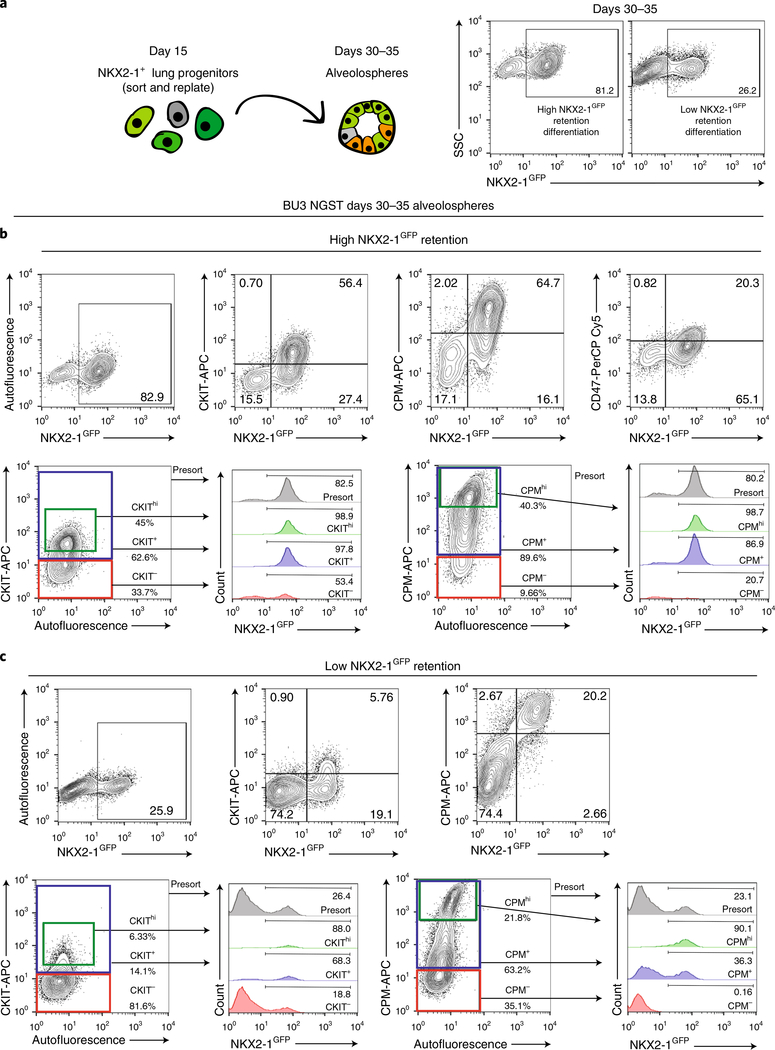
Fig. 3 |. Identification of new cell-surface markers for NKX2–1+ cells.
a, Schematic of sorted day 14 NKX2–1GFP+ lung progenitors analyzed as day 30–35 alveolospheres with flow cytometry representative of two separate differentiations with high versus low NKX2–1GFP retention. b, Top, flow cytometry in a high NKX2–1GFP retention run with coexpression of CKIT and CPM (but not CD47), together with NKX2–1GFP in days 30–35 BU3 NGST alveolospheres. Bottom, suggested sort gates for CPM and CKIT and histograms, showing expression of NKX2–1GFP in cells not gated on the basis of cell-surface markers (Presort), gated for high CPM or CKIT expression (CPMhi or CKIThi), gated for all CPM+ or CKIT+ cells and gated for all CPM or CKIT cells. c, Top, flow cytometry in a low NKX2–1GFP retention run with co-expression of CKIT or CPM together with NKX2–1GFP in days 30–35 alveolospheres. Bottom, suggested sort gates for CPM and CKIT and histograms showing expression of NKX2–1GFP in cells not gated on the basis of cell-surface markers (Presort), gated for high CPM or CKIT expression, gated for all CPM+ or CKIT+ cells, or gated for all CPM or CKIT cells.
Fig. 4 |
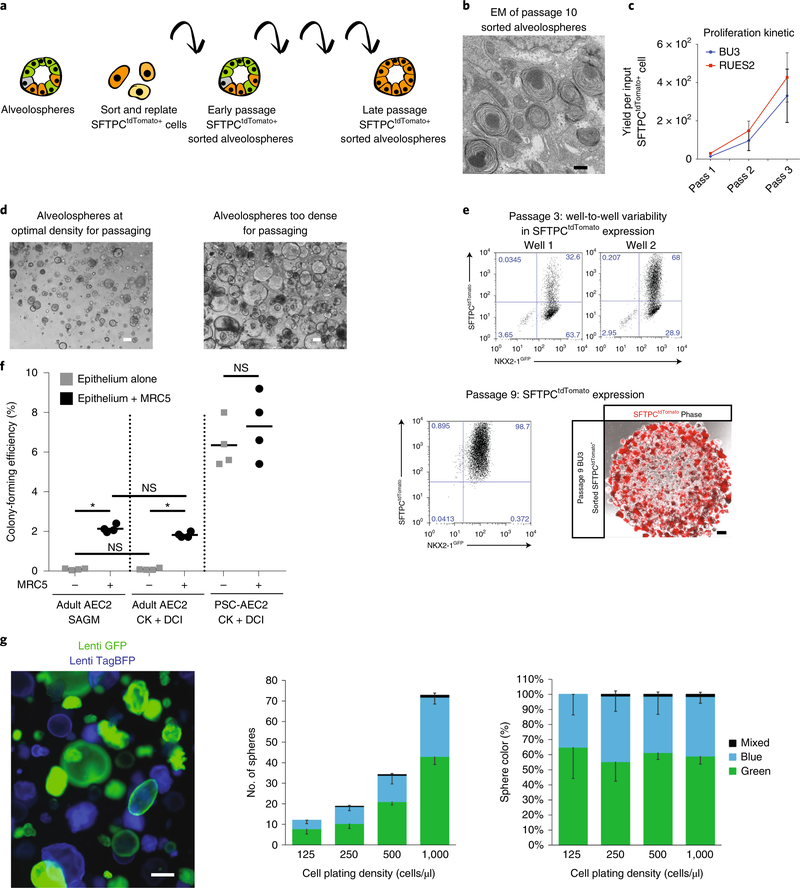
Fig. 4 |. Maintaining alveolospheres in long-term culture.
a, Schematic showing method to sort SFTPCtdTomato cells and passage them sequentially, after which the majority of cells within alveolospheres are SFTPCtdTomato+. b, Electron micrograph of passage 10 alveolospheres shows expression of lamellar body–like inclusions. c, Proliferation kinetic of cell yield per sorted and replated SFTPCtdTomato+ cell in BU3 NGST and RUES2 ST lines over three passages. d, Representative phase-contrast images of alveolospheres at an optimal density for passaging (left) versus too dense for reliable passaging (right). Scale bars, 200 μm. e, Representative flow cytometry of BU3 NGST alveolospheres at passages 3 and 9 after SFTPCtdTomato+ sorting. The percentage of SFTPCtdTomato+ is more variable in early passages (top), although the majority of cells maintain expression of NKX2–1GFP. Representative image of passage 9 alveolospheres expressing SFTPCtdTomato. f, Mean colony-forming efficiency ± s.d., n = 4 biological replicates for RUES2 SFTPCtdTomato+-sorted alveolospheres (~95% SFTPCtdTomato+) and primary adult human AEC2 cells (Adult AEC2) in either SAGM or CK+DCI medium ± MRC5 fibroblast feeder cells. *P ≤ 0.05, ANOVA. g, Assessment of clonality of alveolosphere outgrowth by fluorescent tagging of iAEC2s in separate wells (~day 100) using lentiviral vectors constitutively expressing either TagBFP (blue) or GFP (green). Subsequent mixing of flow cytometry–sorted GFP+ and TagBFP+ iAEC2s at a 1:1 ratio at various densities in 3D Matrigel produces sphere outgrowths that are predominantly monocolored. Photomicrograph represents merged BFP (blue) and GFP (green) channels. Bars represent average sphere numbers and color percentages across five random fields, n = 689 spheres scored, and downward facing error bars represent s.d. for each color; upward error bars represent mixed color scores. Results are representative of two repeated independent experiments on spheres that were >90% SFTPCtdTomato+ at the time of mixing. NS, nonsignificant; Pass, passage; Phase, phase-contrast. Scale bars, 500 nm (b); 100 μm (d); 200 μm (e); 300 μm (g). c, f adapted with permission from ref. , Elsevier.
Fig. 5 |
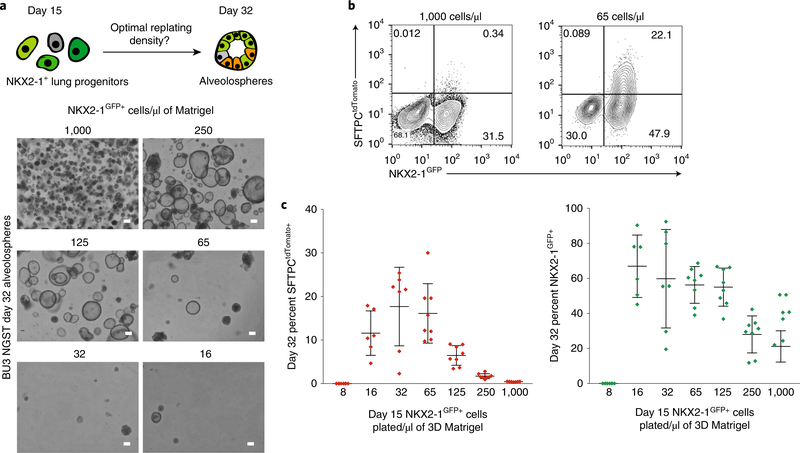
Fig. 5 |. Plating NKX2–1+ cells at lower densities in Matrigel results in improved specification of SFTPCtdTomato+ cells.
a, Schematic of experimental plan and bright-field images of spheres analyzed on day 32 after day 14 NKX2–1+ lung progenitor plating at densities ranging from 8 to 1,000 cells/μl of Matrigel. Scale bars, 200 μm. b, Representative flow cytometry of day 32 alveolospheres originally plated at 1,000 versus 65 cells/μl of Matrigel. c, Graphs show day 32 percentage of SFTPCtdTomato+ and NKX2–1GFP+ cells for each plating density, with error bars showing mean ± s.d.
Fig. 6 |
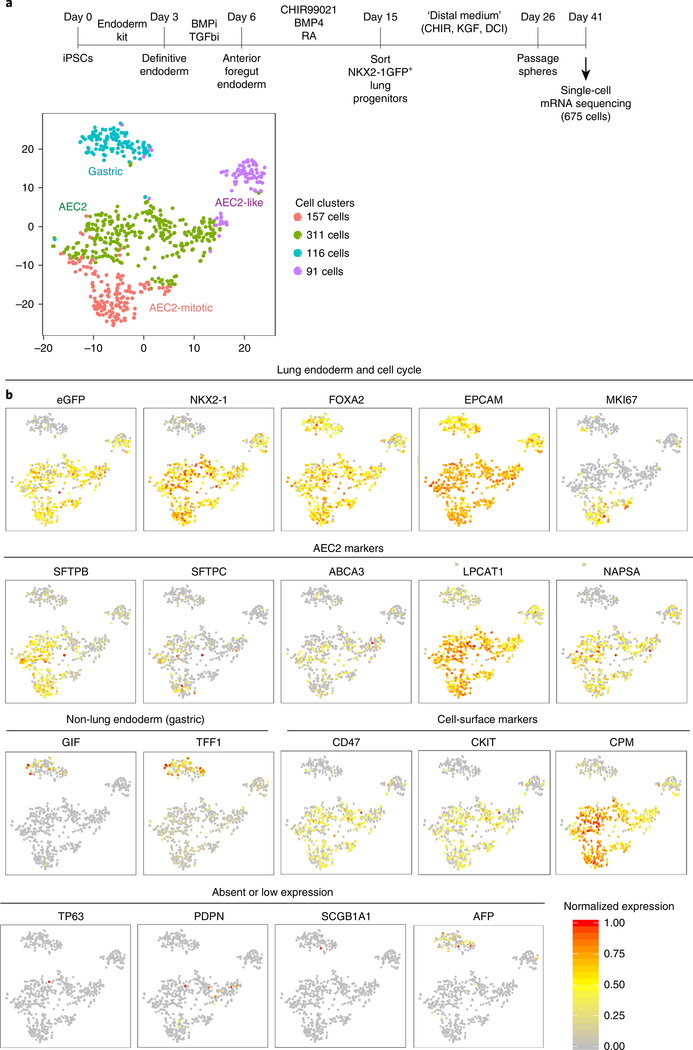
Fig. 6 |. Single-cell sequencing analysis of alveolospheres.
a, Protocol schematic and tSNE plot of 675 cells captured on day 41 of distal differentiation by 10x Genomics platform for single-cell RNA sequencing. Cells were derived from BU3 iPSCs sorted on day 15 of differentiation on the basis of NKX2–1GFP expression and were further differentiated to iAEC2s in ‘distal medium (CK+DCI)’ in 3D Matrigel with a single sphere passage before harvest for computational analysis, as described in McCauley et al.. Cells in ‘distal media (CK+DCI)’ from McCauley et al. have been reanalyzed to generate the tSNE plots and normalized gene expression overlays shown in a and b, whereas cell cluster identities have all been maintained from McCauley et al., where further extensive discussion is available. b, tSNE plots with overlaid normalized expression of indicated marker genes. Datasets are available for download under GEO accession no. GSE103918 or through the bioinformatics portal at www.kottonlab.com. BMPi, inhibition of BMP signaling; RA, retinoic acid; TGFbi, inhibition of TGF signaling.
Fig. 7 |
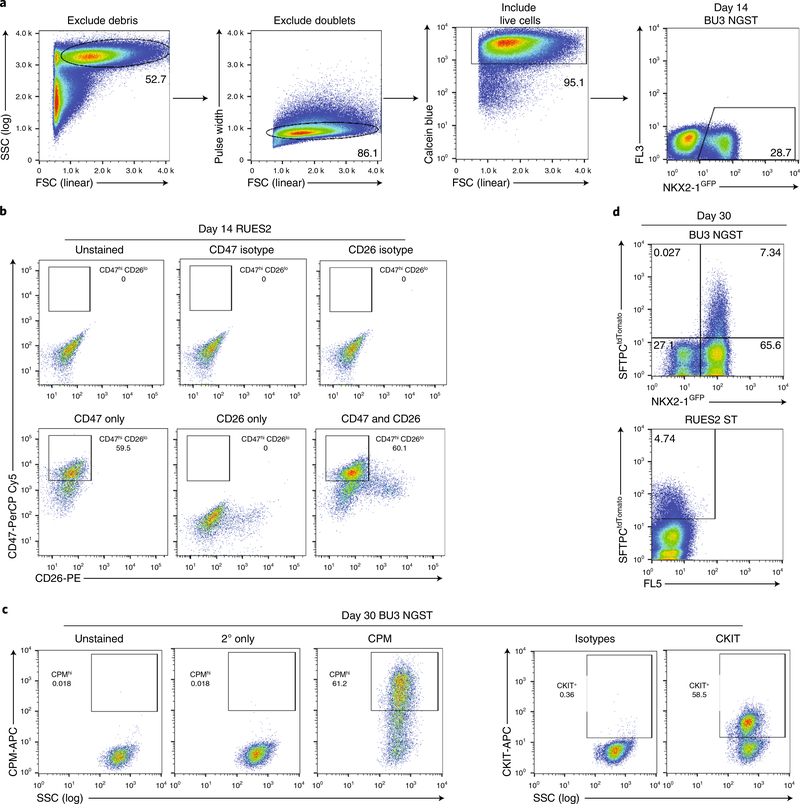
Fig. 7 |. Recommended sorting strategies for day 14 lung progenitors and day 30 alveolospheres.
a, Representative flow cytometry of day 14 cells and sorting gates used to exclude debris (SSC versus FSC), exclude doublets (pulse width versus FSC), include live cells (calcein blue versus FSC), and include NKX2–1GFP+ cells (FL3 versus NKX2–1GFP). b, Representative flow cytometry of day 14 lung progenitor cells already gated using strategy in a with recommended gates for CD47hi/CD26lo cells (RUES2 ST ESC line) with isotype and single-color controls. c, Representative flow cytometry of day 30 alveolospheres stained with CPM or CKIT antibodies with secondary only and isotype controls and recommended sort gates. d, Representative flow cytometry of day 30 alveolospheres already gated using strategy in a with recommended gates for NKX2–1GFP+/SFTPCtdTomato+ cells in BU3 NGST and SFTPCtdTomato+ cells in RUES2 ST. FL3 and FL5, additional fluorescence channels used to measure autofluorescence.

References

    1. Mason RJ & Williams MC Type II alveolar cell. Defender of the alveolus. Am. Rev. Respir. Dis. 115, 81–91 (1977). - PubMed
    1. Whitsett JA, Wert SE & Weaver TE Diseases of pulmonary surfactant homeostasis. Annu. Rev. Pathol. 10, 371–393 (2015). - PMC - PubMed
    1. Jacob A et al. Differentiation of human pluripotent stem cells into functional lung alveolar epithelial cells. Cell Stem Cell 21, 472–488.e10 (2017). - PMC - PubMed
    1. Serra M et al. Pluripotent stem cell differentiation reveals distinct developmental pathways regulating lung-versus thyroid-lineage specification. Development 144, 3879–3893 (2017). - PMC - PubMed
    1. Green MD et al. Generation of anterior foregut endoderm from human embryonic and induced pluripotent stem cells. Nat. Biotechnol. 29, 267–272 (2011). - PMC - PubMed

Publication types