. 2020 Feb 7:486:110076.
doi: 10.1016/j.jtbi.2019.110076. Epub 2019 Nov 13.

The 'breakpoint' of soil-transmitted helminths with infected human migration

Affiliations

The 'breakpoint' of soil-transmitted helminths with infected human migration

Robert J Hardwick et al. J Theor Biol. .

Abstract

Building on past research, we here develop an analytic framework for describing the dynamics of the transmission of soil-transmitted helminth (STH) parasitic infections near the transmission breakpoint and equilibria of endemic infection and disease extinction, while allowing for perturbations in the infectious reservoir of the parasite within a defined location. This perturbation provides a model for the effect of infected human movement between villages with differing degrees of parasite control induced by mass drug administration (MDA). Analysing the dynamical behaviour around the unstable equilibrium, known as the transmission 'breakpoint', we illustrate how slowly-varying the dynamics are and develop an understanding of how discrete 'pulses' in the release of transmission stages (eggs or larvae, depending on the species of STH), due to infected human migration between villages, can lead to perturbations in the deterministic transmission dynamics. Such perturbations are found to have the potential to undermine targets for parasite elimination as a result of MDA and/or improvements in water and sanitation provision. We extend our analysis by developing a simple stochastic model and analytically investigate the uncertainty this induces in the dynamics. Where appropriate, all analytical results are supported by numerical analyses.

Keywords: Control policies; Mathematical models; Monitoring and evaluation; Soil-transmitted helminths; Transmission breakpoints.


Figures

Fig. 1
Fig. 1
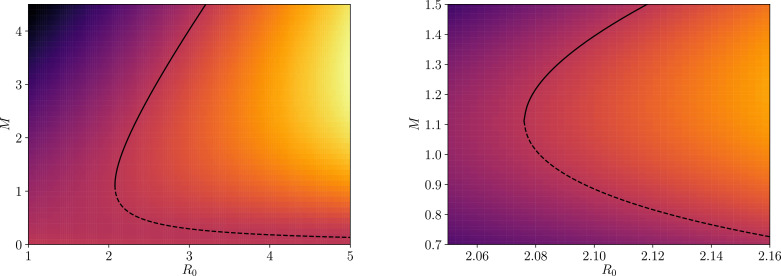
A visualisation of the phase plane generated by Eq. (6) (with k=0.3 and γ=0.08) where black solid and dashed lines correspond to the two branches of equilibrium solution numerically obtained by satisfying Eq. (9). In both panels the heatmap corresponds to the strength and direction of the first derivatives M′(t) (and second, up to a negative constant (μ+μ1)M(t) — see Eq. (8)) computed through Eq. (6) in the vertical direction (lines of constant R0), where lighter colours correspond to strongly positive values (strong forces upwards) and darker colours correspond to strongly negative values (strong forces downwards) — consequently, intermediate colours have the weakest forces in either direction. The right panel is a zoomed version of the left panel with enhanced colour contrast for illustration purposes. The increasing timescales to travel between distances of, e.g., M=[1.01.1,0.91.0,0.830.9] for a fixed value of R0=2.12 are tt0[9.6years,12.9years,23.4years].
Fig. 2
Fig. 2
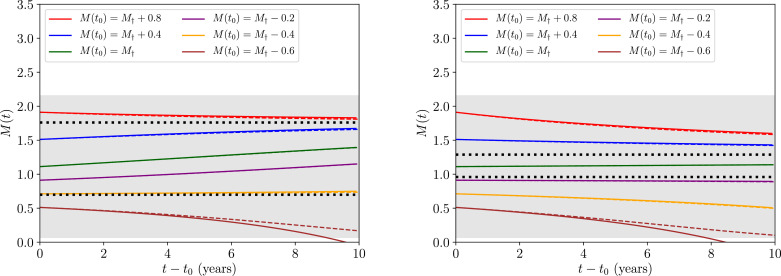
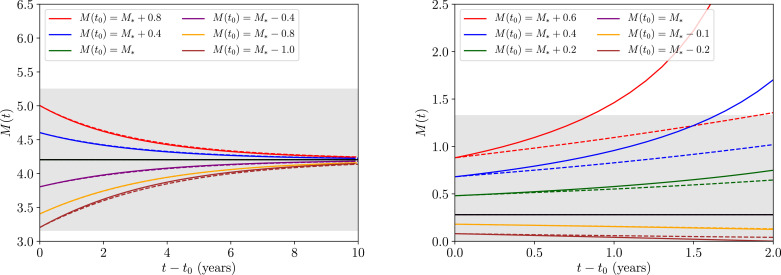
The approximative solution to the transmission dynamics given in Eq. (18) against the full solution to the dynamics obtained numerically by solving the equivalent system with Eqs. (1) and (2), each represented by the coloured solid and dashed lines, respectively, for a range of initial conditions M(t0). In the left panel we have fixed a value of R0=R0(z,k)+0.12.18 and in the right panel with a value of R0=R0(z,k)+0.012.09. The dotted black horizontal lines corresponds to the value of M at the stable (upper) and unstable (lower) equilibria numerically obtained from Eq. (9). Lastly, the grey region corresponds to values for which |MM(z,k)|<1 and hence the expansion used to obtain Eq. (18) leads to good agreement with the full numerical solution.
Fig. 3
Fig. 3
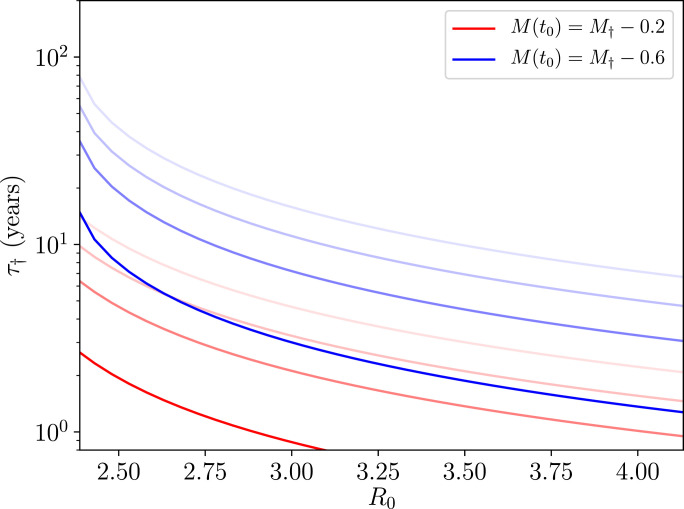
Numerically-obtained values using integral in Eq. (21) to compute the length of time it takes for the transmission dynamics to reach the value of M=M(z,k) for two different initial values of M=M(t0), as shown in the legend. A range of worm death rates have been used of μ1=1/2years1,1/5years1,1/8years1,1/12years1 in decreasing order, which corresponds to a fading colour in the plotted lines.
Fig. 4
Fig. 4
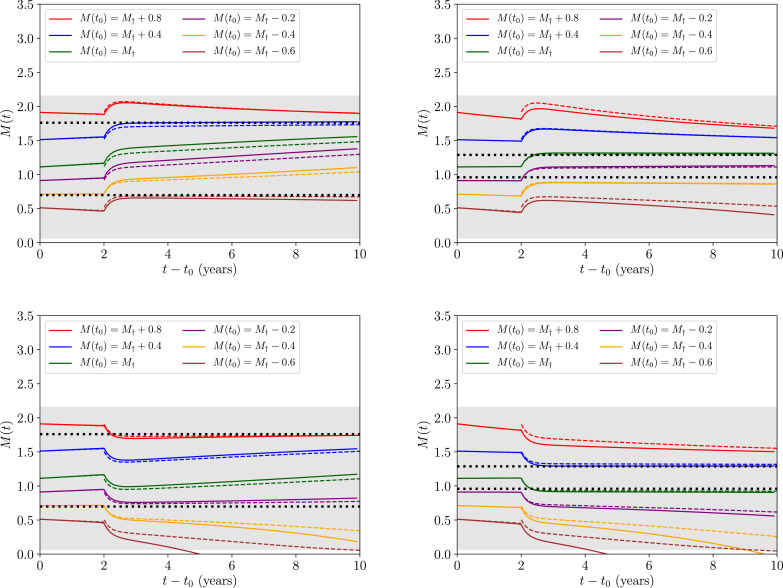
The approximative solution to the transmission dynamics given in Eq. (23) (applied where we have set tpul=2years and Eq. (18) as the solution to the dynamics before this point) against the full solution to the dynamics obtained numerically by solving the equivalent system with Eqs. (1) and (2), each represented by the coloured solid and dashed lines, respectively, for a range of initial conditions M(t0). All lines and the grey region correspond to their equivalent values in Fig. 2, where an additional upper and lower panel split in this set of figures compares the relative dynamical behaviour under the influence of a migration perturbation of βδL(tpul)=+1(1)years1 for the upper (lower) pair of panels.
Fig. 5
Fig. 5
The approximative solution to the transmission dynamics given in Eq. (26) against the full solution to the dynamics obtained numerically by solving the equivalent system with Eqs. (1) and (2), each represented by the coloured solid and dashed lines, respectively, for a range of initial conditions M(t0) and having fixed a value of R0=R0(z,k)+1.03.08. In the left panel we plot the transmission dynamics around the stable equilibrium, and in the right panel we plot the dynamics around the unstable equilibrium. The solid black horizontal line corresponds to the value of M=M*(z,k,R0) at the stable (left panel) and unstable (right panel) equilibrium numerically obtained from Eq. (9). Lastly, the grey region corresponds to values for which |MM*(z,k,R0)|<1.
Fig. 6
Fig. 6
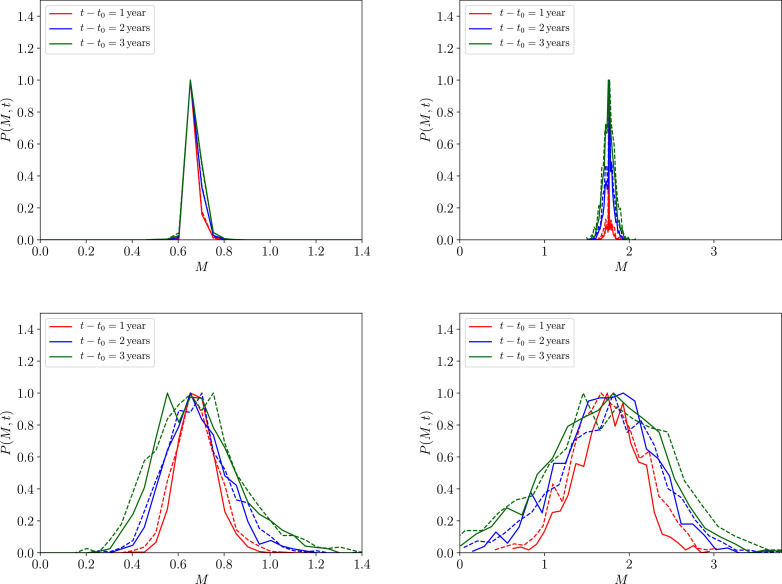
A comparison between the probability distributions P(M, t) at different snaphots in time (denoted by different colours) using r=0.1μ2 (top panels) and r=10μ2 (bottom panels) migration rates, having initialised P(M,t0)=δD(M*M) (where δD is a Dirac delta function) at the unstable (left column) and stable (right column) equilibrium points M*, given a choice of R0=R0(z,k)+0.12.18. The solid lines indicate that the fully non-Markovian process given by Eq. (36) is used, whereas the dashed lines indicate the corresponding choice of approximate Markovian process, given by Eq. (37). The distributions themselves have been numerically obtained by binning 103 realisations of Eq. (40).
Fig. 7
Fig. 7
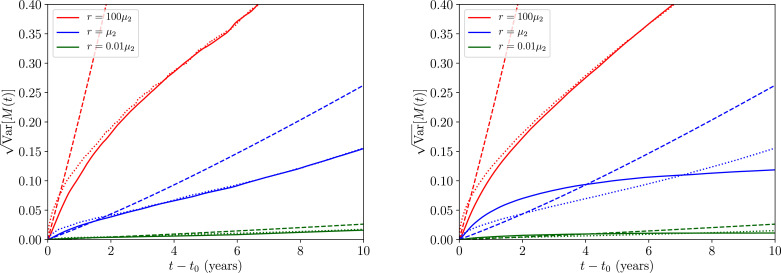
The root-variance over M(t) initialised at the unstable equilibrium M* value (left panel) and at the stable equilibrium M* value (right panel), plotted as a function of time, and numerically obtained by summing over 103 realisations of Eq. (40) using the non-Markovian (solid coloured lines) and Markovian (dotted coloured lines) migration processes given by Eqs. (36) and (37), respectively. The dashed coloured lines correspond to the analytic Markovian solution given in Eq. (41).

References

    1. Accelerating work to overcome the global impact of neglected tropical diseases: a roadmap for implementation: executive summary . 2012. World Health Organization.
    1. Anderson R., Farrell S., Turner H., Walson J., Donnelly C.A., Truscott J. Assessing the interruption of the transmission of human helminths with mass drug administration alone: optimizing the design of cluster randomized trials. Parasites Vectors. 2017;10(1):93. - PMC - PubMed
    1. Anderson R., May R. Dynamics and Control. OUP Oxford; 1992. Infectious diseases of humans: dynamics and control.
    1. Anderson R., Turner H., Farrell S., Yang J., Truscott J. What is required in terms of mass drug administration to interrupt the transmission of schistosome parasites in regions of endemic infection? Parasites Vectors. 2015;8(1):553. - PMC - PubMed
    1. Anderson R.M., May R.M. Vol. 24. Academic Press; 1985. Helminth Infections of Humans: Mathematical Models, Population Dynamics, and Control; pp. 1–101. (Advances in Parasitology). - PubMed

Publication types

LinkOut - more resources