Review
. 2020 Jan;146(1):19-31.
doi: 10.1007/s00432-019-03080-1. Epub 2019 Nov 16.

Hypoxia in solid tumors: a key promoter of cancer stem cell (CSC) resistance

Affiliations
Review

Hypoxia in solid tumors: a key promoter of cancer stem cell (CSC) resistance

Masoud Najafi et al. J Cancer Res Clin Oncol. 2020 Jan.

Abstract

Purpose: Cancer stem cells (CSCs) are highly tumorigenic cell types that reside within specific areas of tumor microenvironment (TME), and are endowed with self-renewal and resistance properties. Here, we aimed to discuss mechanisms involved in hypoxia-derived CSC resistance and targeting for effective cancer therapy.

Results: Preferential localization within hypoxic niches would help CSCs develop adaptive mechanisms, mediated through the modification of responses to various stressors and, as a result, show a more aggressive behavior.

Conclusion: Hypoxia, in fact, serves as a multi-tasking strategy to nurture CSCs with this adaptive capacity, complexing targeted therapies.

Keywords: Adaptation; Cancer stem cell (CSC); Hypoxia; Hypoxia-inducible factor (HIF); Resistance; Stemness; Tumor microenvironment (TME).


Conflict of interest statement

The author(s) declare that they have no conflict of interest.

Figures
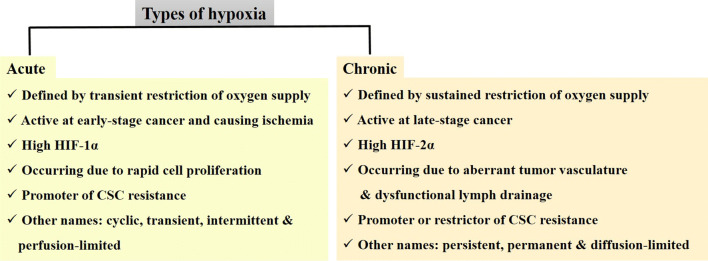
Fig. 1
Fig. 1
Types of hypoxia. Hypoxia is classified into acute and chronic phases, with either one exhibiting diverse roles in cancer stem cell (CSC) resistance. HIF hypoxia-inducible factor
Fig. 2
Fig. 2
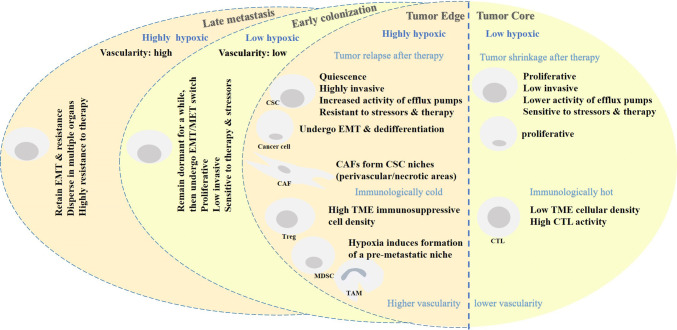
Hypoxia-inducible effects on cellular plasticity. The diagram unveils different characteristics of cells seeded in various areas of tumor (core/edge) or in the metastatic site, causing an adaptive system developed per time. Hypoxia would take a critical role for development of this adaptation. Cancer stem cells (CSCs) residing in the core are proliferative due to exposure to acute hypoxia, while exposure to high range of hypoxia in the edge can cause cellular quiescence and resistance. CSC resistance is maintained in the edge by intense interactions with tumor microenvironment (TME) immune cells, including regulatory T cells (Tregs), tumor-associated macrophages (TAMs) and myeloid-derived suppressive cells (MDSCs). The activity of cancer-associated fibroblasts (CAFs) is also high in this area forming a supportive niche for maintaining quiescent (dormant) state in CSCs, thus guiding cellular invasion. Chronically hypoxic edge area promotes a transition in tumor suppressor cytotoxic T lymphocytes (CTLs) from the edge to core. Thus, the core area is immunologically hot, while the edge is immunologically cold. Early colonized cells first remain dormant so as to develop mechanisms of adaptation, and then the adapted cells initiate proliferation by shifting their phenotype from epithelial–mesenchymal transition (EMT) into mesenchymal–epithelial transition (MET). The cells would finally change their phenotype into EMT, which is for multi-organ dispersing
Fig. 3
Fig. 3
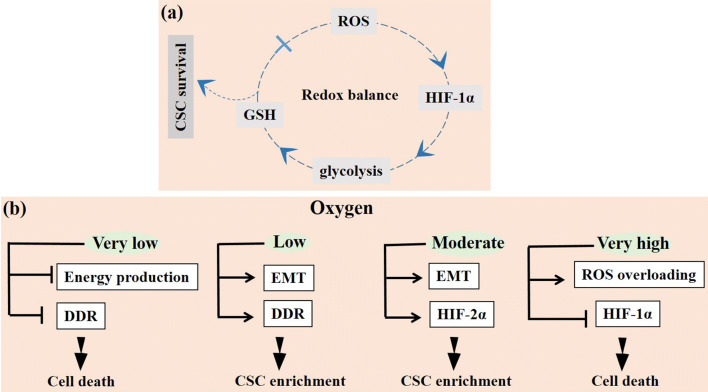
Responses from cancer stem cells (CSCs) to oxygen. a CSCs are equipped with a highly qualified redox balance system. An increase in the rate of reactive oxygen species (ROS) causes a shift in the metabolic demand toward glycolysis through induction of hypoxia-inducible factor (HIF)-1α. Glycolysis would then reduce the accelerated ROS levels by glutathione (GSH) induction. b CSCs have different responses to varied concentrations of oxygen. CSCs acquire epithelial–mesenchymal transition (EMT) and invasion upon exposure to both low and moderate oxygen levels, while very low or very high oxygen concentrations could cause CSC death. DDR, DNA damage response
Fig. 4
Fig. 4
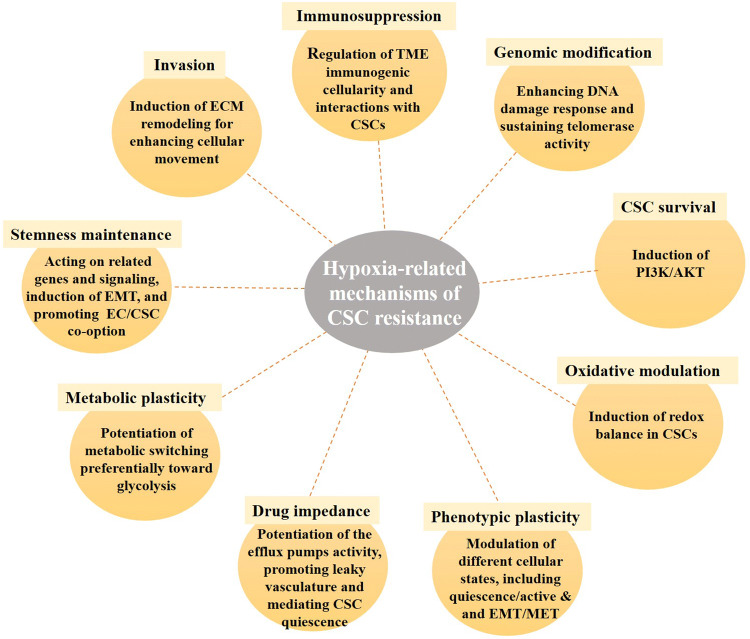
Diagram summarizing roles for hypoxia in mediating cancer stem cell (CSC) resistance to hypoxia. CSCs exploit diverse mechanisms under hypoxia in order to adapt and evade the environmental barriers. ECM, extracellular matrix; EC, endothelial cell; TME, tumor microenvironment; EMT, epithelial-mesenchymal transition; MET, mesenchymal-epithelial transition; and PI3K, phosphoinositide 3-kinase

References

    1. Abyaneh HS, Gupta N, Alshareef A, Gopal K, Lavasanifar A, Lai R (2018) Hypoxia induces the Acquisition of Cancer Stem-like Phenotype via Upregulation and Activation of signal transducer and activator of Transcription-3 (STAT3) in MDA-MB-231, a triple negative breast Cancer cell line. Cancer Microenviron 11(2–3):141–152 - PMC - PubMed
    1. Agnihotri N, Kumar S, Mehta K (2013) Tissue transglutaminase as a central mediator in inflammation-induced progression of breast cancer. Breast Cancer Res 15(1):202 - PMC - PubMed
    1. Alama A, Orengo AM, Ferrini S, Gangemi R (2012) Targeting cancer-initiating cell drug-resistance: a roadmap to a new-generation of cancer therapies? Drug Discov Today 17(9–10):435–442 - PubMed
    1. Alipour M, Majidi A, Molaabasi F, Sheikhnejad R, Hosseinkhani S (2018) In vivo tumor gene delivery using novel peptideticles: pH-responsive and ligand targeted core–shell nanoassembly. Int J Cancer 143(8):2017–2028 - PubMed
    1. Anuja K, Chowdhury AR, Saha A, Roy S, Rath AK, Kar M, Banerjee B (2019) Radiation-induced DNA damage response and resistance in colorectal cancer stem-like cells. Int J Radiat Biol 95(6):667–679 - PubMed

LinkOut - more resources