


Circumventing autophagy inhibition
- PMID: 31736401
- PMCID: PMC6927706
- DOI: 10.1080/15384101.2019.1692483
Circumventing autophagy inhibition
Abstract
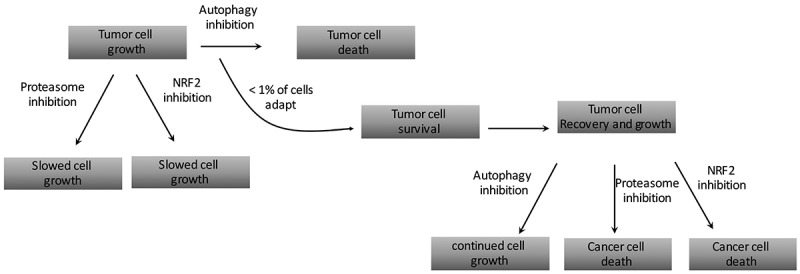
Autophagy is cellular recycling process that plays a complex role in cancer. Pre-clinical studies indicating a pro-tumorigenic role of autophagy have led to the launch of dozens of clinical trials combining autophagy inhibition with other standard of care therapies in different tumor types. A recent publication utilized a novel, acute, CRISPR/Cas9 assay to identify cancer cell lines that are exquisitely sensitive to loss of core autophagy genes within the first 7 days. However, weeks later, rare populations of originally autophagy dependent cells were found that could circumvent autophagy inhibition. Analysis of these rare clones revealed that in the process of circumventing loss of autophagy, the cells upregulated NRF2 signaling to maintain protein homeostasis and consequently become more sensitive to proteasome inhibition as well as knock down of NRF2. This review highlights recent publications regarding the role of autophagy in cancer and potential mechanisms cancer cells may be able to commandeer to circumvent autophagy inhibition. We hope to make significant clinical advances by understanding if and when cancer cells will become resistant to autophagy inhibition, and pre-clinical studies may be able to provide insight into the best combinatorial therapies to prevent tumor relapse while on autophagy inhibitors.
Keywords: ATG7; Autophagy; CRISPR/Cas9; NRF2; chloroquine; proteasome.
Figures

References
Publication types
MeSH terms
Substances
Grants and funding
LinkOut - more resources
Full Text Sources
