. 2019 Nov 1:10:2338.
doi: 10.3389/fpsyg.2019.02338. eCollection 2019.

Dose-Response Matters! - A Perspective on the Exercise Prescription in Exercise-Cognition Research

Affiliations

Dose-Response Matters! - A Perspective on the Exercise Prescription in Exercise-Cognition Research

Fabian Herold et al. Front Psychol. .

Abstract

In general, it is well recognized that both acute physical exercises and regular physical training influence brain plasticity and cognitive functions positively. However, growing evidence shows that the same physical exercises induce very heterogeneous outcomes across individuals. In an attempt to better understand this interindividual heterogeneity in response to acute and regular physical exercising, most research, so far, has focused on non-modifiable factors such as sex and different genotypes, while relatively little attention has been paid to exercise prescription as a modifiable factor. With an adapted exercise prescription, dosage can be made comparable across individuals, a procedure that is necessary to better understand the dose-response relationship in exercise-cognition research. This improved understanding of dose-response relationships could help to design more efficient physical training approaches against, for instance, cognitive decline.

Keywords: cognition; neuroplasticity; neuroprotection; personalized medicine; personalized training; physical activity.


Figures

FIGURE 1
FIGURE 1
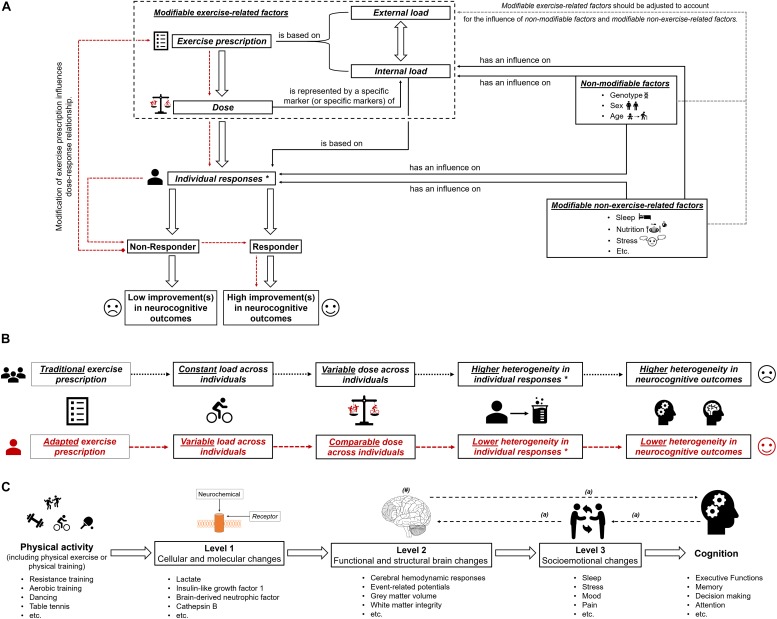
(A) Schematic illustration of the possible influence of exercise prescription on dose, and individual responsiveness (responder and non-responder) with the assumed extent of improvements (high improvements in neurocognitive outcomes and low improvements in neurocognitive outcomes). The dotted red lines show that by using an appropriate exercise prescription, non-responders could be turned into responders. In part (B) of the figure, the difference between “traditional exercise prescription” and “adapted exercise prescription” regarding the load, the dose, the individual response(s), and the corresponding heterogeneity in outcomes is illustrated. “” with regard to subsequent neurobiological processes. In part (C) of the figure, the multiple levels on which physical activity (including physical exercise and physical training) could affect cognitive performance are shown (Stillman et al., 2016). “#” indicates that the brain could be seen as outcome, mediator, or predictor (Stillman and Erickson, 2018). “a” indicates that there are several possibilities in which way structural and functional brain changes, socioemotional changes and cognitive changes are intertwined (Stillman et al., 2016).

References

    1. Abe K. (2012). Total daily physical activity and the risk of AD and cognitive decline in older adults. Neurology 79:1071; author reply 1071. 10.1212/WNL.0b013e31826bd5cf - DOI - PubMed
    1. Ahtiainen J. P., Walker S., Peltonen H., Holviala J., Sillanpää E., Karavirta L., et al. (2016). Heterogeneity in resistance training-induced muscle strength and mass responses in men and women of different ages. Age 38:10. 10.1007/s11357-015-9870-1 - DOI - PMC - PubMed
    1. Aichberger M. C., Busch M. A., Reischies F. M., Ströhle A., Heinz A., Rapp M. A. (2010). Effect of Physical Inactivity on Cognitive Performance after 2.5 Years of Follow-Up. GeroPsych 23 7–15. 10.1024/1662-9647/a000003 - DOI
    1. Ainsworth B. E., Haskell W. L., Whitt M. C., Irwin M. L., Swartz A. M., Strath S. J., et al. (2000). Compendium of physical activities. An update of activity codes and MET intensities. Med. Sci. Sports Exerc. 32 S498–S504. - PubMed
    1. Albinet C. T., Mandrick K., Bernard P. L., Perrey S., Blain H. (2014). Improved cerebral oxygenation response and executive performance as a function of cardiorespiratory fitness in older women: a fNIRS study. Front. Aging Neurosci. 6:273185 10.3389/fnagi.2014.00272 - DOI - PMC - PubMed

LinkOut - more resources