Effect of Internet-Distributed HIV Self-tests on HIV Diagnosis and Behavioral Outcomes in Men Who Have Sex With Men: A Randomized Clinical Trial
- PMID: 31738378
- PMCID: PMC6865312
- DOI: 10.1001/jamainternmed.2019.5222
Effect of Internet-Distributed HIV Self-tests on HIV Diagnosis and Behavioral Outcomes in Men Who Have Sex With Men: A Randomized Clinical Trial
Erratum in
-
Error in Table Data.JAMA Intern Med. 2020 Aug 1;180(8):1134. doi: 10.1001/jamainternmed.2020.1232. JAMA Intern Med. 2020. PMID: 32539069 Free PMC article. No abstract available.
Abstract
Importance: Undiagnosed HIV infection results in delayed access to treatment and increased transmission. Self-tests for HIV may increase awareness of infection among men who have sex with men (MSM).
Objective: To evaluate the effect of providing HIV self-tests on frequency of testing, diagnoses of HIV infection, and sexual risk behaviors.
Design, setting, and participants: This 12-month longitudinal, 2-group randomized clinical trial recruited MSM through online banner advertisements from March through August 2015. Those recruited were at least 18 years of age, reported engaging in anal sex with men in the past year, never tested positive for HIV, and were US residents with mailing addresses. Participants completed quarterly online surveys. Telephone call notes and laboratory test results were included in the analysis, which was completed from August 2017 through December 2018.
Interventions: All participants had access to online web-based HIV testing resources and telephone counseling on request. Participants were randomized in a 1:1 ratio to the control group or a self-testing (ST) group, which received 4 HIV self-tests after completing the baseline survey with the option to replenish self-tests after completing quarterly surveys. At study completion, all participants were offered 2 self-tests and 1 dried blood spot collection kit.
Main outcomes and measures: Primary outcomes were HIV testing frequency (tested ≥3 times during the trial) and number of newly identified HIV infections among participants in both groups and social network members who used the study HIV self-tests. Secondary outcomes included sex behaviors (eg, anal sex, serosorting).
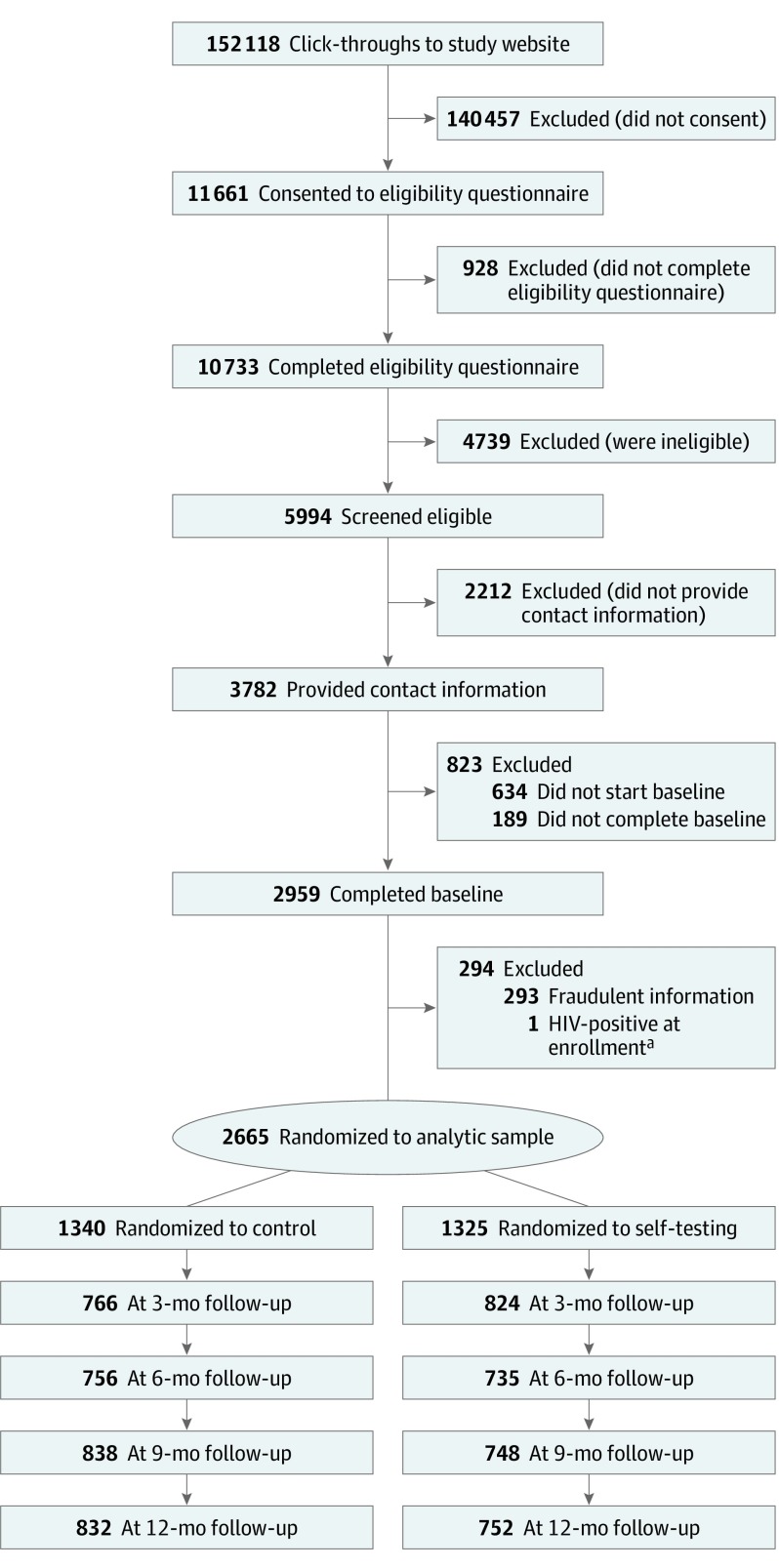
Results: Of 2665 participants, the mean (SD) age was 30 (9.6) years, 1540 (57.8%) were white, and 443 (16.6%) had never tested for HIV before enrollment. Retention rates at each time point were more than 54%, and 1991 (74.7%) participants initiated 1 or more follow-up surveys. More ST participants reported testing 3 or more times during the trial than control participants (777 of 1014 [76.6%] vs 215 of 977 [22.0%]; P < .01). The cumulative number of newly identified infections during the trial was twice as high in the ST participants as the control participants (25 of 1325 [1.9%] vs 11 of 1340 [0.8%]; P = .02), with the largest difference in HIV infections identified in the first 3 months (12 of 1325 [0.9%] vs 2 of 1340 [0.1%]; P < .01). The ST participants reported 34 newly identified infections among social network members who used the self-tests.
Conclusions and relevance: Distribution of HIV self-tests provides a worthwhile mechanism to increase awareness of HIV infection and prevent transmission among MSM.
Trial registration: ClinicalTrials.gov identifier: NCT02067039.
Conflict of interest statement
Figures
Comment in
-
Ending the HIV Epidemic in the United States-The Roles of Increased Testing and Preexposure Prophylaxis.JAMA Intern Med. 2020 Jan 1;180(1):130. doi: 10.1001/jamainternmed.2019.5442. JAMA Intern Med. 2020. PMID: 31738368 No abstract available.
-
Implementation of HIV Self-Testing Program in New York City.JAMA Intern Med. 2020 Apr 1;180(4):616. doi: 10.1001/jamainternmed.2020.0128. JAMA Intern Med. 2020. PMID: 32250400 No abstract available.
-
Implementation of HIV Self-Testing Program in New York City-Reply.JAMA Intern Med. 2020 Apr 1;180(4):616-617. doi: 10.1001/jamainternmed.2020.0125. JAMA Intern Med. 2020. PMID: 32250405 Free PMC article. No abstract available.
References
-
- Centers for Disease Control and Prevention HIV Surveillance Report, 2017; volume 29: Diagnoses of HIV infection in the United States and dependent areas, 2017. https://www.cdc.gov/hiv/pdf/library/reports/surveillance/cdc-hiv-surveil.... Published November 2018. Accessed October 15, 2019.
-
- Centers for Disease Control and Prevention HIV and gay and bisexual men. https://www.cdc.gov/hiv/pdf/group/msm/cdc-hiv-msm.pdf. Published September 2019. Accessed October 15, 2019.
Publication types
MeSH terms
Substances
Associated data
LinkOut - more resources
Full Text Sources
Medical
Miscellaneous