. 2019 Nov 14;9(4):84.
doi: 10.3390/life9040084.

Prebiotic Chemistry that Could Not Not Have Happened

Affiliations

Prebiotic Chemistry that Could Not Not Have Happened

Steven A Benner et al. Life (Basel). .

Abstract

We present a direct route by which RNA might have emerged in the Hadean from a fayalite-magnetite mantle, volcanic SO2 gas, and well-accepted processes that must have created substantial amounts of HCHO and catalytic amounts of glycolaldehyde in the Hadean atmosphere. In chemistry that could not not have happened, these would have generated stable bisulfite addition products that must have rained to the surface, where they unavoidably would have slowly released reactive species that generated higher carbohydrates. The formation of higher carbohydrates is self-limited by bisulfite formation, while borate minerals may have controlled aldol reactions that occurred on any semi-arid surface to capture that precipitation. All of these processes have well-studied laboratory correlates. Further, any semi-arid land with phosphate should have had phosphate anhydrides that, with NH3, gave carbohydrate derivatives that directly react with nucleobases to form the canonical nucleosides. These are phosphorylated by magnesium borophosphate minerals (e.g., lüneburgite) and/or trimetaphosphate-borate with Ni2+ catalysis to give nucleoside 5'-diphosphates, which oligomerize to RNA via a variety of mechanisms. The reduced precursors that are required to form the nucleobases came, in this path-hypothesis, from one or more mid-sized (1023-1020 kg) impactors that almost certainly arrived after the Moon-forming event. Their iron metal content almost certainly generated ammonia, nucleobase precursors, and other reduced species in the Hadean atmosphere after it transiently placed the atmosphere out of redox equilibrium with the mantle. In addition to the inevitability of steps in this path-hypothesis on a Hadean Earth if it had semi-arid land, these processes may also have occurred on Mars. Adapted from a lecture by the Corresponding Author at the All-Russia Science Festival at the Lomonosov Moscow State University on 12 October 2019, and is an outcome of a three year project supported by the John Templeton Foundation and the NASA Astrobiology program. Dedicated to David Deamer, on the occasion of his 80th Birthday.

Keywords: Hadean; RNA formation; meteorite impact; organic minerals; prebiotic chemistry.


Conflict of interest statement

The authors declare no conflict of interest.

Figures
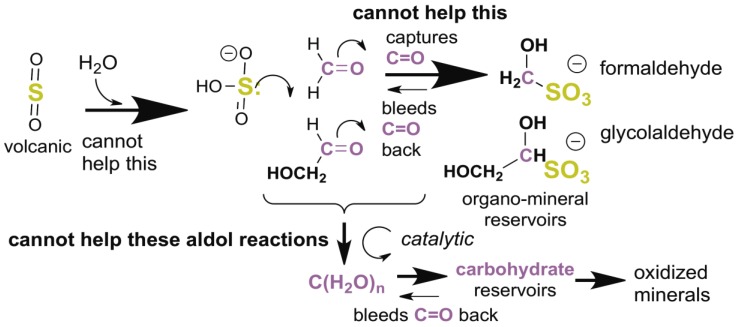
Figure 1
Figure 1
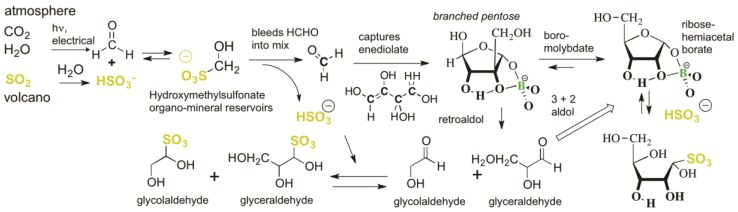
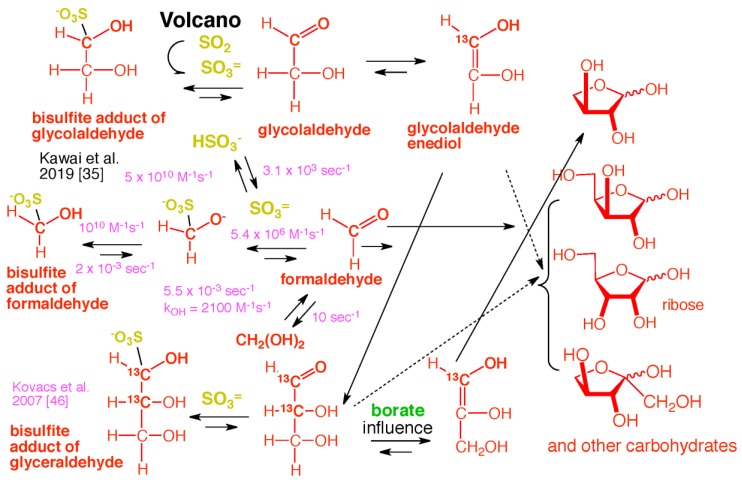
Volcanic sulfur dioxide (SO2) becomes sulfurous acid (H2SO3) in water aerosol particles. With any alkali, this forms the bisulfite anion (HSO3). This, in turn, reacts with carbonyl C=O groups to give sulfonate “bisulfite addition products”. The sulfonates are quite stable to self-reaction and other degradative paths. Their only reaction at modest temperatures is a reversible dissociation to give back carbonyl compounds. Thus, sulfonates slowly bleed reactive C=O species into aqueous mixtures [35].
Figure 2
Figure 2
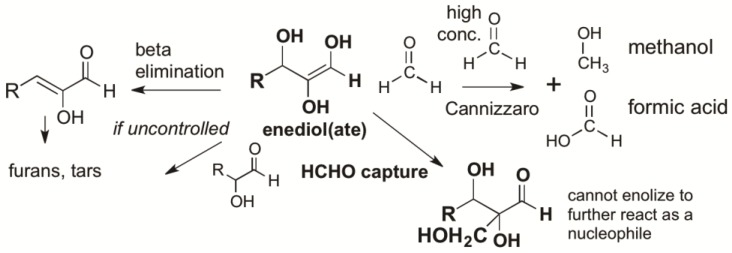
Formaldehyde (HCHO) captures enediol(ate)s formed from C=O carbonyl compounds before they react to give complex mixtures of unproductive species. At high concentrations, HCHO disproportionates in a bimolecular Cannizzaro reaction to give unproductive methanol and formate. However, these high concentrations are not possible in the presence of bisulfite, as the organic sulfonate mineral bleeds only small amounts of HCHO into a prebiotic reaction mixture. Glycolaldehyde is likewise bled into the mixture, but only in catalytic amounts, as its atmospheric formation is far less efficient. Glycolaldehyde cannot accumulate in aqueous alkaline environments because it enolizes under these conditions, a reaction that occurs faster than a Cannizzaro reaction.
Figure 3
Figure 3
Unavoidable reactions involving volcanic SO2, HCHO, and other lower carbohydrates in the presence of borate. With each C–C bond formed from a C=O species that comes from a sulfonate, a bisulfite molecule is released. An increasing bisulfite concentration causes the process to be self-limiting; higher and higher concentrations of bisulfite increase the equilibrium levels of unreactive sulfonates. Borate forms a cyclic adduct with the indicated branched pentose, which can undergo a retroaldol reaction to give glycolaldehyde and glyceraldehyde. These can either combine directly to give ribose [42], or can enolize to fix more HCHO in a catalytic cycle [6]. Reaction of bisulfite with ribose competes with ring closure. Thus, bisulfite addition with ribose is less than with HCHO, glycolaldehyde, and glyceraldehyde. The same is the case with ketoses such as xylulose and ribulose. The stereochemistry shown is entirely arbitrary; in the absence of processes for stereo-control, these compounds are made as racemates.
Figure 4
Figure 4
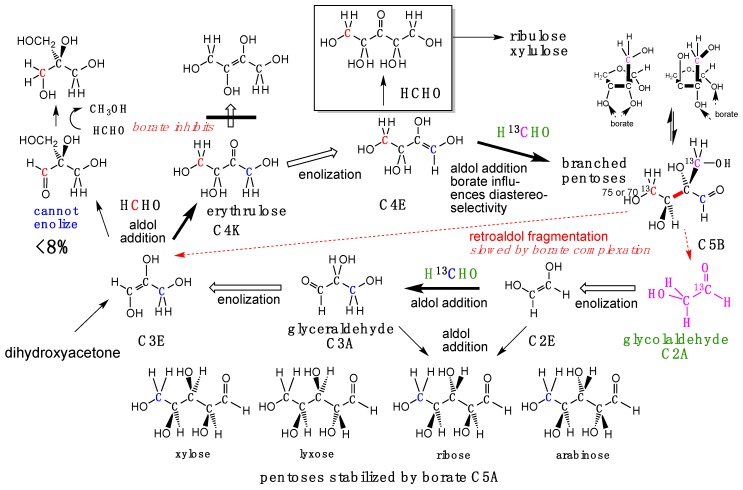
Prebiotic aldol reactions that are unavoidable in the presence of borate, which guides enolization of four-carbon carbohydrates and directs the regiochemistry of attack of HCHO on their enols.
Figure 5
Figure 5
The reversible conversion of branched pentoses at pH 6 (25 °C) catalyzed by Mo6+ gives an alternative path for the creation of linear pentoses and pentuloses [44]. Again, stereochemistry is entirely arbitrary. However, the rearrangement is itself stereospecific.
Figure 6
Figure 6
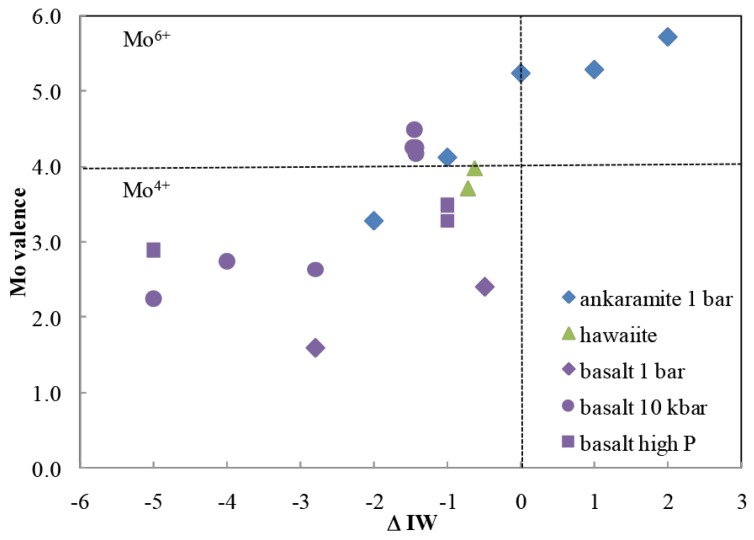
Molybendum in its +6 oxidation state can be obtained from melts having a redox potential greater than the iron–wüstite oxygen fugacity, which is several of orders of magnitude below the fayalite–magnetite–quartz (FMQ) fugacity likely present in the Hadean mantle. From Reference [45].
Figure 7
Figure 7
Overall “bespoke” chemical evolution of carbohydrate species that is hard to avoid in a Hadean environment that had semi-arid subaerial surface to capture precipitating bisulfite addition products formed from volcanic SO2 and atmospherically generated carbonyl compounds [35,46]. Again, stereochemistry is entirely arbitrary. Some key rate constants are shown.
Figure 8
Figure 8
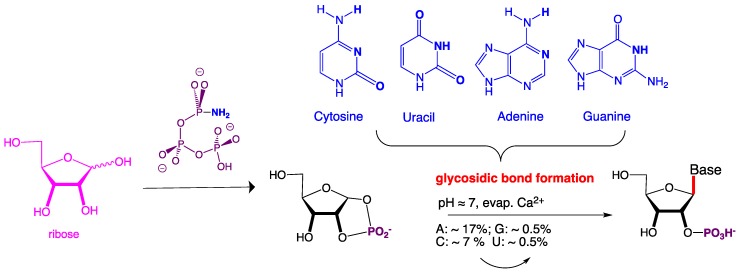
The reaction of amidotriphosphate with ribose gives a 1,2-cyclic phosphate. This reacts in the presence of Ca2+ upon evaporation in urea to give the canonical nucleosides.
Figure 9
Figure 9
(A) Absent borate. Ca2+ and PO43– segregate to give apatite, leaving behind Mg2+ and SO42- to form epsomite, (B), in the presence of BO33–, Mg2+, BO33– and PO43– segregate to give lüneburgite, leaving behind Ca2+ and SO42- to form gypsum. (C) The segregation of gypsum and lüneburgite is seen in laboratory experiments. (D) Lüneburgite samples from three locations on the modern Earth, Chile, Crimea, and (from the type-locality) Germany. Samples are courtesy of Renato Pagano and Robert Lavinsky (The Arkenstone, Richardson TX, https://www.irocks.com/), illustrating the importance of commercial and amateur “rock hounds” in the development of this science.
Figure 10
Figure 10
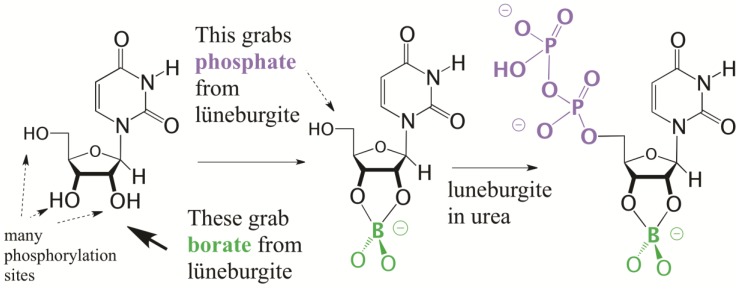
Lüneburgite selectively phosphorylates the 5′-position of nucleosides, since the 2′ and 3′ positions are protected by borate.
Figure 11
Figure 11
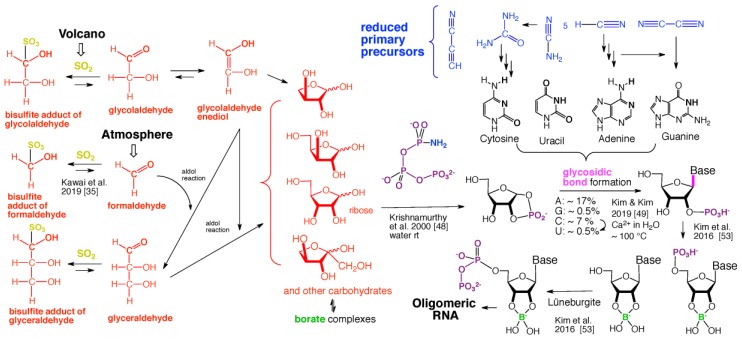
Summary of chemical evolution, all difficult to have avoided in the described Hadean environment, hypothesized to give oligomeric RNA. The silica phases and their relation to oligomeric RNA are described in Reference [55]. Again, stereochemistry is arbitrary. In fact, no hypothesis is offered to generate homochirality among the building blocks presented.

References

    1. White H.B., III Coenzymes as fossils of an earlier metabolic state. J. Mol. Evol. 1976;7:101–104. doi: 10.1007/BF01732468. - DOI - PubMed
    1. Visser C.M., Kellogg R.M. Bioorganic chemistry and the origin of life. J. Mol. Evol. 1978;11:163–168. doi: 10.1007/BF01733891. - DOI - PubMed
    1. Visser C.M., Kellogg R.M. Biotin. Its place in evolution. J. Mol. Evol. 1978;11:171–187. doi: 10.1007/BF01733892. - DOI - PubMed
    1. Gilbert W. Origin of life: The RNA world. Nature. 1986;319:618. doi: 10.1038/319618a0. - DOI
    1. Benner S.A., Ellington A.D., Tauer A. Modern metabolism as a palimpsest of the RNA world. Proc. Nat. Acad. Sci. USA. 1989;86:7054–7058. doi: 10.1073/pnas.86.18.7054. - DOI - PMC - PubMed

LinkOut - more resources