Effect of quercetin on oxidative stress and liver function in beta-thalassemia major patients receiving desferrioxamine: A double-blind randomized clinical trial
- PMID: 31741663
- PMCID: PMC6856539
- DOI: 10.4103/jrms.JRMS_911_18
Effect of quercetin on oxidative stress and liver function in beta-thalassemia major patients receiving desferrioxamine: A double-blind randomized clinical trial
Abstract
Background: Blood transfusion therapy is lifesaving for beta-thalassemia major patients, yet it indirectly causes complications such as oxidative stress and liver dysfunction. In the present study, we investigated the effect of quercetin supplementation on oxidative stress and liver function in beta-thalassemia major patients.
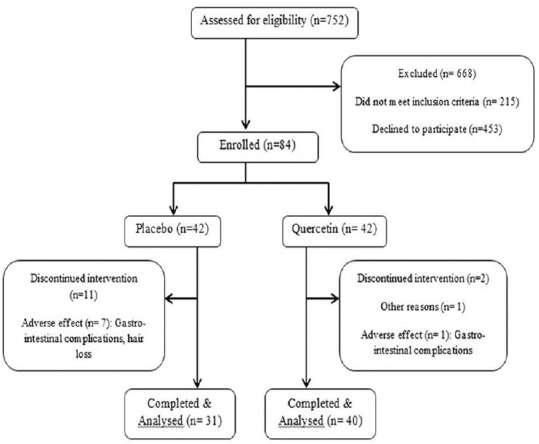
Materials and methods: In this double-blind clinical trial, 84 beta-thalassemia patients who received desferrioxamine (DFO) were randomly assigned to two groups; the treatment group received 500 mg quercetin tablet daily for 12 weeks, and the control group received placebo. In addition to demographic and anthropometric assessment, malondialdehyde (MDA), total antioxidant capacity (TAC), superoxide dismutase (SOD), glutathione peroxidase (GPx), aspartate aminotransferase (AST), alanine aminotransferase (ALT), and alkaline phosphatase (ALP) were biochemically assessed to detect the effect of quercetin on oxidative stress and liver function, respectively. The data were analyzed using SPSS 21. P < 0.05 was considered statistically significant.
Results: Before adjusting for confounding variables, within-group comparison showed that quercetin supplementation reduced ALT (P < 0.001) and TAC (P < 0.001) significantly. Between-group comparison using analysis of covariance analysis though showed that quercetin could significantly reduce ALT (P = 0.002), but there was an insignificant increase in SOD and TAC, and insignificant decrease in GPx, MDA, AST, and ALP (P > 0.05).
Conclusion: According to our results, consumption of 500 mg quercetin supplement daily for 3 months along with DFO treatment might be able to alter liver function, but not the oxidative stress in beta-thalassemia major patients.
Keywords: Beta-thalassemia; liver; oxidative stress; quercetin.
Copyright: © 2019 Journal of Research in Medical Sciences.
Conflict of interest statement
There are no conflicts of interest.
Figures
References
-
- Rund D, Rachmilewitz E. Beta-thalassemia. N Engl J Med. 2005;353:1135–46. - PubMed
-
- Jomova K, Valko M. Importance of iron chelation in free radical-induced oxidative stress and human disease. Curr Pharm Des. 2011;17:3460–73. - PubMed
-
- Rachmilewitz EA, Giardina PJ. How I treat thalassemia. Blood. 2011;118:3479–88. - PubMed
-
- Lee KW, Kim YJ, Kim DO, Lee HJ, Lee CY. Major phenolics in apple and their contribution to the total antioxidant capacity. J Agric Food Chem. 2003;51:6516–20. - PubMed
-
- Bischoff SC. Quercetin: Potentials in the prevention and therapy of disease. Curr Opin Clin Nutr Metab Care. 2008;11:733–40. - PubMed