


The relationship among the progression of inflammation in umbilical cord, fetal inflammatory response, early-onset neonatal sepsis, and chorioamnionitis
- PMID: 31743377
- PMCID: PMC6863554
- DOI: 10.1371/journal.pone.0225328
The relationship among the progression of inflammation in umbilical cord, fetal inflammatory response, early-onset neonatal sepsis, and chorioamnionitis
Abstract
Objectives: No information exists about whether fetal inflammatory-response(FIR), early-onset neonatal sepsis(EONS) and chorioamnionitis(an advanced-stage of maternal inflammatory-response in extraplacental membranes) continuously increase according to the progression of inflammation in umbilical-cord(UC). The objective of current-study is to examine this-issue.
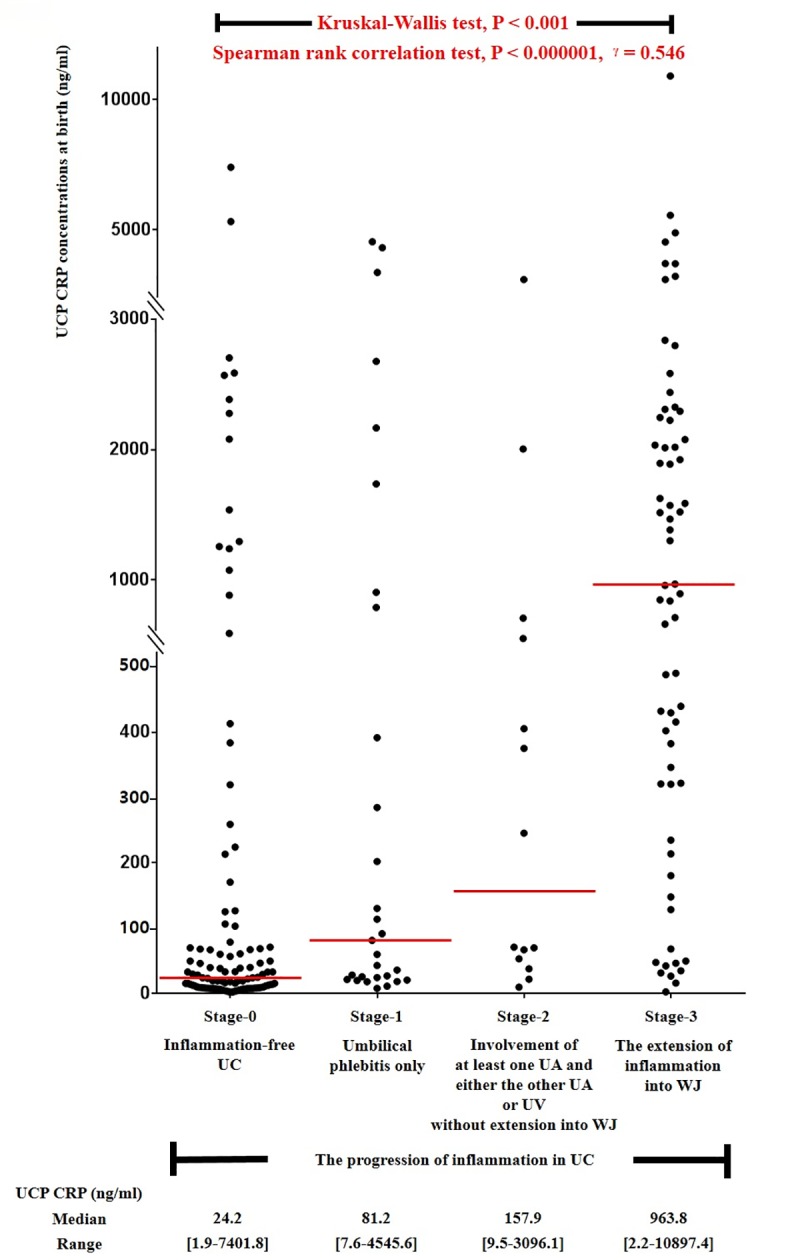
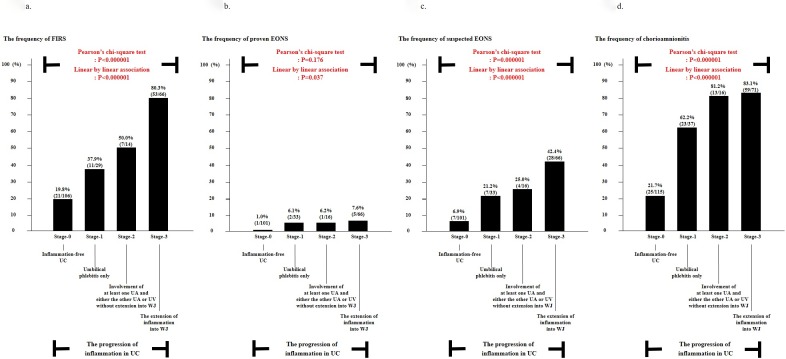
Methods: Study-population included 239singleton pregnant-women(gestational-age[GA] at delivery: 21.6~36weeks) who had inflammation in extraplacental membranes or chorionic plate (CP) and either preterm-labor or preterm-PROM. We examined FIR, and the frequency of fetal inflammatory-responses syndrome(FIRS), proven-EONS, suspected-EONS and chorioamnionitis according to the progression of inflammation in UC. The progression of inflammation in UC was divided with a slight-modification from previously reported-criteria as follows: stage0, inflammation-free UC; stage-1: umbilical phlebitis only; stage-2: involvement of at least one UA and either the other UA or UV without extension into WJ; stage-3: the extension of inflammation into WJ. FIR was gauged by umbilical-cord-plasma(UCP) CRP concentration(ng/ml) at birth, and FIRS was defined as an elevated UCP CRP concentration at birth(≥200ng/ml).
Results: Stage-0, stage-1, stage-2 and stage-3 of inflammation in UC were present in 48.1%, 15.5%, 6.7%, and 29.7% of cases. FIR continuously increased according to the progression of inflammation in UC(Kruskal-Wallis test,P<0.001; Spearman-rank-correlation test,P<0.000001,r = 0.546). Moreover, there was a significant and stepwise increase in the frequency of FIRS, proven-EONS, suspected-EONS and chorioamnionitis according to the progression of inflammation in UC(each for P<0.000005 in both chi-square test and linear-by-linear-association). Multiple logistic-regression analysis demonstrated that the more advanced-stage in the progression of inflammation in UC(i.e., stage-1 vs. stage-2 vs. stage-3), the better predictor of suspected-EONS (Odds-ratio[OR]3.358, 95%confidence-interval[CI]:1.020-11.057 vs. OR5.147, 95%CI:1.189-22.275 vs. OR11.040, 95%CI:4.118-29.592) and chorioamnionitis(OR6.593, 95%CI:2.717-15.999 vs. OR16.508, 95%CI:3.916-69.596 vs. OR20.167, 95%CI:8.629-47.137).
Conclusion: FIR, EONS and chorioamnionitis continuously increase according to the progression of inflammation in UC among preterm-gestations with inflammation in extraplacental membranes or CP. This finding may suggest that funisitis(inflammation in UC) is both qualitatively and quantitatively histologic-counterpart of FIRS, and a surrogate-marker for chorioamnionitis.
Conflict of interest statement
The authors have declared that no competing interests exist.
Figures
References
-
- Park CW, Kim SM, Park JS, Jun JK, Yoon BH. Fetal, amniotic and maternal inflammatory responses in early stage of ascending intrauterine infection, inflammation restricted to chorio-decidua, in preterm gestation. J Matern Fetal Neonatal Med. 2014;27:98–105. 10.3109/14767058.2013.806898 - DOI - PubMed
-
- Park CW, Moon KC, Park JS, Jun JK, Romero R, Yoon BH. The involvement of human amnion in histologic chorioamnionitis is an indicator that a fetal and an intra-amniotic inflammatory response is more likely and severe: clinical implications. Placenta. 2009;30:56–61. 10.1016/j.placenta.2008.09.017 - DOI - PMC - PubMed
Publication types
MeSH terms
LinkOut - more resources
Full Text Sources
Medical
Research Materials
Miscellaneous
