


Systematic Review of the Role of Biomarkers in Predicting Anastomotic Leakage Following Gastroesophageal Cancer Surgery
- PMID: 31744186
- PMCID: PMC6912692
- DOI: 10.3390/jcm8112005
Systematic Review of the Role of Biomarkers in Predicting Anastomotic Leakage Following Gastroesophageal Cancer Surgery
Abstract
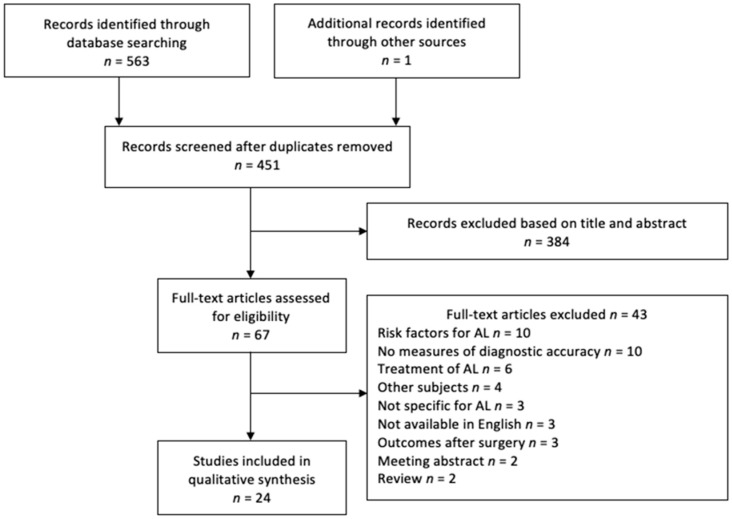
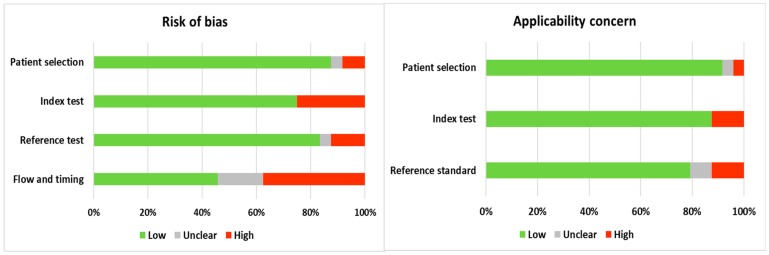
Anastomotic leakage (AL) following gastroesophageal cancer surgery remains a serious postoperative complication. This systematic review aims to provide an overview of investigated biomarkers for the early detection of AL following esophagectomy, esophagogastrectomy and gastrectomy. All published studies evaluating the diagnostic accuracy of biomarkers predicting AL following gastroesophageal resection for cancer were included. The Embase, Medline, Cochrane Library, PubMed and Web of Science databases were searched. Risk of bias and applicability were assessed using the Quality Assessment of Diagnostic Accuracy Studies (QUADAS) 2 tool. Twenty-four studies evaluated biomarkers in the context of AL following gastroesophageal cancer surgery. Biomarkers were derived from the systemic circulation, mediastinal and peritoneal drains, urine and mediastinal microdialysis. The most commonly evaluated serum biomarkers were C-reactive protein and leucocytes. Both proved to be useful markers for excluding AL owing to its high specificity and negative predictive values. Amylase was the most commonly evaluated peritoneal drain biomarker and significantly elevated levels can predict AL in the early postoperative period. The associated area under the receiver operating characteristic (AUROC) curve values ranged from 0.482 to 0.994. Current biomarkers are poor predictors of AL after gastroesophageal cancer surgery owing to insufficient sensitivity and positive predictive value. Further research is needed to identify better diagnostic tools to predict AL.
Keywords: anastomotic leakage; biomarkers; upper gastrointestinal tract.
Conflict of interest statement
The authors declare no conflict of interest.
Figures
References
-
- Carboni F., Valle M., Federici O., Levi Sandri G.B., Camperchioli I., Lapenta R., Assisi D., Garofalo A. Esophagojejunal anastomosis leakage after total gastrectomy for esophagogastric junction adenocarcinoma: Options of treatment. J. Gastrointest. Oncol. 2016;7:515–522. doi: 10.21037/jgo.2016.06.02. - DOI - PMC - PubMed
-
- Robb W.B., Messager M., Goere D., Pichot-Delahaye V., Lefevre J.H., Louis D., Guiramand J., Kraft K., Mariette C., FREGAT Working Group–FRENCH Predictive factors of postoperative mortality after junctional and gastric adenocarcinoma resection. JAMA Surg. 2013;148:624–631. doi: 10.1001/jamasurg.2013.63. - DOI - PubMed
-
- Turrentine F.E., Denlinger C.E., Simpson V.B., Garwood R.A., Guerlain S., Agrawal A., Friel C.M., LaPar D.J., Stukenborg G.J., Jones R.S. Morbidity, mortality, cost, and survival estimates of gastrointestinal anastomotic leaks. J. Am. Coll. Surg. 2015;220:195–206. doi: 10.1016/j.jamcollsurg.2014.11.002. - DOI - PubMed
Publication types
LinkOut - more resources
Full Text Sources
Research Materials
