


Oxidative Status before and after Renal Replacement Therapy: Differences between Conventional High Flux Hemodialysis and on-Line Hemodiafiltration
- PMID: 31744232
- PMCID: PMC6893513
- DOI: 10.3390/nu11112809
Oxidative Status before and after Renal Replacement Therapy: Differences between Conventional High Flux Hemodialysis and on-Line Hemodiafiltration
Abstract
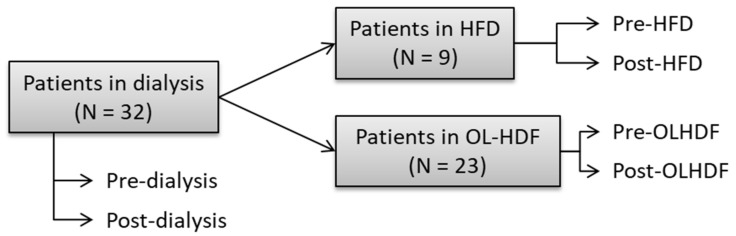
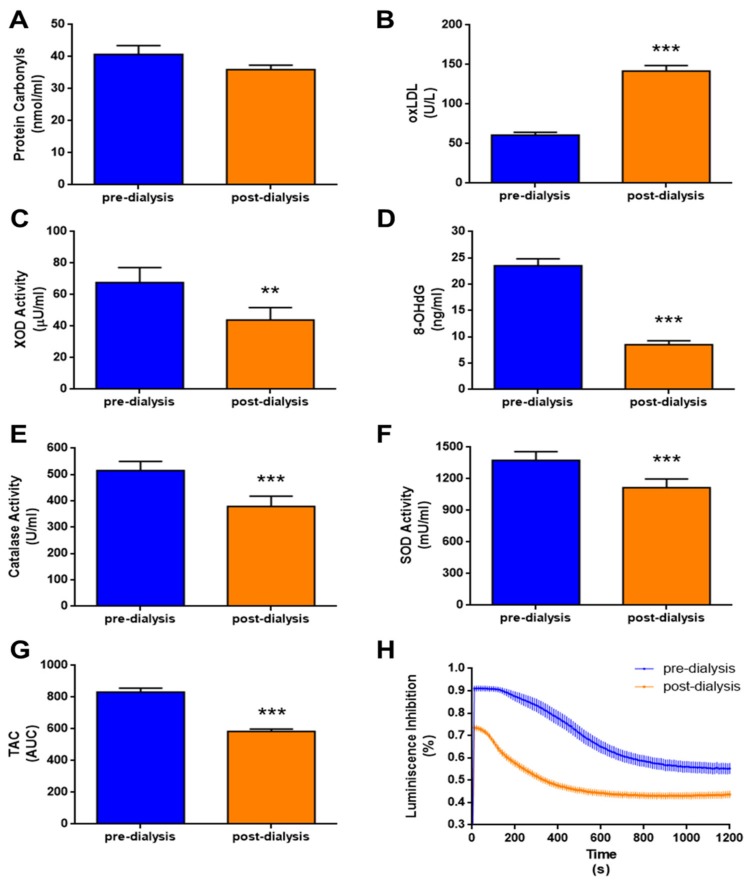
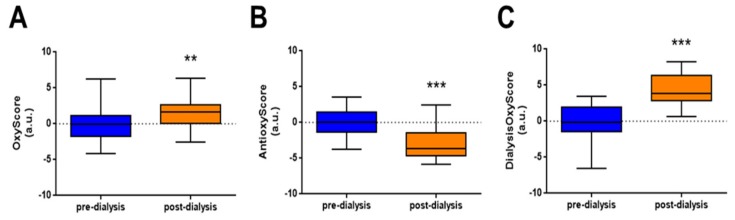
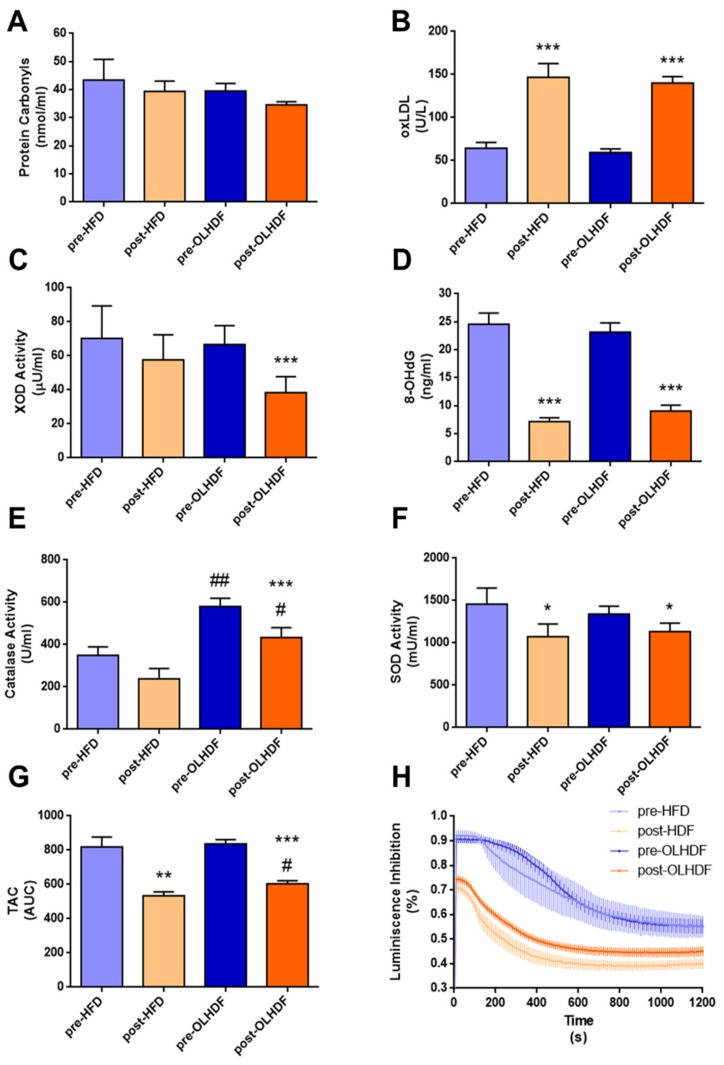
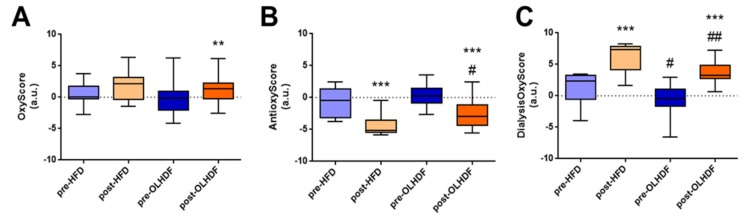
Hemodialysis patients experience high oxidative stress because of systemic inflammation and depletion of antioxidants. Little is known about the global oxidative status during dialysis or whether it is linked to the type of dialysis. We investigated the oxidative status before (pre-) and after (post-) one dialysis session in patients subjected to high-flux dialysis (HFD) or on-line hemodiafiltration (OL-HDF). We analyzed carbonyls, oxidized LDL (oxLDL), 8-hydroxy-2'-deoxyguanosine, and xanthine oxidase (XOD) activity as oxidative markers, and total antioxidant capacity (TAC), catalase, and superoxide dismutase activities as measures of antioxidant defense. Indices of oxidative damage (OxyScore) and antioxidant defense (AntioxyScore) were computed and combined into a global DialysisOxyScore. Both dialysis modalities cleared all markers (p < 0.01) except carbonyls, which were unchanged, and oxLDL, which increased post-dialysis (p < 0.01). OxyScore increased post-dialysis (p < 0.001), whereas AntioxyScore decreased (p < 0.001). XOD and catalase activities decreased post-dialysis after OL-HDF (p < 0.01), and catalase activity was higher after OL-HDF than after HFD (p < 0.05). TAC decreased in both dialysis modalities (p < 0.01), but remained higher in OL-HDF than in HFD post-dialysis (p < 0.05), resulting in a lower overall DialysisOxyScore (p < 0.05). Thus, patients on OL-HDF maintain higher levels of antioxidant defense, which might balance the elevated oxidative stress during dialysis, although further longitudinal studies are needed.
Keywords: dialysis; high-flux dialysis; on-line hemodiafiltration; oxidative stress.
Conflict of interest statement
The authors declare no conflict of interest. The funders had no role in the design of the study; in the collection, analyses, or interpretation of data; in the writing of the manuscript, or in the decision to publish the results.
Figures
References
-
- Gorostidi M., Santamaria R., Alcazar R., Fernandez Fresnedo G., Galceran J.M., Goicoechea M., Oliveras A., Portoles J., Rubio E., Segura J., et al. Spanish Society of Nephrology Document on KDIGO Guidelines for the Assessment and Treatment of Chronic Kidney Disease. Nefrologia. 2014;34:302–316. doi: 10.3265/Nefrologia.pre2014.Feb.12464. - DOI - PubMed
-
- Qureshi A.R., Alvestrand A., Divino Filho J.C., Gutierrez A., Heimburger O., Lindholm B., Bergstrom J. Inflammation, Malnutrition, and Cardiac Disease as Predictors of Mortality in Hemodialysis Patients. J. Am. Soc. Nephrol. 2002;13:28–36. - PubMed
-
- Peters S.A., Bots M.L., Canaud B., Davenport A., Grooteman M.P., Kircelli F., Locatelli F., Maduell F., Morena M., Nube M.J., et al. Haemodiafiltration and Mortality in End-Stage Kidney Disease Patients: A Pooled Individual Participant Data Analysis from Four Randomized Controlled Trials. Nephrol. Dial. Transplant. 2016;31:978–984. doi: 10.1093/ndt/gfv349. - DOI - PubMed
Publication types
MeSH terms
Substances
LinkOut - more resources
Full Text Sources
Medical
