. 2019 Nov 17;8(11):2008.
doi: 10.3390/jcm8112008.

Pulsed Electromagnetic Field Therapy Improves Osseous Consolidation after High Tibial Osteotomy in Elderly Patients-A Randomized, Placebo-Controlled, Double-Blind Trial

Affiliations

Pulsed Electromagnetic Field Therapy Improves Osseous Consolidation after High Tibial Osteotomy in Elderly Patients-A Randomized, Placebo-Controlled, Double-Blind Trial

Patrick Ziegler et al. J Clin Med. .

Abstract

Extremely low-frequency pulsed electromagnetic field (ELF-PEMF) therapy is proposed to support bone healing after injuries and surgical procedures, being of special interest for elderly patients. This study aimed at investigating the effect of a specific ELF-PEMF, recently identified to support osteoblast function in vitro, on bone healing after high tibial osteotomy (HTO). Patients who underwent HTO were randomized to ELF-PEMF or placebo treatment, both applied by optically identical external devices 7 min per day for 30 days following surgery. Osseous consolidation was evaluated by post-surgical X-rays (7 and 14 weeks). Serum markers were quantified by ELISA. Data were compared by a two-sided t-test (α = 0.05). Device readouts showed excellent therapy compliance. Baseline parameters, including age, sex, body mass index, wedge height and blood cell count, were comparable between both groups. X-rays revealed faster osseous consolidation for ELF-PEMF compared to placebo treatment, which was significant in patients ≥50 years (∆mean = 0.68%/week; p = 0.003). Findings are supported by post-surgically increased bone-specific alkaline phosphatase serum levels following ELF-PEMF, compared to placebo (∆mean = 2.2 µg/L; p = 0.029) treatment. Adverse device effects were not reported. ELF-PEMF treatment showed a tendency to accelerate osseous consolidation after HTO. This effect was stronger and more significant for patients ≥50 years. This ELF-PEMF treatment might represent a promising adjunct to conventional therapy supporting osseous consolidation in elderly patients.

Keywords: bone specific alkaline phosphatase (BAP); elderly; extremely low frequency pulsed electromagnetic field (ELF-PEMF) therapy; high tibial osteotomy (HTO); osseous consolidation.


Conflict of interest statement

P.Z., A.K.N., B.W., F.S., A.Z., U.S., A.A., S.S., and S.E. declare no conflict of interest. K.F., A.-K.F., and G.E. are part of Sachtleben GmbH, manufacturer of the Somagen® device. K.F., A.-K.F., and G.E. were not involved in study design, collection, analyses or interpretation of data. A.Z. is scientific and statistical advisor to several companies working with electric medical devices or in the field of orthopedics, including Procon GmbH (Hamburg), Sachtleben GmbH (Hamburg) and Syntellix AG (Hannover).

Figures

Figure 1
Figure 1
Overview of the study design. (A) Schematic overview of the study procedure. (B) Illustration of how the extremely low frequency pulsed electromagnetic field (ELF-PEMF) applicator (Somagen® device) was placed during treatment. (C) Guideline for the quantification of osseous consolidation in high tibial osteotomy (HTO) patients [26]: the green arrow marks the osteotomy (distance A) and the red line marks the gap filling (distance B). Osseous consolidation is calculated as B/A × 100 (%).
Figure 2
Figure 2
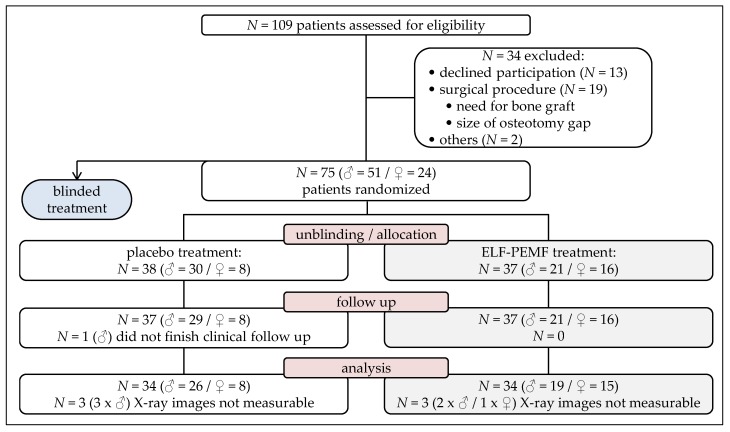
Flow diagram on patient recruitment and study population.
Figure 3
Figure 3
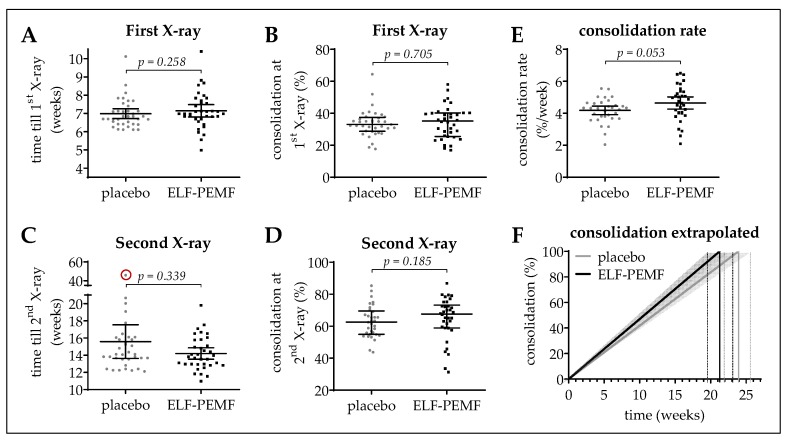
Osseous consolidation in the study cohort. (A,C) show the time from surgery till first (1st) or till second (2nd) X-ray, respectively. (B,D) show the osseous consolidation at the 1st and 2nd X-ray, respectively. Osseous consolidation is given in %. (E) The consolidation rate was determined as: Δ osseous consolidation (2nd X-ray—1st X-ray)/Δ time (2nd X-ray—1st X-ray). Data are represented as scatter diagrams (mean ± 95% CI). (F) Extrapolation of the resulting mean (line) ± SEM (surrounding area) consolidation rates of the ELF-PEMF and placebo group. Two-tailed Mann–Whitney U-test was used to determine p-values. N = 34 per group (geometric mean of n = 3).
Figure 4
Figure 4
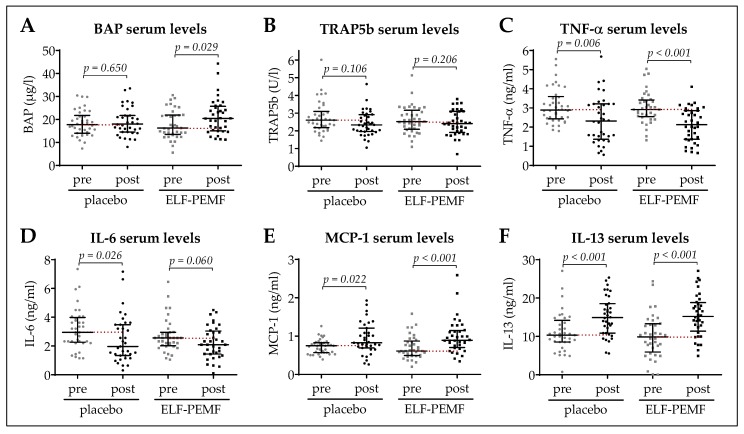
Pre- and post-surgical serum analysis. Serum levels of (A) bone-specific alkaline phosphatase (BAP), (B) tartrate-resistant acidic phosphatase (TRAP5b), (C) tumor necrosis factor alpha (TNF-α), (D) interleukin 6 (IL-6), (E) monocyte chemoattractant protein 1 (MCP-1), and (F) interleukin 13 (IL-13). Data are represented as scatter diagrams (mean ± 95% CI). Placebo: N = 36 and ELF-PEMF: N = 37 (n = 2). Two-tailed Mann–Whitney U-test was used to determine p-values, as indicated.
Figure 5
Figure 5
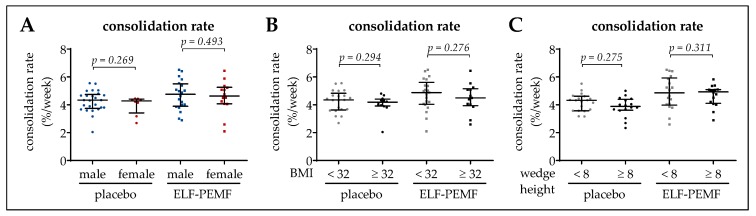
Effect of sex, BMI and wedge height on the osseous consolidation. (A) Sex effect on the rate of osseous consolidation. (B) A BMI of 32 kg/m2 was set as inflection point to investigate the effect of BMI on the consolidation rate. (C) A wedge height of 8 mm was set as inflection point to investigate the effect of the wedge height on the consolidation rate. Data are represented as scatter diagrams (mean ± 95% CI). Two-tailed Mann–Whitney U-test was used to determine p-values, as indicated. N = 68 data points (geometric mean of n = 3) were used for the individual analyses.
Figure 6
Figure 6
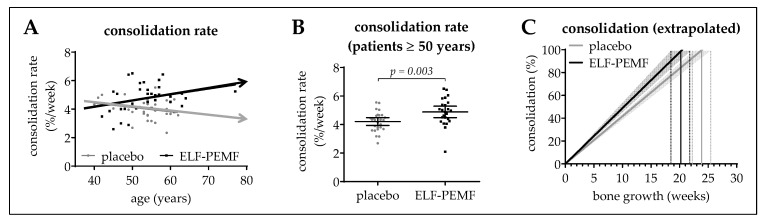
Effect of the patients’ age on the osseous consolidation. (A) Correlation between the osseous consolidation rate and the patients’ age. Trend-lines on the X/Y-diagram cross at an age of ~52 a. (B) Consolidation rate in patients ≥ 50 a (placebo: N = 27; ELF-PEMF: N = 24). Data are represented as scatter diagram (mean ± 95% CI). Two-tailed Mann–Whitney U-test was used to determine the p-value. (C) Extrapolation of the resulting mean (line) ± SEM (surrounding area) consolidation rates of the ELF-PEMF and placebo group.

References

    1. Ziegler P., Friederichs J., Hungerer S. Fusion of the subtalar joint for post-traumatic arthrosis: A study of functional outcomes and non-unions. Int. Orthop. 2017;41:1387–1393. doi: 10.1007/s00264-017-3493-3. - DOI - PubMed
    1. Scolaro J.A., Schenker M.L., Yannascoli S., Baldwin K., Mehta S., Ahn J. Cigarette smoking increases complications following fracture: A systematic review. J. Bone Jt. Surg. Am. 2014;96:674–681. doi: 10.2106/JBJS.M.00081. - DOI - PubMed
    1. Massari L., Benazzo F., Falez F., Cadossi R., Perugia D., Pietrogrande L., Aloj D.C., Capone A., D’Arienzo M., Cadossi M., et al. Can clinical and surgical parameters be combined to predict how long it will take a tibia fracture to heal? A prospective multicentre observational study: The fracting study. Biomed. Res. Int. 2018;2018:1809091. doi: 10.1155/2018/1809091. - DOI - PMC - PubMed
    1. Massari L., Falez F., Lorusso V., Zanon G., Ciolli L., La Cava F., Cadossi M., Chiarello E., De Terlizzi F., Setti S., et al. Can a combination of different risk factors be correlated with leg fracture healing time? J. Orthop. Traumatol. 2013;14:51–57. doi: 10.1007/s10195-012-0218-7. - DOI - PMC - PubMed
    1. Taormina D.P., Shulman B.S., Karia R., Spitzer A.B., Konda S.R., Egol K.A. Older age does not affect healing time and functional outcomes after fracture nonunion surgery. Geriatr. Orthop. Surg. Rehabil. 2014;5:116–121. doi: 10.1177/2151458514532811. - DOI - PMC - PubMed

Grants and funding

LinkOut - more resources