


Risk-based approach to school entry examinations in Germany - a validation study
- PMID: 31744487
- PMCID: PMC6862836
- DOI: 10.1186/s12887-019-1825-8
Risk-based approach to school entry examinations in Germany - a validation study
Abstract
Background: In Germany, all preschoolers undergo a school entry examination (SEE). While most children are sufficiently served with standardized developmental tests only, for a small group of otherwise underserved children, the SEE should also include a subsidiary health checkup. The aim of the study was to validate selection criteria to differentiate these two groups of children.
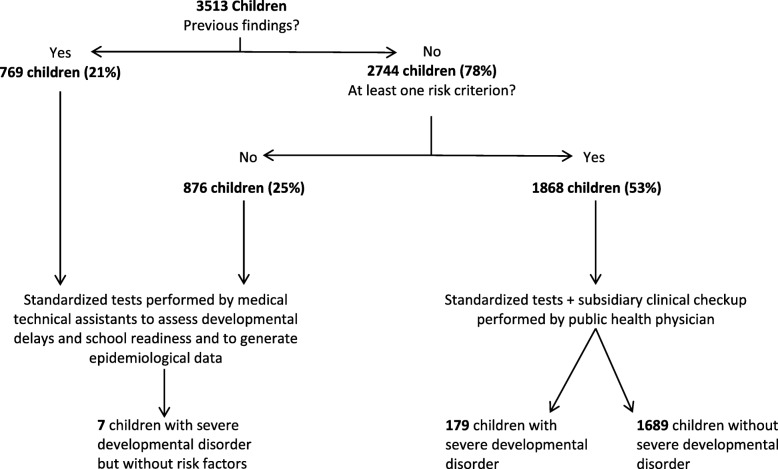
Methods: Secondary data from the SEEs of 2016 and 2017 that contained information on 3513 children were analyzed. Of these children, a subset was selected in which no severe developmental disorders were diagnosed prior to the SEE (n = 2744). The selection criteria identified in an earlier study (low or medium social status, missed the last pediatric routine check-up, migration background, three or more siblings, and raised by a single mother) were then applied to this subset to estimate their effectiveness in finding children at risk for a newly diagnosed severe developmental disorder. The sensitivity, specificity and positive and negative predictive values of the selection criteria were calculated.
Results: The tested selection criteria identified children who would likely benefit from a subsidiary checkup in the context of SEEs with a sensitivity of 96% (95% CI: 94.5-98.9%). The negative predictive value and specificity of the criteria were 99% (98.6-99.7%) and 34% (32.1-35.8%), respectively. By using this approach, the number of children seen by a physician could be reduced to 53% of the age cohorts.
Conclusion: The tested selection criteria are a viable way to differentiate children for whom SEEs should include a subsidiary health checkup from those who do not need it. Therefore, the time that physicians spend with SEEs could be reduced. Using the selection criteria to establish a stepped procedure in SEEs therefore offers a valid way to focus physicians' resources on the children who need them most.
Conflict of interest statement
The authors declare that they have no competing interests.
Figures
References
-
- California Department of Health Care Services . School entry health exam requirement. 2019.
-
- Bollig S, Tervooren A. The order of family as a preventive resource. Informal developmental diagnostic in pediatric and school entry check-ups using the example of exploring children’s television viewing. J Sociol Educ Social. 2009;29(2):157–173.
-
- Franze M, Gottschling A, Hoffmann W. The “Dortmund developmental screening for preschools” (DESK 3–6) as the basis for developmental promotion in preschools in Mecklenburg-West Pomerania. First results of the pilot project “children in preschools” referring to the acceptance of DESK 3–6 by preschool teachers. Bundesgesundheitsblatt. 2010;53(12):1290–1297. doi: 10.1007/s00103-010-1168-y. - DOI - PubMed
Publication types
MeSH terms
LinkOut - more resources
Full Text Sources
Medical
