


Environmental determinants of distribution of freshwater snails and trematode infection in the Omo Gibe River Basin, southwest Ethiopia
- PMID: 31744539
- PMCID: PMC6865041
- DOI: 10.1186/s40249-019-0604-y
Environmental determinants of distribution of freshwater snails and trematode infection in the Omo Gibe River Basin, southwest Ethiopia
Abstract
Background: Determination of infection rates of snail populations is one of the basic tools for epidemiological studies of snail borne diseases. In this study, we opted to determine the trematode infection of freshwater snails in the Omo-Gibe River Basin, southwest Ethiopia.
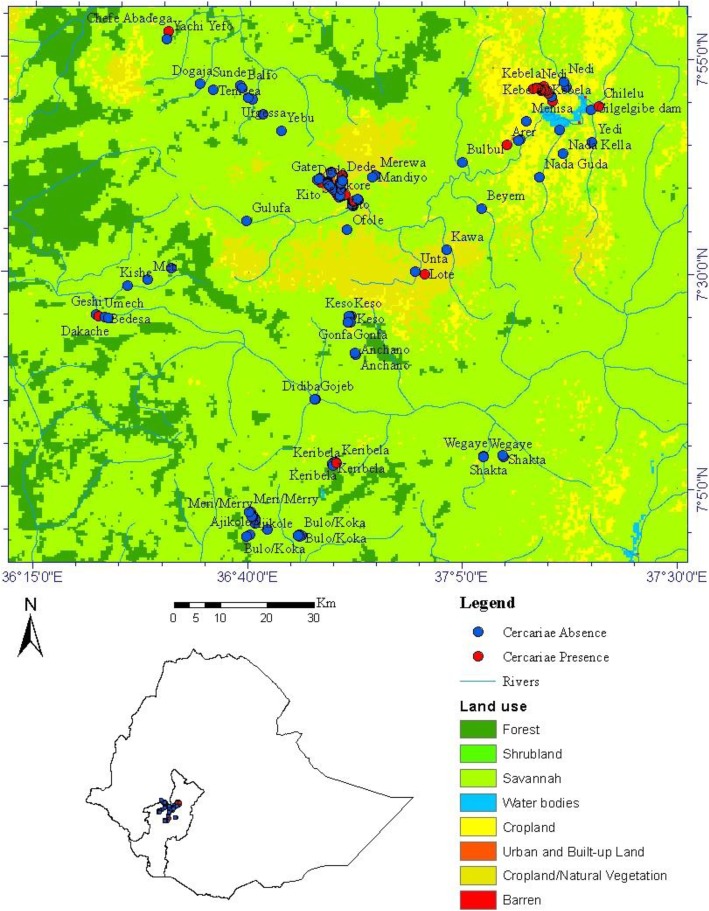
Methods: We collected snail samples from 130 observation sites in lakes, wetlands, rivers, reservoirs and irrigation canals surveyed during the dry season (March to May) in 2016. The snail samples were examined for trematode infections by cercarial shedding immediately after collection. Habitat conditions, water quality, human water contact practices and other human activities were assessed at each survey site. A redundancy analysis (RDA) was used to examine the relationship between cercarial infection and environmental variables. The statistical significance of eigenvalues and cercariae-environment correlations generated by the RDA were tested using Monte Carlo permutations at 499 permutations.
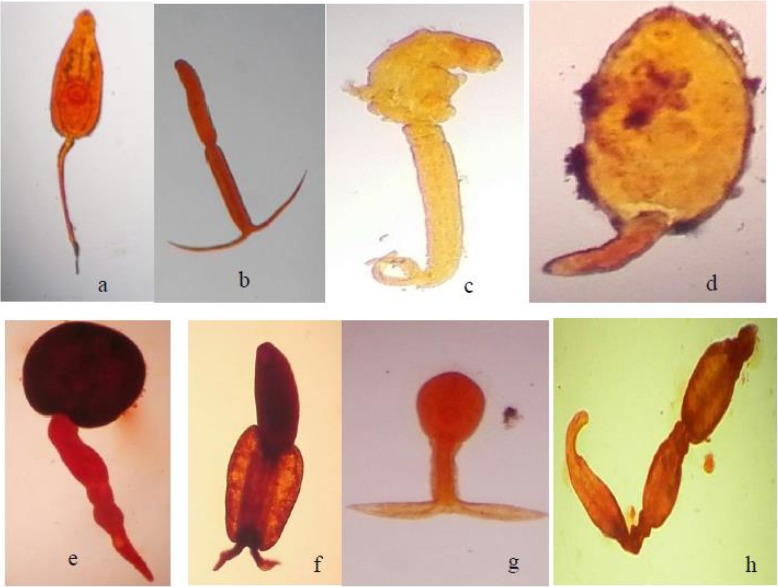
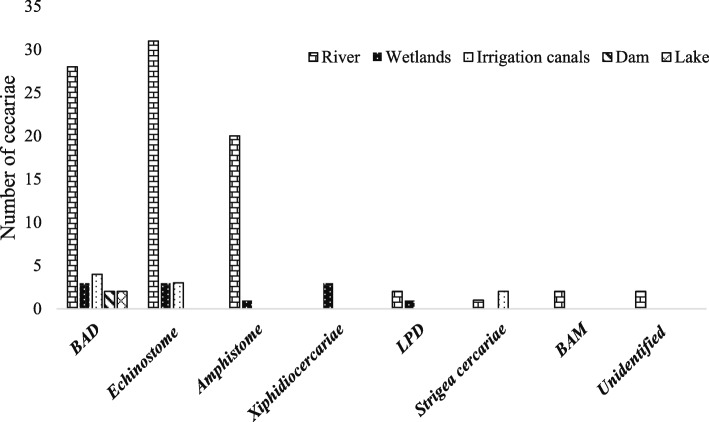
Results: A total of 3107 snails belonging to five species were collected. The most abundant species was Biomphalaria pfeifferi, representing 66% of the total collection. Overall, 109 (3.6%) of the snails were found infected with trematodes (cercariae). Biomphalaria pfeifferi was found to be the most highly infected, accounting 85% of all infected snails. A total of eight morphologically different types of cercariae were recorded, which included: Echinostoma cercariae, brevifurcate apharyngeate distome cercariae, amphistome cercariae, brevifurcate apharyngeate monostome cercariae, xiphidiocercariae, longifurcate pharyngeate distome cercariae, strigea cercariae and unidentified cercariae. Brevifurcate apharyngeate distome cercariae, and Echinostoma cercariae were the most abundant cercariae, accounting for 36 and 34% of all infection, respectively. The mean concentration of water conductivity and 5 days biological oxygen demand were higher in irrigation canals and lake sampling points. Human activities such as open field defecation, urination, livestock grazing, farming, and swimming were highly correlated with trematode infection.
Conclusions: The abundance, occurrence and infection rates of snail species were largely influenced by water physicochemical quality, sanitation and water contact behaviour of the inhabitants. Human activities, such as open field defecation and urination, livestock grazing, farming, and swimming were important predictors of the abundance of cercariae. Therefore, awareness creation should be implemented for proper containment of excreta (urine and faeces) and reducing human and animal contacts with surface waters to reduce snail-borne disease transmission.
Keywords: Biomphalaria pfeifferi; Cercaria; Ethiopia; Freshwater; Schistosomiasis; Snail; Trematode.
Conflict of interest statement
The authors declare that they have no competing interests.
Figures

References
-
- El-Khayat HM, Ismail NM, Mahmoud KM, Ragb FM, El-Said KM, Mostafa BB, et al. Evaluation of some chemical parameters as potential determinants of freshwater snails with special reference to medically important snails in Egypt. World Acad Sci Eng Technol. 2011;5:11.
-
- Arshad GM, Maqbool A, Qamar MF, Muhammad S, Bukhari SMH, Hashmi HA, Ashraf M. Prevalence and ecology of freshwater snails in some selected districts of southern Punjab. Pak J Life Soc Sci. 2011;9(1):17–20.
MeSH terms
Grants and funding
LinkOut - more resources
Full Text Sources
Research Materials
