. 2020 Jan 24;48(2):748-760.
doi: 10.1093/nar/gkz1091.

Atypical organizations and epistatic interactions of CRISPRs and cas clusters in genomes and their mobile genetic elements

Affiliations

Atypical organizations and epistatic interactions of CRISPRs and cas clusters in genomes and their mobile genetic elements

Aude Bernheim et al. Nucleic Acids Res. .

Abstract

Prokaryotes use CRISPR-Cas systems for adaptive immunity, but the reasons for the frequent existence of multiple CRISPRs and cas clusters remain poorly understood. Here, we analysed the joint distribution of CRISPR and cas genes in a large set of fully sequenced bacterial genomes and their mobile genetic elements. Our analysis suggests few negative and many positive epistatic interactions between Cas subtypes. The latter often result in complex genetic organizations, where a locus has a single adaptation module and diverse interference mechanisms that might provide more effective immunity. We typed CRISPRs that could not be unambiguously associated with a cas cluster and found that such complex loci tend to have unique type I repeats in multiple CRISPRs. Many chromosomal CRISPRs lack a neighboring Cas system and they often have repeats compatible with the Cas systems encoded in trans. Phages and 25 000 prophages were almost devoid of CRISPR-Cas systems, whereas 3% of plasmids had CRISPR-Cas systems or isolated CRISPRs. The latter were often compatible with the chromosomal cas clusters, suggesting that plasmids can co-opt the latter. These results highlight the importance of interactions between CRISPRs and cas present in multiple copies and in distinct genomic locations in the function and evolution of bacterial immunity.


Figures

Figure 1.
Figure 1.
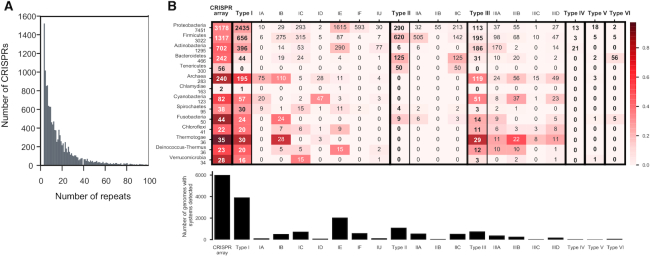
Distribution of CRISPR arrays and clusters of cas genes in the genomes of Prokaryotes. (A) Histogram of the number of repeats in CRISPRs (histogram truncated at 100, because higher values are very rare, maximum is 587). (B) Distribution per clade (on the top panel only clades with >25 genomes are indicated). The cells indicate the number of genomes with systems detected in the clade, and the colour of the cell is proportional to the average frequency per genome (the darker, the more frequent, see scale). The bottom panel shows the total number of genomes with elements detected in the dataset.
Figure 2.
Figure 2.
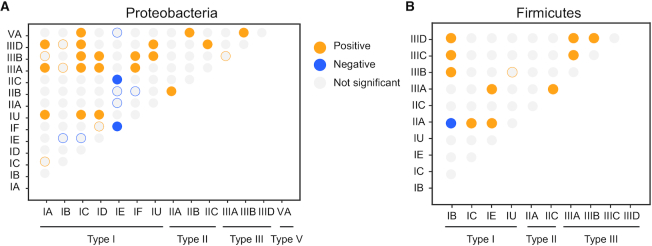
Significant associations between Cas subtypes in the same genome in Proteobacteria (A) and Firmicutes (B). Each circle corresponds to the association between two subtypes. Associations are represented in grey (not significant), blue (negative), and orange (positive). Only sub-types with systems present in >1% of the genomes in the clade are represented (the others never have significant statistics). Statistical significance was assessed at two stages. First, we assumed that distributions are independent of phylogeny and made 2 × 2 contingency tables where independence was tested using a Fisher exact test (P < 0.05). Second, for the tests revealing significant effects, we made a phylogenetic logistic regression to control for the effect of phylogeny and selected only the significant associations (P < 0.05, Wald test). Coloured circles surrounding grey disks correspond to statistically significant interactions for Fisher exact test that were found not significant after the phylogenetic logistic regression.
Figure 3.
Figure 3.
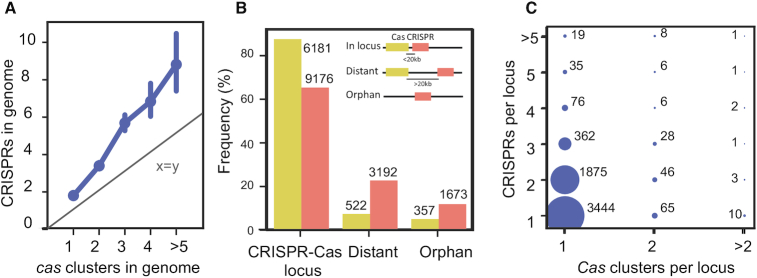
Organization of CRISPR–Cas loci. (A) Number of CRISPR arrays in function of the number of cas clusters in bacterial genomes (mean, CI 95%). The straight line indicates the identity (number of CRISPRs equal to the number of cas clusters) (B) Frequency of CRISPRs and cas clusters in terms of their genetic context. Loci were classed as complete CRISPR–Cas loci when they included at least one CRISPR and one cas cluster, ‘distant’ when the element (CRISPR or cas cluster) is >20 kb from the closest cognate element, and ‘orphan’ when the cognate element is absent from the genome. (C) Quantification of the different organizations of CRISPR–Cas loci.
Figure 4.
Figure 4.
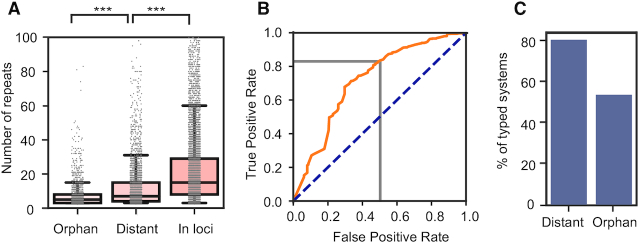
Characterization of CRISPRs according to their association with cas clusters. (A) Number of repeats in CRISPRs in function of their distance to cas clusters (Tukey HSD, all pairs, P < 0.001). (B) ROC curve (orange) of the results of the study using logistic regression to predict the subtype of Cas systems for the best hit of the set of repeats of a CRISPR. In grey, the threshold chosen to assign subtype to unknown arrays (74% identity). (C) Percentage of orphan and distant arrays with subtype assignment.
Figure 5.
Figure 5.
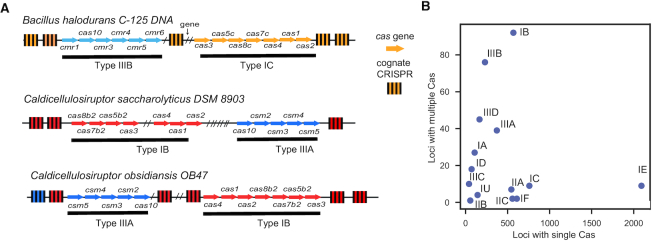
Association between Cas clusters. (A) Examples of complex CRISPR–Cas loci found in Bacteria. Arrows represent cas genes and cas clusters are coloured by subtypes. Genes that were not identified as cas genes were omitted and replaced by a slash (/). CRISPRs colours match the Cas subtype to which their repeats were assigned. Grey indicates that no subtype could be assigned. (B) Number of loci with a given Cas subtype found in simple or complex loci.
Figure 6.
Figure 6.
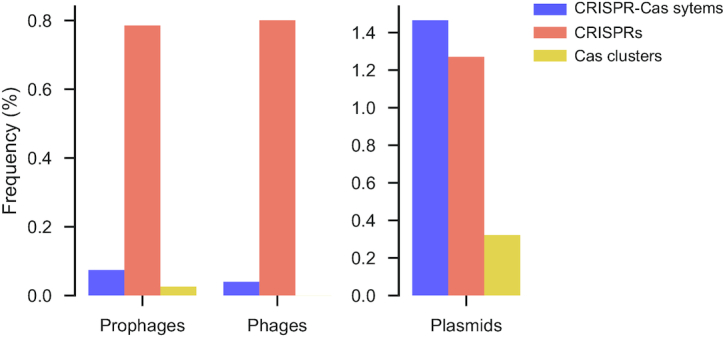
Frequency of CRISPR–Cas systems in prophages, phages and plasmids. Frequency notes the percentage of such mobile elements encoding at least one CRISPR–Cas system, a cas cluster or a CRISPR. Note that the scales of the axes are different, since CRISPR–Cas are much more abundant in plasmids.

References

    1. Barrangou R., Fremaux C., Deveau H., Richards M., Boyaval P., Moineau S., Romero D.A., Horvath P.. CRISPR provides acquired resistance against viruses in prokaryotes. Science. 2007; 315:1709–1712. - PubMed
    1. Brouns S.J.J., Jore M.M., Lundgren M., Westra E.R., Slijkhuis R.J.H., Snijders A.P.L., Dickman M.J., Makarova K.S., Koonin E.V., van der Oost J.. Small CRISPR RNAs guide antiviral defense in prokaryotes. Science. 2008; 321:960–964. - PMC - PubMed
    1. Marraffini L.A., Sontheimer E.J.. CRISPR interference limits horizontal gene transfer in staphylococci by targeting DNA. Science. 2008; 322:1843–1845. - PMC - PubMed
    1. Garneau J.E., Dupuis M.-È., Villion M., Romero D.A., Barrangou R., Boyaval P., Fremaux C., Horvath P., Magadán A.H., Moineau S.. The CRISPR/Cas bacterial immune system cleaves bacteriophage and plasmid DNA. Nature. 2010; 468:67–71. - PubMed
    1. Gophna U., Kristensen D.M., Wolf Y.I., Popa O., Drevet C., Koonin E. V. No evidence of inhibition of horizontal gene transfer by CRISPR Cas on evolutionary timescales. ISME J. 2015; 9:2021–2027. - PMC - PubMed

Publication types

MeSH terms

LinkOut - more resources