Long-term Functional, Psychological, Emotional, and Social Outcomes in Survivors of Firearm Injuries
- PMID: 31746949
- PMCID: PMC6902182
- DOI: 10.1001/jamasurg.2019.4533
Long-term Functional, Psychological, Emotional, and Social Outcomes in Survivors of Firearm Injuries
Abstract
Importance: The outcomes of firearm injuries in the United States are devastating. Although firearm mortality and costs have been investigated, the long-term outcomes after surviving a gunshot wound (GSW) remain unstudied.
Objective: To determine the long-term functional, psychological, emotional, and social outcomes among survivors of firearm injuries.
Design, setting, and participants: This prospective cohort study assessed patient-reported outcomes among GSW survivors from January 1, 2008, through December 31, 2017, at a single urban level I trauma center. Attempts were made to contact all adult patients (aged ≥18 years) discharged alive during the study period. A total of 3088 patients were identified; 516 (16.7%) who died during hospitalization and 45 (1.5%) who died after discharge were excluded. Telephone contact was made with 263 (10.4%) of the remaining patients, and 80 (30.4%) declined study participation. The final study sample consisted of 183 participants. Data were analyzed from June 1, 2018, through June 20, 2019.
Exposures: A GSW sustained from January 1, 2008, through December 31, 2017.
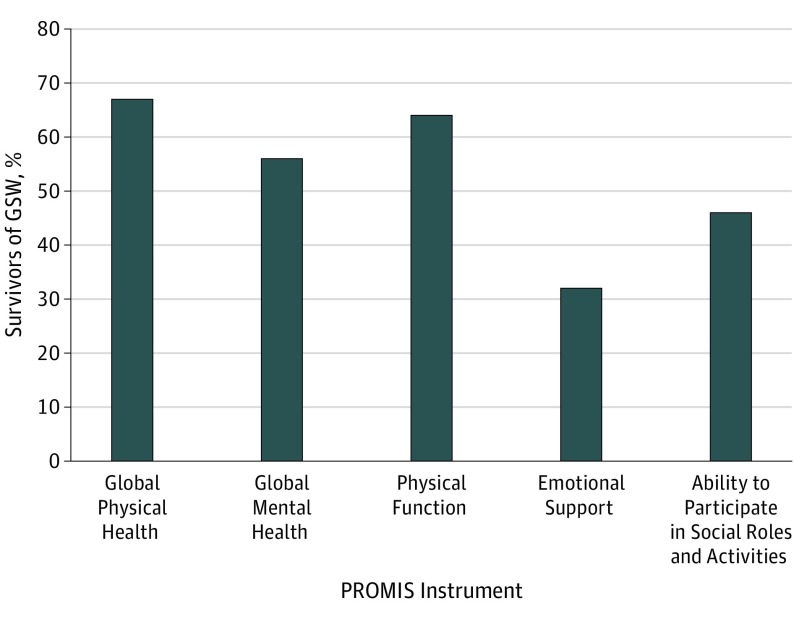
Main outcomes and measures: Scores on 8 Patient-Reported Outcomes Measurement Information System (PROMIS) instruments (Global Physical Health, Global Mental Health, Physical Function, Emotional Support, Ability to Participate in Social Roles and Activities, Pain Intensity, Alcohol Use, and Severity of Substance Use) and the Primary Care PTSD (posttraumatic stress disorder) Screen for the Diagnostic and Statistical Manual of Mental Disorders, Fifth Edition.
Results: Of the 263 patients who survived a GSW and were contacted, 183 (69.6%) participated. Participants were more likely to be admitted to the hospital compared with those who declined (150 [82.0%] vs 54 [67.5%]; P = .01). Participants had a median time from GSW of 5.9 years (range, 4.7-8.1 years) and were primarily young (median age, 27 years [range, 21-36 years]), black (168 [91.8%]), male (169 [92.3%]), and employed before GSW (pre-GSW, 139 [76.0%]; post-GSW, 113 [62.1%]; decrease, 14.3%; P = .004). Combined alcohol and substance use increased by 13.2% (pre-GSW use, 56 [30.8%]; post-GSW use, 80 [44.0%]). Participants had mean (SD) scores below population norms (50 [10]) for Global Physical Health (45 [11]; P < .001), Global Mental Health (48 [11]; P = .03), and Physical Function (45 [12]; P < .001) PROMIS metrics. Eighty-nine participants (48.6%) had a positive screen for probable PTSD. Patients who required intensive care unit admission (n = 64) had worse mean (SD) Physical Function scores (42 [13] vs 46 [11]; P = .045) than those not requiring the intensive care unit. Survivors no more than 5 years after injury had greater PTSD risk (38 of 63 [60.3%] vs 51 of 119 [42.9%]; P = .03) but better mean (SD) Global Physical Health scores (47 [11] vs 43 [11]; P = .04) than those more than 5 years after injury.
Conclusions and relevance: This study's results suggest that the lasting effects of firearm injury reach far beyond mortality and economic burden. Survivors of GSWs may have negative outcomes for years after injury. These findings suggest that early identification and initiation of long-term longitudinal care is paramount.
Conflict of interest statement
Figures
Comment in
-
Long-term Consequences in Trauma: At the Center of the Public Health Approach Is the Survivor's Voice.JAMA Surg. 2020 Jan 1;155(1):59-60. doi: 10.1001/jamasurg.2019.4560. JAMA Surg. 2020. PMID: 31746974 No abstract available.
References
-
- Centers for Disease Control and Prevention CDC WONDER: about underlying cause of death, 1999-2017. https://wonder.cdc.gov/controller/saved/D76/D48F344. Published December 2018. Accessed December 01, 2018.
MeSH terms
LinkOut - more resources
Full Text Sources
Medical