. 2019 Nov 20;9(1):17129.
doi: 10.1038/s41598-019-53639-8.

Appetitive and aversive motivation in depression: The temporal dynamics of task-elicited asymmetries in alpha oscillations

Affiliations

Appetitive and aversive motivation in depression: The temporal dynamics of task-elicited asymmetries in alpha oscillations

Simone Messerotti Benvenuti et al. Sci Rep. .

Abstract

The capability model of alpha asymmetries posits that state emotional manipulations are a more powerful detector of depression-related motivational deficits than alpha activity at rest. The present study used a time-frequency approach to investigate the temporal dynamics of event-related changes in alpha power during passive viewing of emotional pictures in individuals with dysphoria (n = 23) and in individuals without dysphoria (n = 24). In the whole group, the processing of pleasant and unpleasant compared to neutral pictures was associated with a decrease in event-related alpha power (i.e., alpha desynchronization) at centro-parietal and parietal scalp sites in the 538-1400 ms post-stimulus. The group with dysphoria revealed a smaller alpha desynchronization than the group without dysphoria in response to pleasant, but not neutral and unpleasant, stimuli at frontal, fronto-central and centro-parietal sites. Interestingly, at central and centro-parietal scalp sites, the difference between groups in response to pleasant stimuli was lateralized to the right hemisphere, whereas no clear lateralization was observed at frontal and fronto-central scalp sites. These findings suggest that decreased cortical activity (i.e., reduced alpha desynchronization) in a network involving bilateral frontal and right-lateralized parietal regions may provide a specific measure of deficits in approach-related motivation in depression.


Conflict of interest statement

The authors declare no competing interests.

Figures
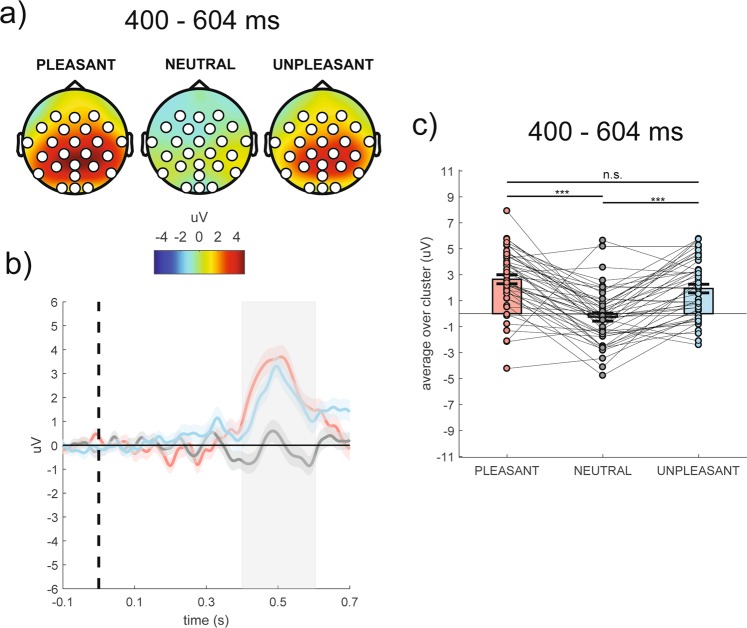
Figure 1
Figure 1
(Panel a) Topography of the mean ERP amplitude (μV) averaged over the significant time points (400–604 ms time window) for pleasant, neutral and unpleasant conditions. (Panel b) Time course of grand-average ERP waveforms averaged over the significant electrodes for pleasant (red line), neutral (grey line) and unpleasant (light blue line) conditions. Shaded areas represent ± standard error of the mean (SEM); the colored frame represents the significant time window (400–604 ms). (Panel c) Mean ERP amplitude of each participant averaged over the significant electrodes and time points for pleasant, neutral and unpleasant conditions. Each circle represents one participant; colored frames represent the mean ERP amplitude across all participants and the solid black lines represent ± SEM. ***p < 0.001.
Figure 2
Figure 2
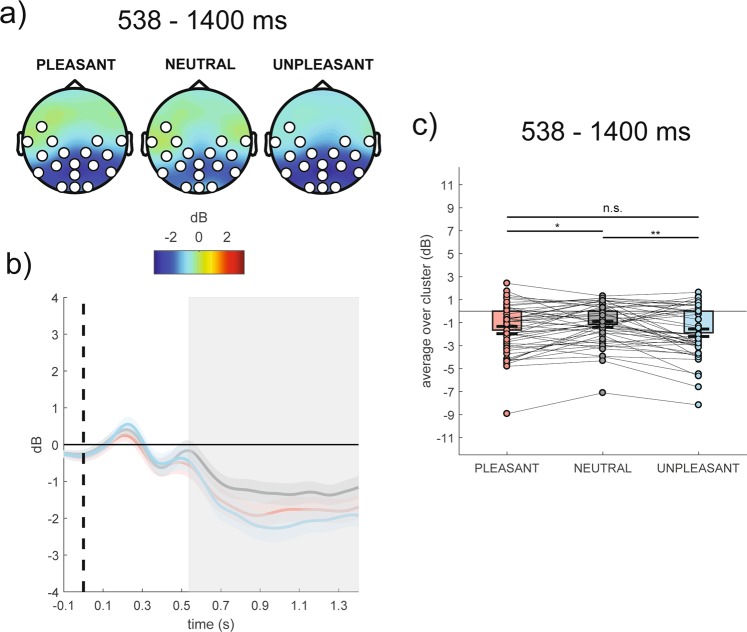
(Panel a) Topography of the mean event-related alpha power (dB) averaged over the significant time points (538–1400 ms time window) for pleasant, neutral and unpleasant conditions. (Panel b) Time course of grand-average event-related alpha power averaged over the significant electrodes for pleasant (red line), neutral (grey line) and unpleasant (light blue line) conditions. Shaded areas represent ± standard error of the mean (SEM); the colored frame represents the significant time window (538–1400 ms). (Panel c) Mean event-related alpha power of each participant averaged over the significant electrodes and time points for pleasant, neutral and unpleasant conditions. Each circle represents one participant; colored frames represent the mean event-related alpha power across all participants and the solid black lines represent ± SEM. *p < 0.05; **p < 0.01.
Figure 3
Figure 3
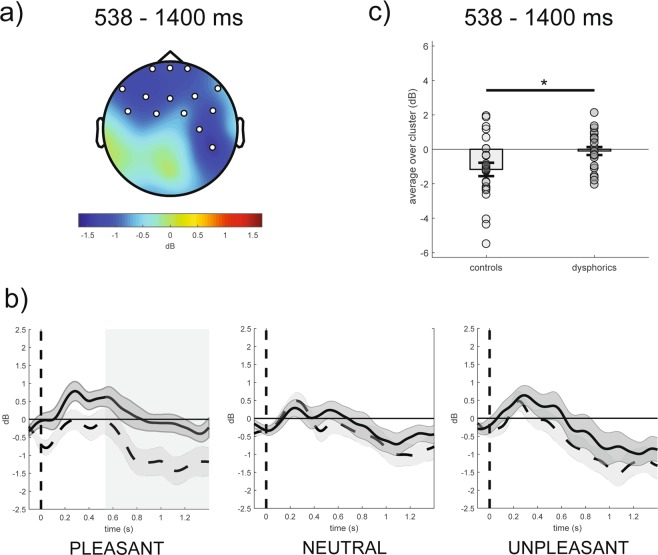
(Panel a) Topography of the mean difference between groups in event-related alpha power (dB; group without dysphoria minus group with dysphoria) averaged over the significant time points (538–1400 ms time window) for the pleasant condition. (Panel b) Time course of grand-average event-related alpha power averaged over the significant electrodes for pleasant, neutral and unpleasant conditions in the group with dysphoria (solid line) and in the group without dysphoria (dashed line). Shaded areas represent ± standard error of the mean (SEM); the colored frame represents the significant time window (538–1400 ms). (Panel c) Mean event-related alpha power of each participant in the group with dysphoria and in the group without dysphoria (i.e., controls) averaged over the significant electrodes and time points for the pleasant condition. Each circle represents one participant; the frames represent the mean event-related alpha power across all participants in the group with dysphoria and in the group without dysphoria and the solid black lines represent ± SEM. *p < 0.05.

References

    1. American Psychiatric Association. Diagnostic and statistical manual of mental disorders, 5th ed. (American Psychiatric Association, Arlington, VA, 2013).
    1. Clark DA, Beck AT. Cognitive theory and therapy of anxiety and depression: Convergence with neurobiological findings. Trends Cogn. Sci. 2010;14:418–424. doi: 10.1016/j.tics.2010.06.007. - DOI - PubMed
    1. Rottenberg J, Gross JJ, Gotlib IH. Emotion context insensitivity in major depressive disorder. J. Abnorm. Psychol. 2005;114:627–639. doi: 10.1037/0021-843X.114.4.627. - DOI - PubMed
    1. Beeney JE, Levy KN, Gatzke-Kopp LM, Hallquist MN. EEG asymmetry in borderline personality disorder and depression following rejection. Personal. Disord. 2014;5:178–85. doi: 10.1037/per0000032. - DOI - PMC - PubMed
    1. Golin S, Hartman SA, Klatt EN, Munz K, Wolfgang GL. Effects of self-esteem manipulation on arousal and reactions to sad models in depressed and nondepressed college students. J. Abnorm. Psychol. 1977;86:435–439. doi: 10.1037/0021-843X.86.4.435. - DOI - PubMed

Publication types