Review
. 2020 Apr:61:17-24.
doi: 10.1016/j.sbi.2019.10.001. Epub 2019 Nov 18.

Recent insights into the structure of TFIID, its assembly, and its binding to core promoter

Affiliations
Review

Recent insights into the structure of TFIID, its assembly, and its binding to core promoter

Avinash B Patel et al. Curr Opin Struct Biol. 2020 Apr.

Abstract

TFIID is a large multiprotein assembly that serves as a general transcription factor for transcription initiation by eukaryotic RNA polymerase II (Pol II). TFIID is involved in the recognition of the core promoter sequences and neighboring chromatin marks, and can interact with gene-specific activators and repressors. In order to obtain a better molecular and mechanistic understanding of the function of TFIID, its structure has been pursued for many years. However, the scarcity of TFIID and its highly flexible nature have made this pursuit very challenging. Recent breakthroughs, largely due to methodological advances in cryo-electron microscopy, have finally described the structure of this complex, both alone and engaged with core promoter DNA, revealing the functional significance of its conformational complexity in the process of core promoter recognition and initiation of Pol II transcription. Here, we review these recent structural insights and discuss their implications for our understanding of eukaryotic transcription initiation.


Figures

Figure 1
Figure 1
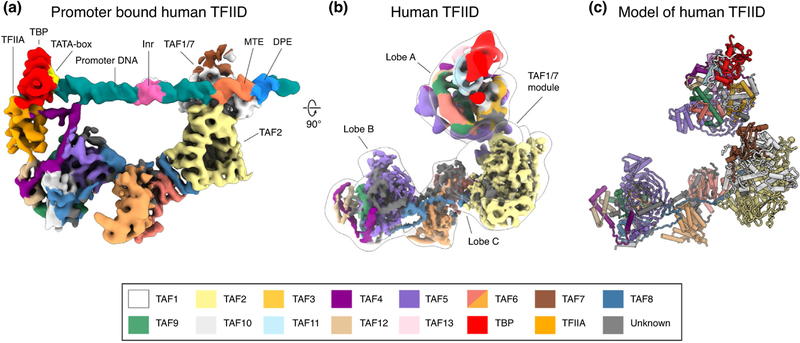
Cryo-EM structures of TFIID and its binding to DNA. (a) Cryo-EM reconstruction of human TFIID bound to promoter DNA. The promoter elements in the SCP are highlighted. (b) Cryo-EM reconstructions of TFIID, with a transparent outline of TFIID in a canonical state and fitted cryo-EM maps from focused refinements of the BC core and Lobe A, colored by subunit following the code shown at the bottom of figure. (c) Atomic model of human TFIID using the same subunit color code.
Figure 2
Figure 2
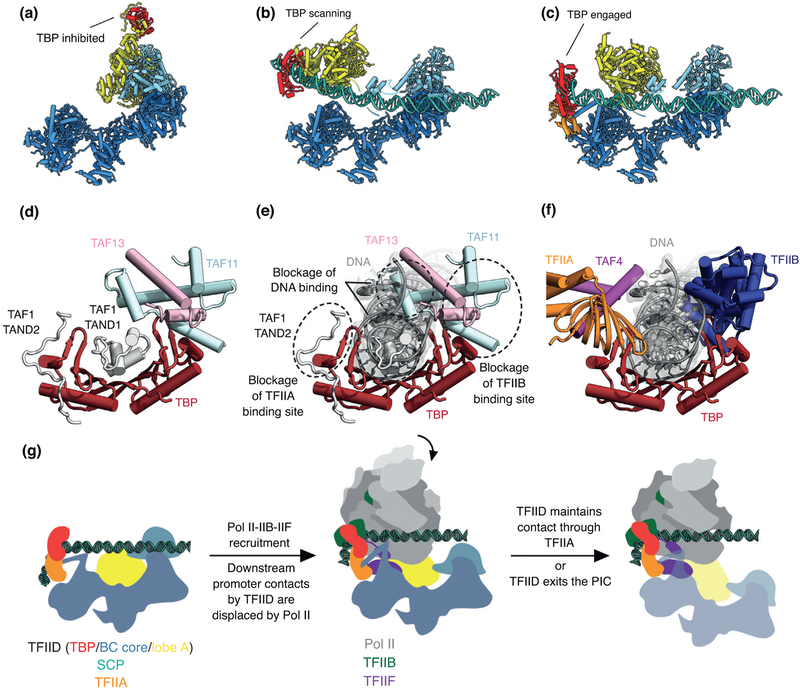
Changes in TBP binding partners through the process of promoter binding. On the top are the atomic structures of human TFIID in the process of promoter engagement. With (a) in the canonical state, (b) in the scanning state and (c) in the engaged state. On the bottom, (d) shows TBP bound by inhibitory TAFs, (e) how these TAFs act to inhibit DNA binding and (f) how TBP binds the general transcription factors TFIIA and TFIIB when in complex with the PIC. The engaged TFIID complex recruits Pol II (g) with the aid of TFIIB and TFIIF.
Figure 3
Figure 3
Possible model of human TFIID assembly. A number of TFIID subcomplexes initially assemble in the cytoplasm (5TAF: TAF4, 5, 6, 9, 12; cTAF: TAF2, 8, 10; sTAF: TAF1, 7, 11, 13 and TBP; TAF3/10) and can enter the nucleus due to the presence of nuclear localization signal sequences on TAF4, TAF8, TAF1 and TAF3. The final stages of TFIID assembly likely occur in the nucleus. We propose that the binding of either cTAF or TAF3/10 to the 5TAF leads to two different core subcomplexes, bcTAF and aTAF, respectively. Once the bcTAF and aTAF subcomplexes heterodimerize, they can then interact with the sTAF subcomplex to complete the assembly of TFIID.
Figure 4
Figure 4
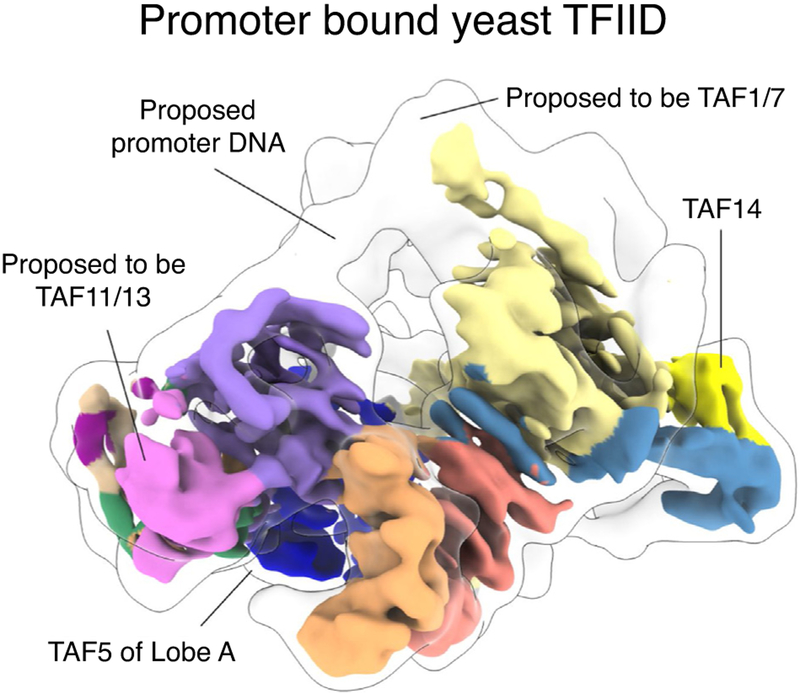
Structure of the promoter bound yeast TFIID. Cryo-EM reconstruction of yeast (Komagataella phaffii) TFIID proposed to be bound to promoter DNA. Outlined is the 20 Å low-pass filtered map to help visualize potential DNA density. Two of the major differences from the human TFIID complex are indicated.
Figure 5
Figure 5
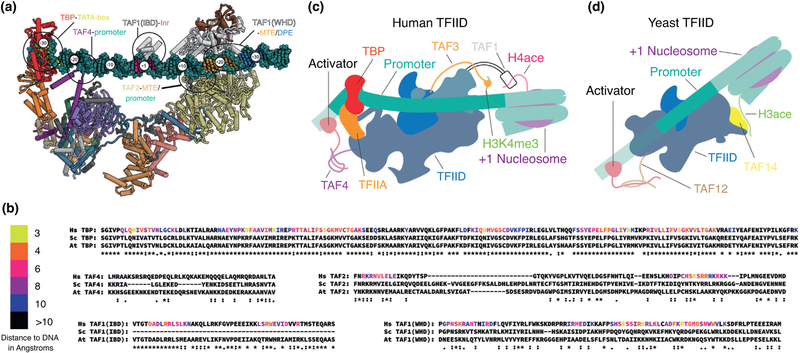
Evolutionary comparison of TFIID elements involved in interactions with DNA, activators and histone modifications. (a) Atomic model of human TFIID bound to promoter DNA, with subunits colored according to the code at the bottom of Figure 1. Major points of interaction of TFIID with promoter DNA are highlighted. (b) Sequence alignment of the regions that interact with promoter DNA as seen in human TFIID for human, yeast (Saccharomyces cerevisiae) and plant (Arabidopsis thaliana). Residues are colored based on the distance to the DNA in the model of human TFIID bound to promoter DNA, except for the TAF4 region proximal to the promoter for which the sequence register could not be determined. Alignment scores for the TAF1 Inr binding domain (IBD) was calculated using only the human and A. thaliana sequences, as S. cerevisiae lacks this domain entirely. (c) Model of interactions of human TFIID with chromatin marks on the +1 nucleosome and with upstream activators. (d) Model of interaction of yeast TFIID with chromatin marks on the +1 nucleosome and with upstream activators.

References

    1. Roeder RG: The role of general initiation factors in transcription by RNA polymerase II. Trends Biochem Sci 1996, 21:327–335. - PubMed
    1. Goodrich JA, Cutler G, Tjian R: Contacts in context: promoter specificity and macromolecular interactions in transcription. Cell 1996, 84:825–830. - PubMed
    1. Levine M, Cattoglio C, Tjian R: Looping back to leap forward: transcription enters a new era. Cell 2014, 157:13–25. - PMC - PubMed
    1. Burley SK, Roeder RG: Biochemistry and structural biology of transcription factor IID (TFIID). Annu Rev Biochem 1996, 65:769–799. - PubMed
    1. Bieniossek C, Papai G, Schaffitzel C, Garzoni F, Chaillet M, Scheer E, Papadopoulos P, Tora L, Schultz P, Berger I: The architecture of human general transcription factor TFIID core complex. Nature 2013, 493:699–702. - PubMed

Publication types

MeSH terms