. 2020 Jun;45(7):1097-1104.
doi: 10.1038/s41386-019-0572-8. Epub 2019 Nov 21.

Rats display empathic behavior independent of the opportunity for social interaction

Affiliations

Rats display empathic behavior independent of the opportunity for social interaction

Stewart S Cox et al. Neuropsychopharmacology. 2020 Jun.

Abstract

Empathy, the capacity for shared emotional valence with others, can allow for cooperativity and social bonding between individuals. However, clinical studies indicate it is dysregulated in neuropsychiatric disorders like autism and addiction, making a translationally relevant model of empathy extremely important. The evolutionary basis of the empathic behaviors observed across numerous species can be described using the Perception Action Model (PAM), in which shared affect can promote an action that eliminates the distress of both the "Target" and, by extension, the "Observer". Increasing evidence suggests rodents will work to reduce the distress of a conspecific, but current models of helping behavior are unable to completely parse apart whether the reported behavior is driven by empathy or social reward. The current study demonstrates, using a novel behavioral model, rats learn to aid a distressed conspecific in the absence of social reward, retain the task over time, and previous experience increases the rate of task acquisition. Further, our model suggests that empathic behavior is subject to low effort as compared to a social reward. We next validated the specificity of this model to study empathic processes, characterized the importance of both the Target's level of distress and the impact of the Observer's familiarity with the Target on empathic behavior. Overall, we believe this model adheres to the PAM of empathy by eliminating the influence of social interaction. Importantly, it can be used to directly evaluate the neurocircuitry of empathy and explore the interplay between blunted empathic behavior and neuropsychiatric disorders.


Figures
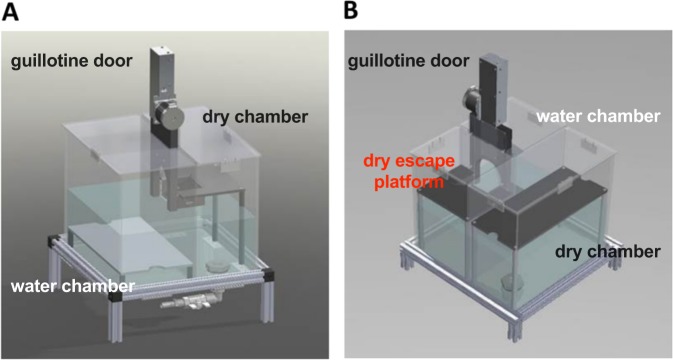
Fig. 1
Fig. 1
a This illustration depicts the two-chamber apparatus that allowed for social contact. Observer rats placed in the dry chamber have access to a chain that, when pulled, releases the target rat from the wet chamber onto the same side as the Observer through an automated guillotine door. b An illustration of the three-chamber empathy apparatus created to better model empathic behavior via the elimination of social reward as a confounding variable. Observer rats learn to pull a chain to release target rats from the water chamber into a separate dry chamber.
Fig. 2
Fig. 2
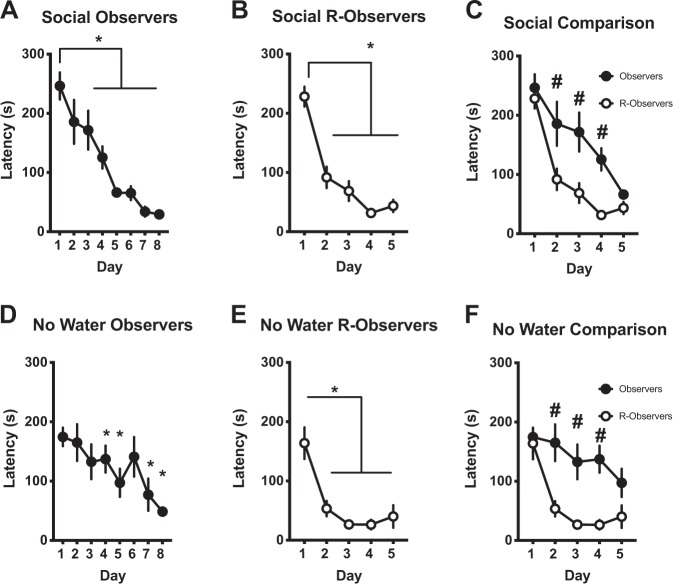
ac Rats readily release a conspecific from a pool of water. Performance of seven pairs of male rats during the social two-chamber task. a Latency for observer rats to chain pull to release a distressed partner decreased over 8 days. Significantly shorter latencies occurred on days 2–8. b R-observer rats showed a decrease in response latency by day 2 with significantly shorter latencies occurring on days 2–5. c When the first 5 days of the acquisition and reversal phases were directly compared, R-observer rats performed the task significantly faster on days 2–4. df Rats will perform and operant task for social interaction. Performance of eight pairs of male rats during the social two-chamber task with the target placed in a dry compartment (i.e. no distress present). d Observer rats’ latencies to release a non-distressed target decreased over the course of 8 days with significantly shorter latencies on days 4–5 and 7–8. e R-observer rats had a decrease in the latency to release the R-target over 5 days with significantly shorter latencies on days 2–5. f When the first 5 days of the acquisition and reversal phases were directly compared, R-observer rats performed the task significantly faster on days 2–4. *Significant difference from day 1 (p < 0.05). #Significant difference from R-Observers (p < 0.05).
Fig. 3
Fig. 3
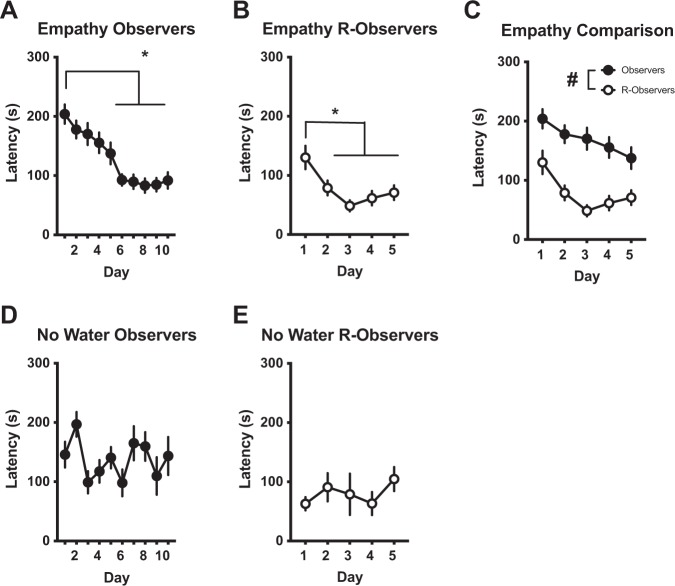
ac Rats engage in empathic behavior in the absence of social interaction. Performance of 24 (acquisition: 8 pairs/cohort over 3 cohorts) or 16 (reversal: 8 pairs/cohort over 2 cohorts) of male rats during our novel empathy task. a Latency for observer rats to chain pull to release a distressed partner decreased over 10 days. Significantly shorter latencies occurred on days 4–10. b R-observer rats that previously experienced the water showed a decrease in response latency by day 2. Specifically, significantly shorter latencies occurred on days 2–5. c When the first 5 days of acquisition and reversal were compared to each other, significantly shorter latencies were found across all 5 days in the reversal compared to the acquisition phase. d, e Rats do not respond in the absence of distress or social reward. Performance of male rats (n = 8 pairs) during the novel empathy task, when the target was placed in a dry compartment (i.e. no distress present). d No clear response pattern emerged when observer rats opened the guillotine door for target rats placed in a dry compartment rather than in water. e R-observer rats also showed no difference across days. *Significant difference from day 1 (p < 0.05). #Significant difference from R-Observers (p < 0.05).
Fig. 4
Fig. 4
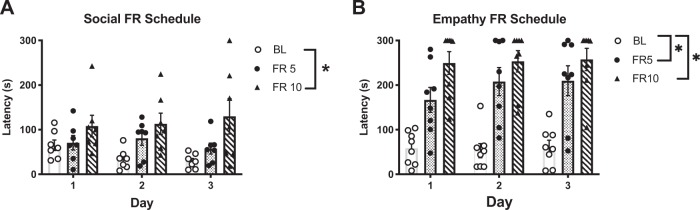
Prosocial behaviors are subject to effort. Observer rats underwent an increasing FR schedule moving from FR5 to FR10 (3 days each) to release the distressed Target following acquisition of either the two- or three-chamber task. a In the social task, latency significantly increased on an FR10 relative to an FR1. b In the empathy task, latency increased significantly on both an FR 5 and FR 10 schedule relative to BL. Removal of social interaction as a reward diminished the motivation for maintaining the chain pull behavior in the empathy task as compared to the social task. *Significant difference from baseline (p < 0.05).
Fig. 5
Fig. 5
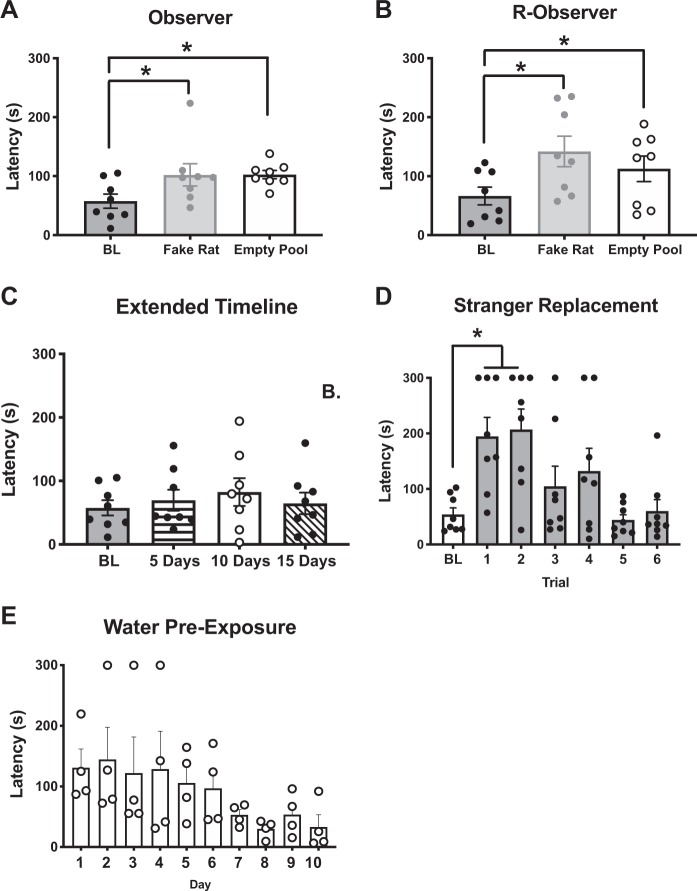
Elucidating the specificity of the chain pull response on the targets’ distress. Performance of male rats across three cohorts (8 pairs/cohort) in separate control experiments using the three-chamber empathy task. a Observer rats significantly increased their chain pull latency when the distressed conspecific was removed and replaced by either a fake rat or an empty pool of water (three consecutive days of each condition) when compared to baseline (BL, average of final 3 days of acquisition). b In a separate cohort, R-Observer rats also demosntrated an increased latency to chain pull in response to a fake rat and an empty pool relative to BL (average of final 3 days of reversal). c Following 10 days (20 trials) of acquisition, Observer rats (n = 8) maintained release behavior for 15 days. Specifically, observers were reintroduced to the three-chamber empathy task and latencies to release the distressed targets were recorded 5, 10, and 15 days following their last acquisition session. Latencies did not change over time compared to BL. d In another study, a rat that was completely unfamiliar to the R-Observer rat was introduced into the wet side of the empathy chamber (“stranger”). Latency to release the “stranger” was significantly potentiated compared to baseline during the first two trials, but subsequently returned to levels not significantly different from BL. e A cohort of observer rats (n = 4) were pre-exposed to the pool of water (yoked to time spent by Targets in Experiment 3) without being rescued prior to the start of acquisition of the empathy task. There was a significant effect across days; however, there were no differences between days 1 and 10 on post hoc analysis. *Significant difference from baseline (p < 0.05).

Comment in

  • Taking action: empathy and social interaction in rats.
    Venniro M, Golden SA. Venniro M, et al. Neuropsychopharmacology. 2020 Jun;45(7):1081-1082. doi: 10.1038/s41386-019-0596-0. Epub 2020 Jan 2. Neuropsychopharmacology. 2020. PMID: 31896768 Free PMC article. No abstract available.

References

    1. Meyza KZ, Bartal IB-A, Monfils MH, Panksepp JB, Knapska E. The roots of empathy: through the lens of rodent models. Neurosci Biobehav Rev. 2017;76:216–34. doi: 10.1016/j.neubiorev.2016.10.028. - DOI - PMC - PubMed
    1. Preston SD, de Waal FBM. Empathy: its ultimate and proximate bases. Behav Brain Sci. 2002;25:1–20. doi: 10.1017/S0140525X02000018. - DOI - PubMed
    1. de Waal FBM, Preston SD. Mammalian empathy: behavioural manifestations and neural basis. Nat Rev Neurosci. 2017;18:498–509. doi: 10.1038/nrn.2017.72. - DOI - PubMed
    1. Meyza K, Knapska E. What can rodents teach us about empathy? Curr Opin Psychol. 2018;24:15–20. doi: 10.1016/j.copsyc.2018.03.002. - DOI - PubMed
    1. Sivaselvachandran S, Acland EL, Abdallah S & Martin LJ. Behavioral and mechanistic insight into rodent empathy. Neurosci Biobehav Rev. 2018;91:130–7. - PubMed

Publication types