Observational Study
. 2020 Jan;120(1):94-106.
doi: 10.1055/s-0039-1700517. Epub 2019 Nov 21.

Platelet Function Changes during Neonatal Cardiopulmonary Bypass Surgery: Mechanistic Basis and Lack of Correlation with Excessive Bleeding

Affiliations
Observational Study

Platelet Function Changes during Neonatal Cardiopulmonary Bypass Surgery: Mechanistic Basis and Lack of Correlation with Excessive Bleeding

Nicole M J Zwifelhofer et al. Thromb Haemost. 2020 Jan.

Abstract

Thrombocytopenia and platelet dysfunction induced by extracorporeal blood circulation are thought to contribute to postsurgical bleeding complications in neonates undergoing cardiac surgery with cardiopulmonary bypass (CPB). In this study, we examined how changes in platelet function relate to changes in platelet count and to excessive bleeding in neonatal CPB surgery. Platelet counts and platelet P-selectin exposure in response to agonist stimulation were measured at four times before, during, and after CPB surgery in neonates with normal versus excessive levels of postsurgical bleeding. Relative to baseline, platelet counts were reduced in patients while on CPB, as was platelet activation by the thromboxane A2 analog U46619, thrombin receptor activating peptide (TRAP), and collagen-related peptide (CRP). Platelet activation by adenosine diphosphate (ADP) was instead reduced after platelet transfusion. We provide evidence that thrombocytopenia is a likely contributor to CPB-associated defects in platelet responsiveness to U46619 and TRAP, CPB-induced collagen receptor downregulation likely contributes to defective platelet responsiveness to CRP, and platelet transfusion may contribute to defective platelet responses to ADP. Platelet transfusion restored to baseline levels platelet counts and responsiveness to all agonists except ADP but did not prevent excessive bleeding in all patients. We conclude that platelet count and function defects are characteristic of neonatal CPB surgery and that platelet transfusion corrects these defects. However, since CPB-associated coagulopathy is multifactorial, platelet transfusion alone is insufficient to treat bleeding events in all patients. Therefore, platelet transfusion must be combined with treatment of other factors that contribute to the coagulopathy to prevent excessive bleeding.


Conflict of interest statement

None declared.

Figures
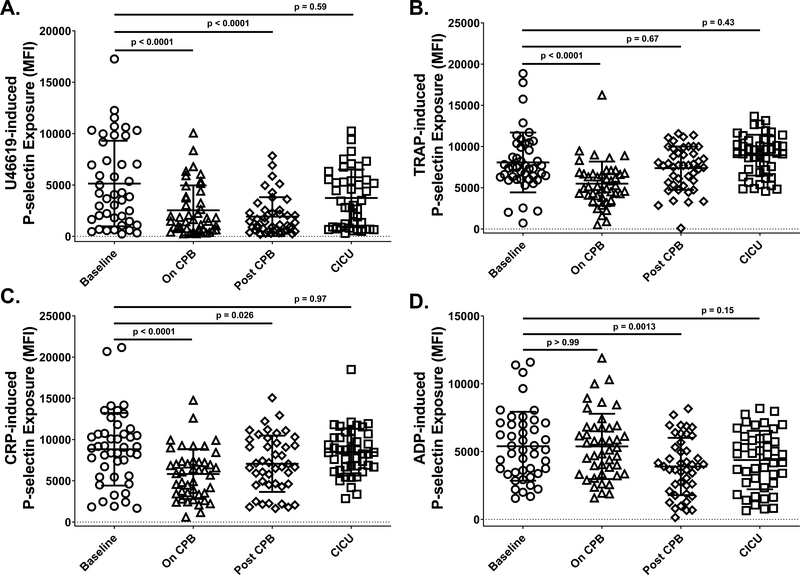
Figure 1.
Figure 1.. Exposure to cardiopulmonary bypass (CPB) affected responsiveness of neonatal platelets to in vitro stimulation in an agonist-dependent manner.
Whole blood (WB) was recovered from neonates at four times during CPB surgery, including prior to initiation of surgery (Baseline; circles), after completion of surgery but before separation from CPB (On CPB; triangles), after separation from CPB and prophylactic transfusion of platelets (Post-CPB; diamonds), and immediately after admission to the cardiac intensive care unit (CICU; squares). Platelets in WB samples were stimulated with (A) thromboxane A2 analog U46619 (1 μM), (B) thrombin receptor activating peptide (TRAP; 10 μM), (C) collagen-related peptide (CRP; 2.5 μg/mL), or (D) adenosine diphosphate (ADP; 20 μM). Activated platelets were identified by flow cytometry following staining with a phycoerythrin (PE)-tagged antibody specific for the platelet α-granule constituent, P-selectin. Results are reported as PE median fluorescence intensity (MFI). Each symbol represents the result for a single patient, bars denote means ± standard deviations, and dotted lines represent MFI = 0 (n=44 for TRAP, CRP and ADP; n=43 for U46619 - patient 26 excluded for technical reasons). Generalized Estimating Equation (GEE) with maximum likelihood estimation method was used to model the variables over time accounting for bleeding status. Normal distribution with identity link function (A), lognormal distribution with identity link function (B and C), and gamma distribution with log link function (D) were used for comparisons. Statistically significant differences between groups are indicated by p values. Note that platelet responses to stimulation with U46619, TRAP and CRP all dropped significantly On CPB relative to Baseline and returned to Baseline values after platelet transfusion and by the time of admission to the CICU. In contrast, platelet responses to stimulation with ADP were significantly lower than Baseline values only at the Post-CPB time point.
Figure 2.
Figure 2.. Exposure to CPB resulted in mild platelet activation.
WB was recovered from neonates at four times during CPB surgery, including prior to initiation of surgery (Baseline; circles), after completion of surgery but before separation from CPB (On CPB; triangles), after separation from CPB and prophylactic transfusion of platelets (Post CPB; diamonds), and immediately after admission to the cardiac intensive care unit (CICU; squares). Activated platelets were identified by flow cytometry following staining with a phycoerythrin (PE)-tagged antibody specific for the platelet α-granule constituent, P-selectin. Results are reported as (A) the percentage of platelets that were PE positive and (B) PE median fluorescence intensity (MFI). Each symbol represents the result for a single patient, bars denote means ± standard deviations, and dotted lines represent 0 percent PE-positivity (A) or PE MFI = 0 (B). Generalized Estimating Equation (GEE) with maximum likelihood estimation method was used to model the variables over time accounting for bleeding status. Lognormal distribution with identity link function was used for comparisons. Statistically significant differences between groups are indicated by p values. Note that, while the percentage of platelets that were P-selectin positive was significantly greater On CPB relative to Baseline, the MFI of P-selectin-positive platelets was, albeit significantly, only slightly greater than Baseline at the On CPB and Post CPB time points. (n=42 - patient 26 excluded for technical reasons and patient 38 excluded because of high Baseline PE MFI)
Figure 3.
Figure 3.. Low platelet counts equivalent to those experienced by neonates on CPB reduced platelet responsiveness to stimulation via thromboxane A2 and thrombin, but not collagen, receptors.
The platelet count in WB samples obtained from healthy adult subjects was left unmodified (closed circles) or reduced to thrombocytopenic levels observed in neonates on CPB (open circles) prior to stimulation with (A) thromboxane A2 analog U46619 (1 μM), (B) thrombin receptor activating peptide (TRAP; 10 μM), or (C) collagen-related peptide (CRP; 2.5 μg/mL). Activated platelets were identified by flow cytometry following staining with a phycoerythrin (PE)-tagged antibody specific for the platelet α-granule constituent, P-selectin. Results are reported as PE median fluorescence intensity (MFI). Lines represent paired results for unmodified and thrombocytopenic WB samples from the same subject (n=10). Because the data were normally distributed, the paired t-test was used to compare thrombocytopenic whole blood samples to those with normal platelet counts. Statistically significant differences between groups are indicated by p values. Note that platelet responses to stimulation with U46619 were dramatically reduced, responses to TRAP were slightly but significantly reduced, and responses to CRP were not reduced in thrombocytopenic relative to non-thrombocytopenic WB samples.
Figure 4.
Figure 4.. Reduced levels of expression of the GPVI collagen receptor accompanied reduced platelet responsiveness to stimulation with collagen related peptide (CRP) in neonates on CPB.
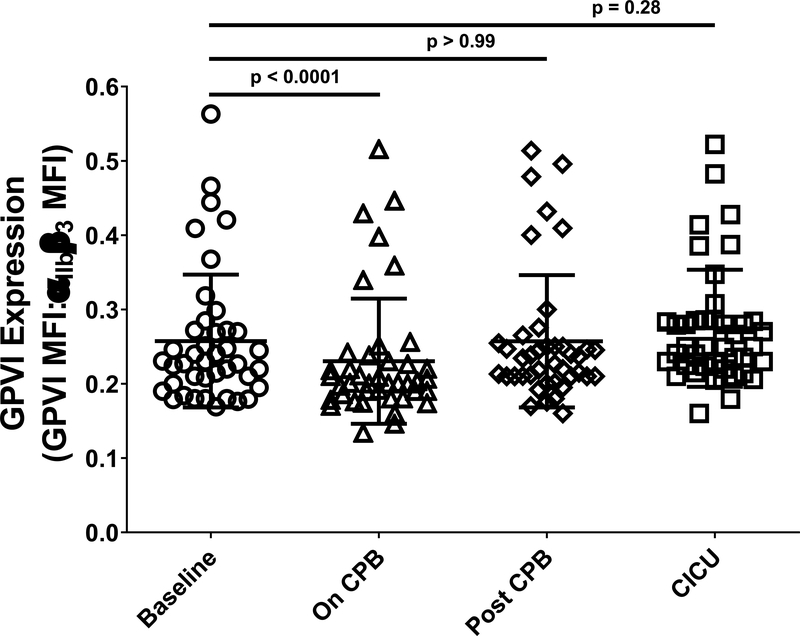
WB samples drawn from patients prior to initiation of CPB surgery (Baseline, circles), after completion of surgery but before separation from CPB (On CPB, triangles), after separation from CPB and transfusion of platelets (Post-CPB, diamonds), and immediately after admission to the cardiac intensive care unit (CICU, squares) were used for assessment of levels of platelet GPVI expression. Flow cytometry was performed following staining of platelets with an Alexafluor 488-tagged antibody specific for αIIbβ3 and an Alexafluor 647-tagged antibody specific for human GPVI. Results are reported as the ratio of Alexafluor 647/Alexaflour 488 median fluorescence intensity (MFI). Each symbol represents the result for a single patient and bars denote means ± standard deviations (n = 41; patients 26 and 33 were excluded because of missing data for all time points; patient 38 was excluded because of abnormally high levels of expression of GPVI relative to αIIbβ3). Generalized Estimating Equation (GEE) with maximum likelihood estimation method was used to model the variables over time accounting for bleeding status. Lognormal distribution with identity link function was used for comparisons. Statistically significant differences between groups are indicated by p values. Note that platelet GPVI expression levels were significantly lower in neonates On CPB relative to Baseline, and returned to baseline values following platelet transfusion.
Figure 5.
Figure 5.. Single donor platelet (SDP) units reduced the responsiveness of platelets in fresh whole blood to activation by adenosine diphosphate (ADP).
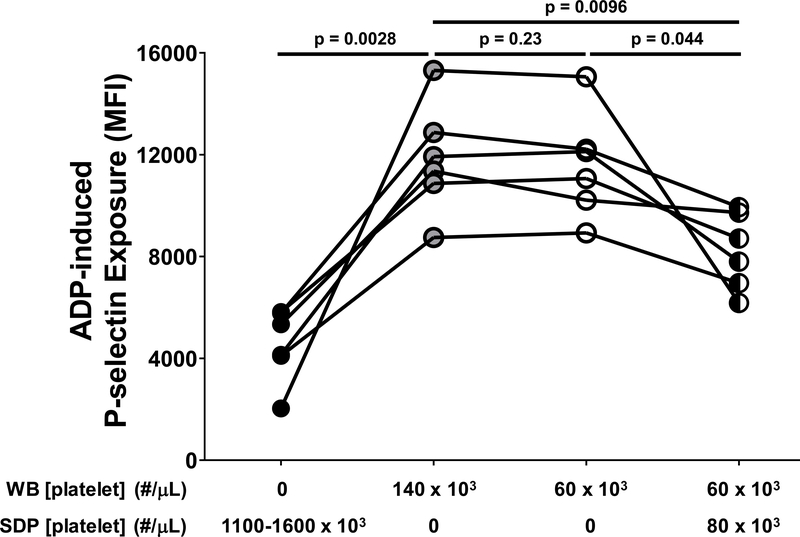
Apheresis-derived SDP units were obtained from Versiti – Blood Center of Wisconsin and left unmodified (black circles). Whole blood (WB) samples were obtained from healthy adult volunteers and manipulated to achieve a normal platelet count (140 × 103/μL; gray circles) or were made thrombocytopenic to approximate platelet counts observed in neonates on cardiopulmonary bypass (60 × 103/μL; open circles). SDP units were mixed with thrombocytopenic WB samples to achieve a final platelet count of 140 × 103/μL, with 60 × 103/μL platelets derived from WB and 80 × 103/μL platelets derived from SDP units (black and white circles). Each of these platelet preparations was stimulated with ADP (20 μM). Activated platelets were identified by flow cytometry following staining with a phycoerythrin (PE)-tagged antibody specific for the platelet α-granule constituent, P-selectin. Results are reported as PE median fluorescence intensity (MFI). Each symbol represents the result for a single experiment and lines represent relationships between SDP and WB samples studied in a given experiment (n=6). Because the data were normally distributed, the paired t-test was used to compare thrombocytopenic whole blood samples to those with normal platelet counts. Statistically significant differences between groups are indicated by p values. Note that, compared to WB with a platelet count of 140 × 103/μL, the response to stimulation with ADP was lower in SDP units, the same in WB samples with a thrombocytopenic platelet count of 60 × 103/μL, and reduced in thrombocytopenic WB samples to which platelets from SDP units were added to achieve a platelet count of 140 × 103/μL.
Figure 6.
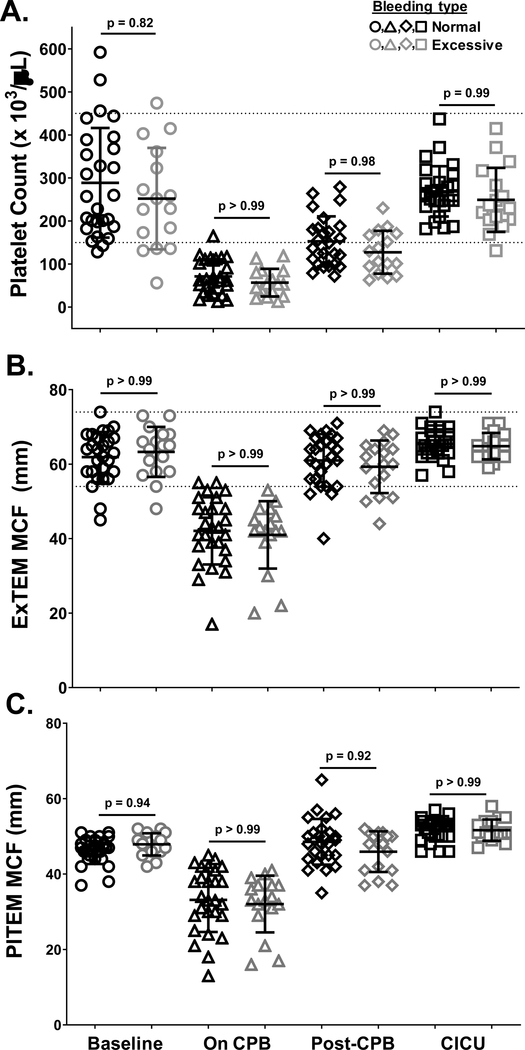
Figure 6.. Platelet counts and platelet-dependent Rotational Thromboelastometry (ROTEM) values changed similarly over the course of CPB surgery in neonates who bled excessively following surgery relative to those who did not.
WB samples were drawn from patients prior to initiation of CPB surgery (Baseline, circles), after completion of surgery but before separation from CPB (On CPB, triangles), after separation from CPB and prophylactic transfusion of platelets and cryoprecipitate (Post-CPB, diamonds), and immediately after admission to the cardiac intensive care unit (CICU, squares). Platelet counts (A) and ROTEM ExTEM (B) and PlTEM (C) values were determined immediately after blood samples were drawn. Results from patients who experienced normal (black symbols) vs. excessive (gray symbols) levels of bleeding were plotted separately. Each symbol represents the result for a single patient, bars denote means ± standard deviations, and dotted lines represent the normal ranges in healthy infants as described previously (n=44 for ROTEM ExTEM and PlTEM values; n = 41 for platelet counts - patients 2, 3, and 4 were excluded because of missing data). Generalized Estimating Equation (GEE) with maximum likelihood estimation method was used to model the variables over time accounting for bleeding status. Normal distribution with identity link function was used for comparisons. Note that platelet counts and ROTEM values did not differ significantly between patients who bled excessively vs. those who did not at any time point.
Figure 7.
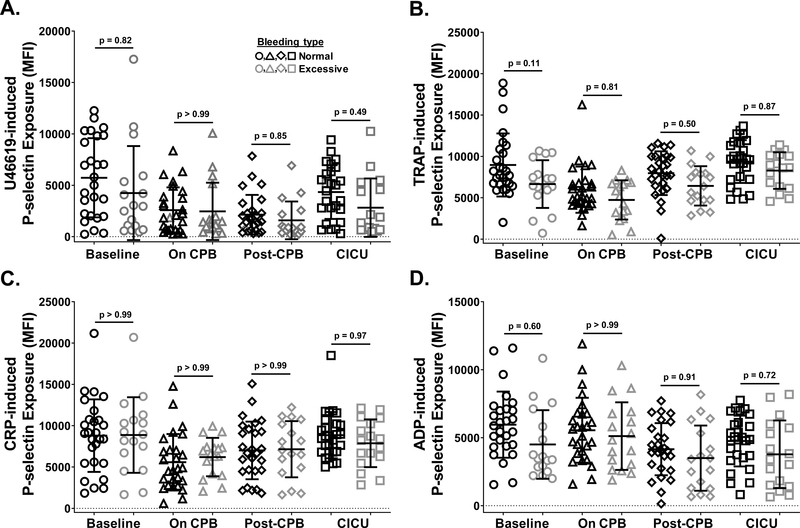
Figure 7.. Platelet responsiveness to agonist stimulation changed similarly in neonates who bled excessively following CPB surgery relative to those who did not.
WB was recovered from neonates at four times during CPB surgery, including prior to initiation of surgery (Baseline; circles), after completion of surgery but before separation from CPB (On CPB; triangles), after separation from CPB and prophylactic transfusion of platelets (Post CPB; diamonds), and immediately after admission to the cardiac intensive care unit (CICU; squares). Platelets in WB samples were stimulated with (A) thromboxane A2 analog U46619 (1 μM), (B) thrombin receptor activating peptide (TRAP; 10 μM), (C) collagen-related peptide (CRP; 2.5 μg/mL), or (D) adenosine diphosphate (ADP; 20 μM). Activated platelets were identified by flow cytometry following staining with a phycoerythrin (PE)-tagged antibody specific for the platelet α-granule constituent, P-selectin. Results are reported as PE median fluorescence intensity (MFI). Results observed in patients who experienced normal (black symbols) vs. excessive (gray symbols) levels of bleeding were plotted separately. Each symbol represents the result for a single patient, bars denote means ± standard deviations, and dotted lines represent MFI = 0 (n=44 for TRAP, CRP and ADP; n=43 for U46619 - patient 26 excluded for technical reasons). Generalized Estimating Equation (GEE) with maximum likelihood estimation method was used to model the variables over time accounting for bleeding status. Normal distribution with identity link function (A), lognormal distribution with identity link function (B and C), and gamma distribution with log link function (D) were used for comparisons. Statistically significant differences between groups are indicated by p values. Note that platelet responses to stimulation with U46619, TRAP, CRP, and ADP did not differ significantly between patients who bled excessively vs. those who did not at any time point.

References

    1. Manno CS, Hedberg KW, Kim HC, et al. Comparison of the hemostatic effects of fresh whole blood, stored whole blood, and components after open heart surgery in children. Blood 1991; 77(5): 930–936. - PubMed
    1. Petaja J, Lundstrom U, Leijala M, et al. Bleeding and use of blood products after heart operations in infants. J Thorac Cardiovasc Surg 1995; 109(3): 524–529. - PubMed
    1. Chambers LA, Cohen DM, Davis JT. Transfusion patterns in pediatric open heart surgery. Transfusion 1996; 36(2): 150–154. - PubMed
    1. Williams GD, Bratton SL, Riley EC, et al. Association between age and blood loss in children undergoing open heart operations. Ann Thorac Surg 1998; 66(3): 870–875; discussion 875–876. - PubMed
    1. Williams GD, Bratton SL, Ramamoorthy C. Factors associated with blood loss and blood product transfusions: a multivariate analysis in children after open-heart surgery. Anesth Analg 1999; 89(1): 57–64. - PubMed

Publication types

Substances